🇺🇸🇮🇷 Washington may be employing a strategy similar to Syria's: a protracted, attritional approach, waiting for a breakthrough.
The U.S. Central Command has confirmed that two U.S. soldiers were killed while defending against Iranian missile and drone attacks at Jordan's Mowafak Salti Air Base, and one soldier is missing. The Associated Press reports that this is the first time U.S. troops have been killed by direct Iranian fire since the start of the war.
This is precisely the "red line" for all-out war that Trump has mentioned.
On the same day, Iran announced the expiration of the memorandum of understanding, added all power plants and desalination plants in Kuwait to its "target list," and set a deadline: strikes after Monday would completely end the tit-for-tat confrontation.
Alex Christopher of the Durand newspaper draws a crucial conclusion: the strategy is to prolong the process.
The decision to cripple Iran was made long ago, and the model is precisely Syria: sanctions, strikes, and proxy wars, a protracted attrition war until a breakthrough is achieved.
“Think of it as a larger Syria.”
The first round was attacks on nuclear facilities, the second was seeking regime change, and the third is a direct confrontation over the Strait of Hormuz.
The key is this: Washington has waited a decade for a breakthrough in Syria, and this strategy has never faced the predicament of $100 a barrel of oil and dwindling strategic oil reserves.
Neoconservatives don't concern themselves with the economy, but this time, economic factors will determine the final outcome.
His biggest concern is water resources.
If desalination facilities continue to be attacked, the Gulf region will slide towards a humanitarian catastrophe, and no one has set the warning line.
@AXChristoforou
496
0
0
40
Mario Nawfal
07-19 06:45
フォロー
🇺🇸🇮🇷 Washington may be employing a strategy similar to Syria's: a protracted, attritional approach, waiting for a breakthrough.
The U.S. Central Command has confirmed that two U.S. soldiers were killed while defending against Iranian missile and drone attacks at Jordan's Mowafak Salti Air Base, and one soldier is missing. The Associated Press reports that this is the first time U.S. troops have been killed by direct Iranian fire since the start of the war.
This is precisely the "red line" for all-out war that Trump has mentioned.
On the same day, Iran announced the expiration of the memorandum of understanding, added all power plants and desalination plants in Kuwait to its "target list," and set a deadline: strikes after Monday would completely end the tit-for-tat confrontation.
Alex Christopher of the Durand newspaper draws a crucial conclusion: the strategy is to prolong the process.
The decision to cripple Iran was made long ago, and the model is precisely Syria: sanctions, strikes, and proxy wars, a protracted attrition war until a breakthrough is achieved.
“Think of it as a larger Syria.”
The first round was attacks on nuclear facilities, the second was seeking regime change, and the third is a direct confrontation over the Strait of Hormuz.
The key is this: Washington has waited a decade for a breakthrough in Syria, and this strategy has never faced the predicament of $100 a barrel of oil and dwindling strategic oil reserves.
Neoconservatives don't concern themselves with the economy, but this time, economic factors will determine the final outcome.
His biggest concern is water resources.
If desalination facilities continue to be attacked, the Gulf region will slide towards a humanitarian catastrophe, and no one has set the warning line.
@AXChristoforou
370
0
0
30
Mario Nawfal
07-12 11:02
フォロー
For the first time since the ceasefire, Iran has completely blocked the Strait of Hormuz, prompting a US response within minutes.
The trigger: A missile struck the Cypriot-flagged cargo ship "Galaxy," sailing on the Oman route. One crew member is missing, and the ship caught fire and sank.
A statement from the Central Command claimed that the airstrike was carried out on the orders of the Commander-in-Chief and was unlike any previous strike.
Reports indicate that for the first time since June 17, land-based ATACMS and HIMARS missiles were launched from Kuwait and Bahrain, signifying the formal participation of the two Gulf states in the military operation.
The strike range extended from Jask to near Bushehr and as far as Kaman, making it the widest-ranging strike to date. Air defense systems near Tehran also activated their alarms.
Brandon Wechett argues that the speed of the response speaks volumes: such swift retaliation implies that these "packages" were already prepared, and that the government anticipated actions on a scale far exceeding tit-for-tat.
His deeper perspective remains unchanged.
Washington has consistently bet that economic sanctions would destroy the Iranian regime, but 47 years of sanctions have never shaken a government whose legitimacy has never been based on economic foundations.
Iran dares not back down because it concerns Tehran's survival; Washington dares not back down either, because Trump views Iran's control of the Straits as a failure.
His rhetoric about World War I lingers in people's minds: No one called 1914 a world war either.
They call it the Third Balkan Crisis.
@WeTheBrandon
364
0
0
48
Mario Nawfal
06-30 10:13
フォロー
🇺🇸🇮🇷 Airstrikes and diplomacy are not contradictory, but rather part of the same strategy.
Some strongly believe that Iran is winning the battle for the Strait of Hormuz, using force to turn the strait into a tollbooth, allowing ships passage only with Tehran's permission.
This premise is correct. This battle, this war, has revolved around the Strait of Hormuz from beginning to end.
However, concluding that Trump is losing this war is a misjudgment.
Two threads must be considered simultaneously. After a weekend of tit-for-tat airstrikes, both sides agreed to a cessation of operations and sent teams to Doha, while US warplanes escorted oil tankers, keeping oil prices near pre-war levels.
This is coercive diplomacy; the bombings were intended to influence the negotiation process, not replace it.
The agreement's initial implementation demonstrated freedom of navigation in the Strait of Hormuz.
Ships disregarded Iran's navigational demands, the southern Oman shipping route remained open, and oil prices fell faster than anyone expected.
Iran resorted to force because it watched helplessly as it lost control of the Strait of Hormuz.
The Washington-led attack destroyed Iran's coastal radar, weakening its ability to demand concessions that couldn't be made at the negotiating table.
Pay attention to the subtle clues in the communication. Trump said Iran requested the meeting.
Tehran denied arranging any talks.
In the same meeting room, contradictory messages emerged: Iran insisted that contact could only proceed through mediators in the Strait of Hormuz.
Both sides were pretending there was no dialogue, yet both were engaging in dialogue.
The crucial question is whether genuine negotiations can take place without resorting to further violence.
Now, violence itself is the negotiation.
Source: The Wall Street Journal, Al Jazeera / Author: Daniel
316
0
0
32
Mario Nawfal
06-28 11:15
フォロー
Ultimately, what may curb this cycle of attacks in the US is not diplomacy, but oil prices.
Retired senior US Navy officer Harlan Ullman astutely points out the real de-escalating force, and it's not out of goodwill.
He told Al Jazeera that oil prices are likely to surge due to market bets on the failure of both the Lebanon and Iran nuclear deals, and this surge might force Trump back to the negotiating table.
This perfectly aligns with everything this war has shown.
Trump signed the agreement because he didn't want economic disaster, and domestic considerations that initially led to ending the war now dominate the ceasefire agreement.
Every tanker hit drives up oil prices, and rising domestic oil prices are a consequence Trump cannot avoid through military strikes.
Ullman's warning deserves our serious consideration.
Tit-for-tat retaliation "could get out of control."
Two oil tankers and three waves of US airstrikes in four days—this cycle repeats itself, with no mechanism to stop it except for the consequences.
This stranglehold war will continue until Iran stops its missteps, or until American voters begin to pay the price.
Source: Al Jazeera/CNN/Author: Daniel
363
0
0
25
Mario Nawfal
06-22 16:10
フォロー
The tit-for-tat sanctions between Washington and Beijing have escalated again.
China today imposed trade restrictions on dozens of U.S. companies in retaliation for the Pentagon earlier this month adding more Chinese tech companies to its 1260H military-related list.
Beijing's Commerce Department added 10 U.S. suppliers to its export control list, including rare earth miners MP Materials and USA Rare Earth, and drone manufacturers Teal Drones and Jaia Robotics, prohibiting China from exporting any dual-use products to these companies.
Another move banned 46 U.S. companies primarily engaged in defense business from participating in Chinese government procurement.
All of this appears more symbolic, as most of the sanctioned companies have virtually no business in China.
This looks like a modest retaliation by Beijing to avoid jeopardizing the recently stabilized U.S.-China relations following the reconciliation between Trump and Xi last month.
Source: CNBC / Author: Julie
374
0
0
24
Henrik Zeberg
03-15 04:36
フォロー
Danskerne skal has Friday ads and markets Bedste kræftmedicin
If you have any questions, be sure to address them absolutely. Punktum.
Men sådan er det desværre ikke i Danmark i dag.
He said he would send him out by the 27th. My Tyskland ertallet 96 %. Block absurdity and urimelig forskel.
Vi ved, in dybt kompetente danske læger altid vil gore deres yderste for at hjælpe, men in de alt for tit oplever urimelige Benspænd fra et tungt Bureaukrati og kuglerammetænkning i Medicinrådet. Her Brug man often on tygge drøv på medicingodkendelser, some EU for længst har Givet grønt lys til.
The Free Union is the recipient and also the administrator.
The cost is 1 mg lang, the most effective medicine on the European market.
The principle and simplicity: Hvis en behandling er EU-godkendt, og dinspeciallæge vurderer, at det er den rigtige for dig, så skal du have den.
Vi skal has afskaffet de stricte standardløsninger og sikre en langthurigere godkendelse af ny, banebrydende medicin. For the det processing procedure, I made a basic attempt and endelig on sætte mennesket for systemet.
Vi kan godt.
338
0
0
38
BRICS News
03-11 23:39
フォロー
Breaking news: The Iranian military has stated that its "tit-for-tat" strike policy has ended and warned that continued strikes are now underway.
425
0
0
31
Anthony Pompliano 🌪
03-01 20:18
フォロー
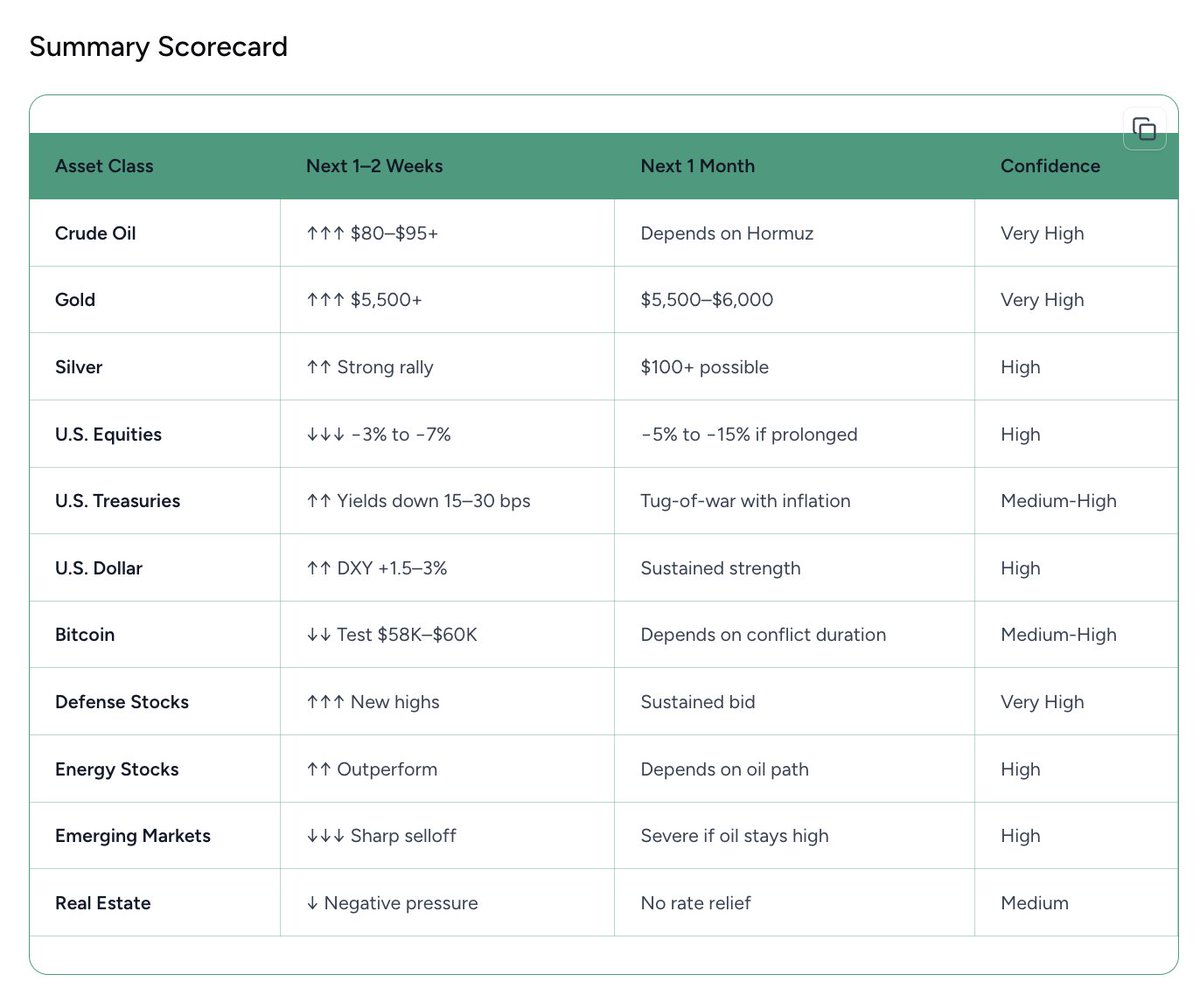
I developed an AI tool to predict financial market movements following the US bombing of Iran.
@cfosilvia told me the following scenarios are likely:
- Crude oil prices will rise sharply.
- US stocks will fall sharply.
- Gold prices will rise sharply.
- US Treasury prices will rise, and yields will fall.
- The US dollar will strengthen.
- Bitcoin and cryptocurrencies will fall.
- International stock markets will fall, but with divergent trends.
- The real estate market will face downward pressure.
- Industrial commodity markets will react differently.
(You can ask her to analyze the impact on your portfolio :)
Silvia also outlined key variables to watch in the coming weeks.
👉 The next 72 hours will determine whether this is a two-week market upheaval or a months-long market shift.
👉 The Strait of Hormuz—If Iran attempts to block or exploit the strait, prices for all global commodities will surge. This is the most important variable.
👉 Escalation or Containment – Will Iran's retaliation remain tit-for-tat (e.g., missile strikes at al-Qaeda), or will it target oil infrastructure in Saudi Arabia, the UAE, or Kuwait? The Iranian-backed Houthi rebels have already threatened to launch another attack on the Red Sea.
👉 Russian and Chinese Reactions – Russia calls Trump's actions hypocritical. China is Iran's largest oil buyer. Any coordinated response would escalate the situation beyond a regional conflict.
👉 Speed of Resolution – In June 2025, a ceasefire was reached between Israel and Iran within 11 days. Markets recovered quickly. If this event follows the same pattern, then selling would be a buying opportunity. But if Trump's rhetoric of "regime change" implies a protracted conflict, then the macroeconomic environment will be drastically different.
👉 Fed Response – The Fed cannot address the oil crisis by cutting interest rates. If inflation expectations are pushed higher, the argument that "high inflation will last longer" will resurface strongly.
Free trial of Silvia:
478
0
0
21
Anthony Pompliano 🌪
02-28 23:50
フォロー
I developed an AI tool to predict financial market movements following the US bombing of Iran.
@cfosilvia told me the following scenarios are likely:
- Crude oil prices will rise sharply.
- US stocks will fall sharply.
- Gold prices will rise sharply.
- US Treasury prices will rise, and yields will fall.
- The US dollar will strengthen.
- Bitcoin and cryptocurrencies will fall.
- International stock markets will fall, but with divergent trends.
- The real estate market will face downward pressure.
- Industrial commodity markets will react differently.
(You can ask her to analyze the impact on your portfolio :)
Silvia also outlined key variables to watch in the coming weeks.
👉 The next 72 hours will determine whether this is a two-week market upheaval or a months-long market shift.
👉 The Strait of Hormuz—If Iran attempts to block or exploit the strait, prices for all global commodities will surge. This is the most important variable.
👉 Escalation or Containment – Will Iran's retaliation remain tit-for-tat (e.g., missile strikes at al-Qaeda), or will it target oil infrastructure in Saudi Arabia, the UAE, or Kuwait? The Iranian-backed Houthi rebels have already threatened to launch another attack on the Red Sea.
👉 Russian and Chinese Reactions – Russia calls Trump's actions hypocritical. China is Iran's largest oil buyer. Any coordinated response would escalate the situation beyond a regional conflict.
👉 Speed of Resolution – In June 2025, a ceasefire was reached between Israel and Iran within 11 days. Markets recovered quickly. If this event follows the same pattern, then selling would be a buying opportunity. But if Trump's rhetoric of "regime change" implies a protracted conflict, then the macroeconomic environment will be drastically different.
👉 Fed Response – The Fed cannot address the oil crisis by cutting interest rates. If inflation expectations are pushed higher, the argument that "high inflation will last longer" will resurface strongly.
Free trial of Silvia: