
















Foreign media commented that SpaceX completed the largest initial public offering (IPO) in U.S. history in June, but the stock price performance after listing quickly reminded the market that a record amount of funds raised does not necessarily mean that future returns will also be record-breaking.
Limited increase in value after listing of SpaceX
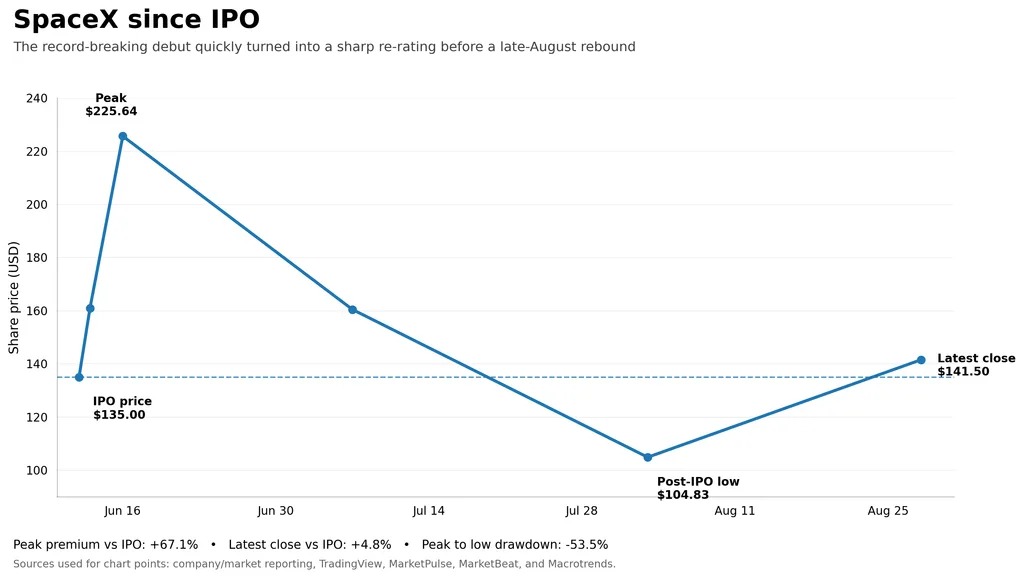
As of the close on August 28th, the stock price of SpaceX was reported at $141.50, representing an increase of less than 5% from the issue price of IPO. This contrasts with the initial enthusiasm during its listing period. At that time, the company's market value quickly exceeded $2 trillion, but the stock price subsequently fell below the issue price in July, indicating the volatility pressures faced by high-valued transactions in the secondary market.
- The closing price on August 28th was $141.50.
- Less than a 5% increase from the issue price
- Fell below the issue price for the first time in July
The article argues that the significance of SpaceX's listing this time lies mainly in the scale of funds raised and the valuation level, rather than short-term stock price returns. What determines a company's long-term returns are still revenue growth, profit margins, and operational execution, rather than how much capital IPO itself raises.
Wal-Mart demonstrates the effect of long-term compound interest
To illustrate this point, the article uses Walmart as a comparison. Based on its closing price of around $103.09 on August 28th, if an investor invested $1,000 in Walmart at that time, the current market value would be approximately $38.4 million, and this figure does not even include dividends.
However, the article also emphasizes that companies with long-term high returns do not always experience continuous growth. Walmart recently saw a significant decline after its financial report was released, due to same-store sales in the United States falling short of expectations, with the stock price dropping by more than 8% in a single day. This indicates that even companies with outstanding long-term performance can experience temporary setbacks.
NVIDIA offers another approach.
The article also mentions NVIDIA. Calculated based on the closing price of $217.54 on August 28th, if the same amount of $1,000 was invested at that time, its current value would be approximately $8.7 million.
In the article's view, NVIDIA and Walmart represent two different paths to returns: the former reflects faster growth realization, while the latter reflects longer-term compound interest accumulation. In comparison, what is more noteworthy about SpaceX at present is not its record-breaking listing size, but whether it can convert its high valuation into sustained performance growth over the next few years.
The article concludes that market value reflects the price that investors are willing to pay at present, but this does not directly indicate how much value a company will be able to create in the next 20 or 50 years. For newly listed companies, the fundraising record itself is more of a starting point than a result of returns.