web3: Procedural Vote in the U.S. Senate Fails, Progress of Clarity Act Stalls
Coinpaper
09-16 03:30
Ai Focus
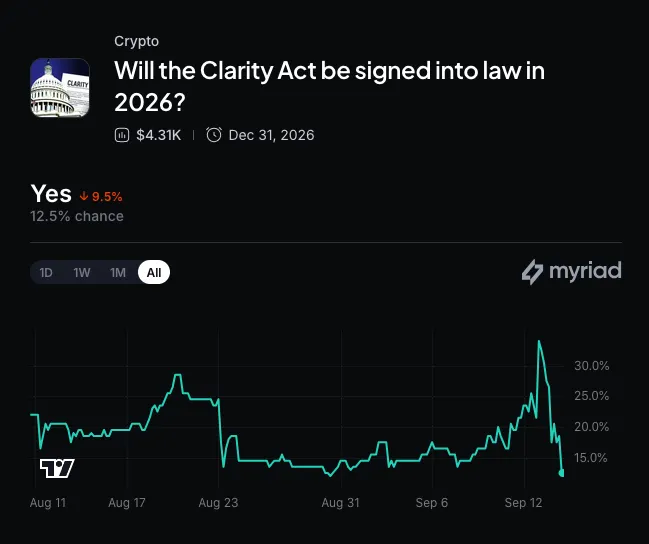
The U.S. Senate failed to pass a procedural vote on Clarity Act, hindering the advancement of legislation in the crypto market.
Helpful
No.Help

The U.S. Senate failed to pass a key procedural vote on Tuesday to advance the Clarity Act legislation, resulting in a significant setback for this crypto market bill at the Senate stage. This vote was regarding the procedural step of 'whether to proceed to consideration' and not the final vote, but the outcome has essentially halted the further advancement of the bill.

The threshold of 60 votes was not met.

The senator vetoed the application to terminate the debate on the "initiation of bill deliberation motion." According to Senate rules, 60 votes are required at this step in order to limit the debate and proceed with the formal consideration of the bill.

This means that the Senate is currently unable to proceed with the subsequent legislative process for Clarity Act. Senator Cynthia Lummis from Wyoming, who supports the bill, stated on the same day that this outcome almost certainly means that there is no longer any room for the bill to move forward.

The bill originally focused on the division of regulatory responsibilities.

Clarity Act was originally intended to establish a federal regulatory framework for the US cryptocurrency market and to clarify the respective regulatory responsibilities of the US Securities and Exchange Commission (SEC) and the Commodity Futures Trading Commission (CFTC).

According to reports, one of the goals of this bill is to provide a clearer compliance path for most crypto activities within the United States, thereby ending the long-standing disputes over regulatory jurisdiction.

Negotiations are stuck on issues such as stablecoins.

Prior to this vote, relevant negotiations had been ongoing for several months. The disputes mainly focused on three aspects: the stablecoin incentive mechanism, anti-illegal financial protection measures, and ethical restrictions related to President Trump's interests in cryptocurrencies.

The bill had previously been postponed to be dealt with after the Senate's August recess. The latest procedural vote failure means that these differences have ultimately not been resolved, and it also represents another setback for Congress's efforts to advance legislation on the crypto market this round.

Tip
$0
Like
1
Save
1
Views 640
HKWDB reminds readers to view blockchain rationally, stay aware of risks, and beware of virtual token issuance and speculation. All content on this site represents market information or related viewpoints only and does not constitute any form of investment advice. If you find sensitive content, please click“Report”,and we will handle it promptly。
Submit
Comment 0
Hot
Latest
No comments yet. Be the first!
Related
From Marx's vampires to Buffett's moats, the crumbling Gothic castle has been capitalism's favorite metaphor for 250 years.
As the AI transaction exposed the cracks in the "noble mansion" of early 21st-century capitalism, the metaphors of "castles" and "moats" long used on Wall Street have once again come into focus. Tech stocks such as Alphabet, ServiceNow, and Intel have recently seen significant declines, prompting the market to re-evaluate whether the moats surrounding these AI giants can truly hold them off.
Fortune
·2026-11-01 01:02:44
12
Mark Zuckerberg joins Miami's 'billionaire fortress', a glimpse of his real estate empire
According to Fortune, Mark Zuckerberg, the CEO of Meta with a net worth of $222 billion, is reportedly recently purchased a mansion worth $170 million on Indian Creek Island in Florida alongside his wife, Dr. Priscilla Chan. The mansion is located near the residence that Jeff Bezos, the founder of Amazon, is building. The report also outlines Zuckerberg's property holdings in Palo Alto, Kauai Island in Hawaii, Lake Tahoe, and Washington D.C.
Fortune
·2026-10-31 23:52:42
59
CFTC Chairman Says Binance Hacker Attack Indicates That Offshore Exchanges Need US Regulation
Michael Selliger, chairman of the U.S. Commodity Futures Trading Commission (CFTC), stated that the $6.4 billion hack incident at Binance “precisely demonstrates” the necessity of the crypto market regulations proposed by the agency this month. He described the attack as being more likely caused by a vulnerability introduced through a laptop rather than a flaw in the blockchain itself; however, Binance later indicated that the investigation had uncovered “more entry points” for the attack.
Decrypt
·2026-10-31 23:10:23
45
Intel experiences its largest single-day decline in over forty years; the NASDAQ falls nearly 3%, gold drops to a one-year low, and crude oil continues to rise for four months in a row.
Amazon and Intel's financial reports disappointed the market. Investors are increasingly skeptical about the returns on the huge AI expenditures of these tech giants. All three major U.S. stock indices closed lower, with tech stocks leading the decline, while energy and essential consumer goods sectors performed strongly against the trend. Driven by the Middle East situation, crude oil prices rose to a six-month high; U.S. Treasury yields fell, gold dropped to a one-year low, and Bitcoin lost its support below $77,000.
Wallstreetcn
·2026-10-31 22:30:06
51
Neuberger Next Generation Connectivity Fund Announces an Increase in Allocation Rate and Reveals the Monthly Allocation for Next Month
Neuberger Next Generation Connectivity Fund Inc. (NYSE : NBXG) announces a distribution of $0.132 per common share, to be paid on November 30, 2026, with the record date and ex-dividend date both set for November 16, 2026. The fund states that under its actively managed distribution policy, future monthly distributions are expected to be $0.132 per share, but whether this can be maintained depends on market conditions, investment returns, capital gains, and expenses, among other factors.
PR Newswire
·2026-10-31 22:21:54
50
View More