
















The U.S. attempt to turn AI computing power into tradable financial products has first encountered regulatory resistance. The Commodity Futures Trading Commission (CFTC) of the United States has extended the review period for CME Group's GPU computing power futures by 45 days, and thus the first batch of contracts, which were scheduled to be launched on October 5th, cannot be listed as planned.
Review extended to November 9th.
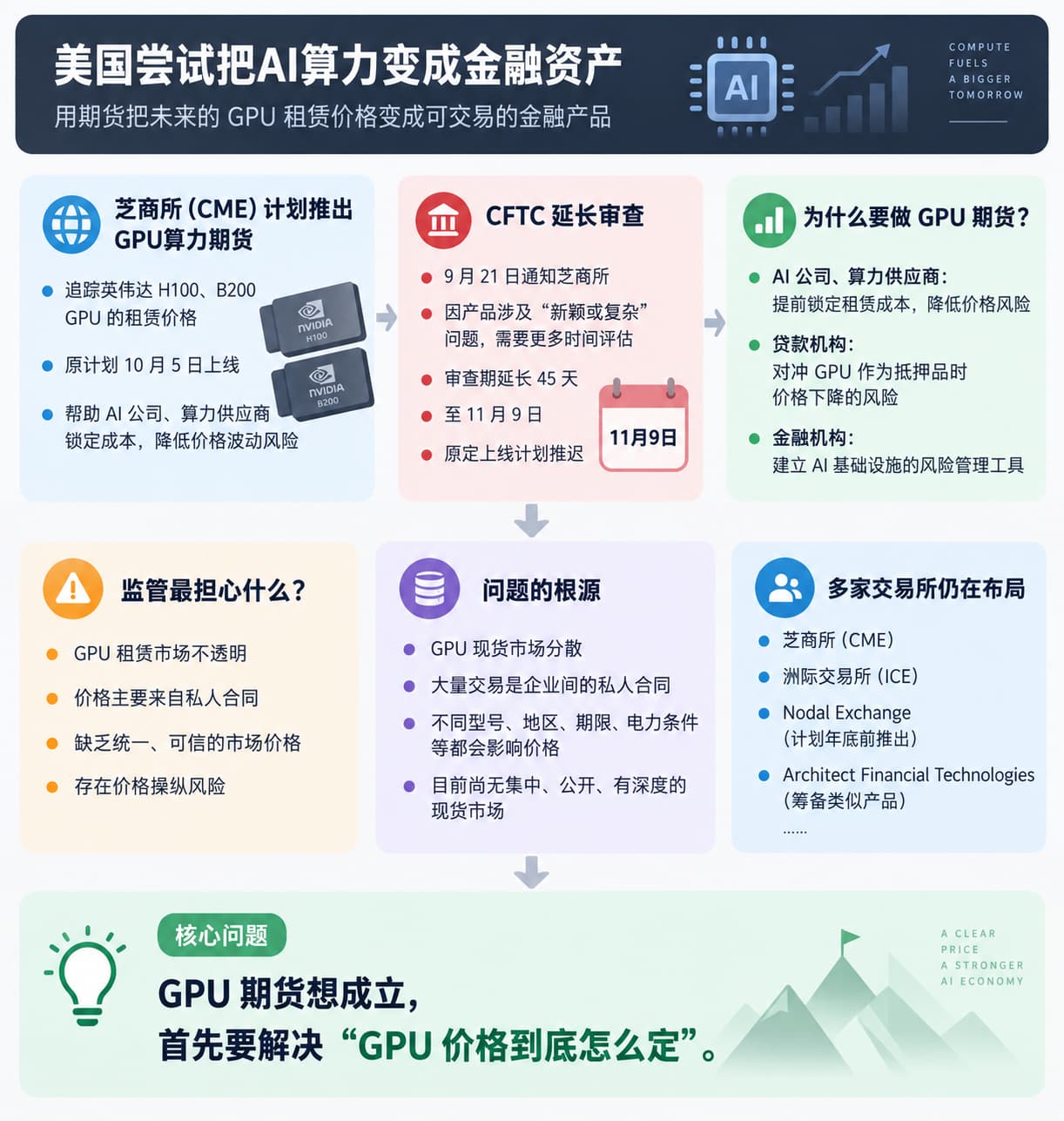
According to foreign media reports, CFTC notified the CME on September 21 that such products involve “novel or complex” issues and require more time for evaluation. The new deadline for review is November 9th, which means that the related contracts will not likely be launched until the review process progresses further.
In August, the Chicago Mercantile Exchange announced this plan to launch two types of AI computing power futures, which will track the rental prices of NVIDIA H100 and B200 GPU respectively. The settlement benchmark is provided by the data company Sil, which also issues the Data token. This is seen as a new attempt by Wall Street to promote the financialization of AI computing power.
Regulators focus on the source of pricing
The core purpose of such products is to allow AI companies, computing power providers, and related financing institutions to lock in the rental costs of GPU in advance, thereby reducing the impact of price fluctuations. For institutions that provide loans for data centers and GPU equipment, these tools can also be used to hedge against the risk of declining collateral prices.
But what CFTC is currently most concerned about is not whether there is a demand, but whether the price benchmark is reliable. Regulatory authorities have previously made efforts to solicit public opinions on derivatives and set a 60-day comment period. Their judgment is that the computing power financial market may contribute to the development of the US AI industry, but the GPU leasing market itself is still fragmented and lacks transparency.
Unlike stocks or commodities, the rental prices of GPU mainly come from private contracts between enterprises, lacking a centralized, public, and liquid spot market. In this context, how the price indices relied on for futures settlement are formed, whether they are representative, and whether large suppliers and demanders may influence the benchmark prices have all become key points of scrutiny.
- Review extended by 45 days
- The new deadline is November 9th.
- The original scheduled listing date was October 5th.
Multiple exchanges competing for the market
CME is not the only platform to be deploying in this area. Intercontinental Exchange has announced plans to launch GPU computing power futures, but no specific date has been set yet. Earlier this month, foreign media also reported that Nodal Exchange plans to introduce futures products linked to the rental prices of NVIDIA chips by the end of the year, with settlement prices based on an index compiled by Compute Desk.
Nodal plans to cover the architectures of Blackwell and Hopper, and GPU. It hopes to leverage its experience in the electricity derivatives market to help customers manage both computing power and electricity costs. Architect Financial Technologies is also preparing similar products.
Multiple traditional exchanges and new platforms are entering the market simultaneously, indicating that financial institutions are attempting to establish new risk management tools around the rapidly expanding infrastructure expenditure for AI. However, with the spot price formation mechanism still unclear, whether computing power futures can be successfully implemented depends on regulatory authorities' judgment regarding benchmark prices and manipulation risks.