
















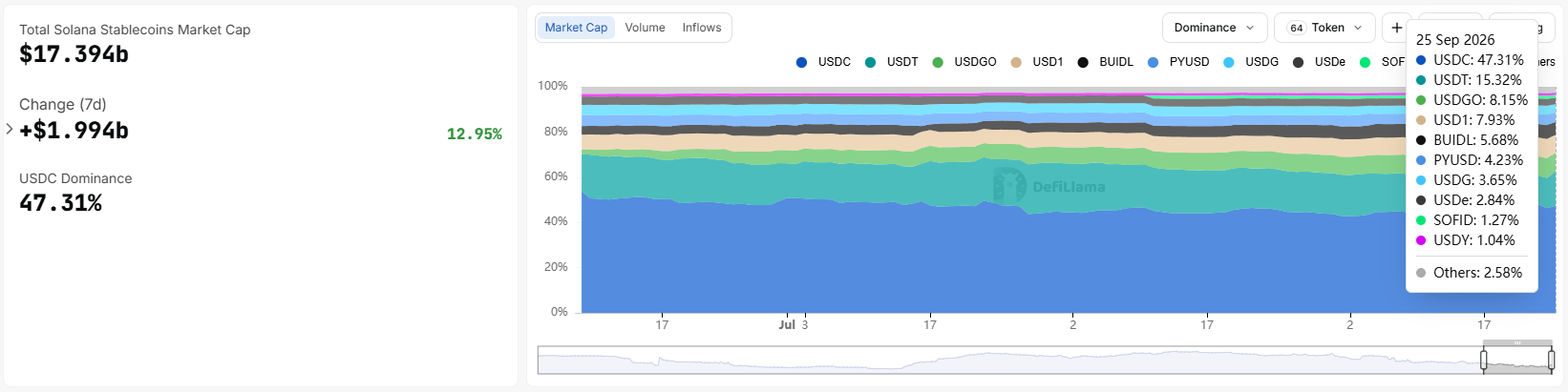
Solana The supply of stablecoins on the chain has reached a record high, indicating that liquidity denominated in US dollars continues to flow into this network. According to reports, as of September 25th, the total supply of stablecoins on the chain reached $17.39 billion, an increase of $1.26 billion from the previous day's $16.13 billion, representing a daily growth of about 7.8%.
Over $1.2 billion added in 24 hours
This round of growth mainly came from two major issuers. Circle and Tether jointly added approximately 1.28 billion US dollars in stablecoins, which is slightly higher than the net increase of 1.26 billion US dollars across the entire network. This indicates that the new issuance essentially constituted the main source of this round of expansion.
In terms of structure, USDC remains the largest stablecoin on Solana, accounting for 47.31% of the total supply, which is approximately 8.23 billion US dollars. USDT ranks second, with a supply of about 2.66 billion US dollars.
USDC Proportion Drops Significantly
Although USDC still ranks first, its dominant position has significantly declined compared to before. Reports mention that last week, USDC's share in the Solana stablecoin market dropped to around 44%, a significant decline from the peak of 80.3% set in February 2025.
This means that the structure of stablecoins on Solana is becoming more decentralized, with no single asset holding an absolute advantage anymore. As more stablecoins flow in, the liquidity in dollars available for on-chain transactions, DeFi, and payment scenarios is also expanding accordingly.
US regulators advance in unison
While the supply of stablecoins is expanding, U.S. regulators are also advancing relevant rules. On September 24th, the Federal Reserve proposed two rules that apply to issuers of payment-type stablecoins within its regulatory scope.
According to the proposed framework, issuers will need to fully support stablecoins with approved reserve assets, which include short-term U.S. Treasury bonds and other high-quality liquid assets. The rules will also introduce capital and risk management requirements, and establish an approval process for banks regulated by the Federal Reserve to apply for issuing payment-type stablecoins.
Regulatory advancement coincides with an increase in on-chain supply, reflecting that the stablecoin market is gradually shifting from mere expansion to a phase where both "scale growth" and "compliance building" proceed in parallel.