











CBN News 2026-09-28 15:17:45
Author: Lu Yuan Editor-in-Chief: Ge Weier
This column explores the new changes that the development of Silicon Valley AI has brought to the business world. What is truly worth questioning is not "Buffett bought it, so Google is cheap," but rather: whether Google can turn its annual capital expenditure of nearly $200 billion into sustainable cloud profits and a new generation of business distribution rights.
Three sets of signals bring this issue to the fore: Berkshire's large-scale investments, a sharp increase in Alphabet capital expenditures, and a sudden, steep rise in Google Cloud revenue and profit curves.
On June 1st, Alphabet signed a private placement agreement worth $10 billion with a Berkshire Hathaway-affiliated entity: $5 billion was used to purchase Class A shares at approximately $351.81 per share; $5 billion was used to purchase Class C shares at approximately $348.20 per share. Alphabet subsequently disclosed that the public offering of common stock completed in June, the mandatory conversion of preferred stock, and the private placement with Berkshire Hathaway resulted in a total net financing of about $49.6 billion, with an additional issuance quota of up to $40 billion for ATM set aside; as of the end of June, this ATM quota had not yet been utilized. Referring to all these arrangements collectively as "having completed $80 billion in financing" can lead to confusion between the funds that have already been received and the reserved issuance tools.
The market did not surrender just because Buffett appeared. The stock price of GOOGL once fell to around $330, breaking through Berkshire Hathaway’s Class A private placement price; on September 21st, it closed at $354.97, once again rising above that price, only to fall back below it by September 24th. The stock price repeatedly crossing the purchase price illustrates that the purchase price is not a judge of value, but merely a benchmark for observing market divergence.
In an interview hosted by CNBC and conducted with Becky Quick, Berkshire CEO Greg Abel stated that the company is able to observe how AI is utilized and what kind of returns it generates within its subsidiaries. As a result, Berkshire has increased its interest in AI and considers Google to be an important participant. He also revealed that the initial investment was initiated by Buffett, and he discussed the amount and pricing with Buffett before subsequently expanding his holdings. These are public statements; as for how the two calculate the intrinsic value of Alphabet, the outside world is not aware of that information.
Alphabet Capital expenditure in the second quarter was $44.9 billion, with the full-year guidance raised to $195 billion to $205 billion; operating cash flow for the quarter was $39.1 billion, resulting in a free cash flow of approximately -$5.8 billion. Meanwhile, Google Cloud revenue increased by 82% year-over-year to $24.768 billion, with an operating profit of $8.814 billion and an operating margin of about 35.6%. The 82% refers to revenue growth, not profit growth.
So, in 2026, the most important question regarding Google has changed: whether it will lose its position as the leading search engine to chatbots remains important; but a deeper question is, who can turn a single query into a series of real-world actions and generate revenue from those actions.
The market has not surrendered to Buffett.
When the stock price falls below Berkshire Hathaway's cost, the easiest explanation is “Buffett bought too early”; when the stock price returns above the cost level, the easiest explanation becomes “Buffett was right.” Both statements treat price as the answer, yet price is precisely the problem itself.
From Berkshire Hathaway's public statements and stock holding behaviors, a logical analysis can be derived: what they may be focusing on is not the next model ranking list, but whether AI has already entered the corporate process, and whether Google can simultaneously control models, chips, cloud services, data centers, and user access points. This is the journalist's inference based on public information, not a paraphrase of the investors' thoughts.
If Alphabet remains primarily a search advertising company, then becoming more asset-intensive would mean a discount to its valuation. Search advertising used to be a low-asset, high-profit, and strong-cash-flow business; however, when it is forced to participate in the arms race of computing power, depreciation, electricity costs, and financing expenses will eat into future profits ahead of time.
However, if Alphabet is transforming into AI – a platform for infrastructure and action distribution – then capital expenditure is not just a list of costs, but rather a ticket to compete for future revenue streams. The issue is not how much money is spent, but rather how long it takes for each dollar of capital invested to generate one dollar of sustainable cash flow.
This is the true dividing line between value investing and market sentiment: the former bets that cash flows will eventually appear, while the latter demands that cash flows appear now. No one can win solely by faith.
From search distribution to action distribution
In January this year, Chinese entrepreneur SeanShu conducted interviews in Las Vegas, followed by more interviews in Silicon Valley, and then registered a company in Los Angeles. Faced with company registration, trademarks, banking, communication, and cross-border usage, he was almost a novice: how to set up a company, how to open an account, how to buy a phone card, how to keep an American number after returning to China, and how to make a mobile phone support both physical SIM, eSIM, and Wi - Fi Calling.
Offline communities provided the initial direction. In February and September 2026, SeanShu communicated with TSVC, an early-stage investor from Silicon Valley, both in person and online, and obtained guidance on company registration in Delaware. In January, February, and September 2026, he interacted with Harley, a co-founder of a startup, both in Los Angeles and online, and Harley recommended Stripe. However, from the time "someone provided a clue" to the time "the matter was actually completed," there were tens of thousands of online interactions and hundreds of offline guidance sessions involving bank branches, fee conditions, legal communications, device compatibility, and cross-border communications, among other detailed aspects.
SeanShu assigned the same set of questions to Gemini, ChatGPT, and Claude respectively. In this case, the solution provided by Gemini was the closest to implementation: it not only explained the rules but also provided maps, service points, service providers, and next steps, telling him where to go, how to ask questions, how to avoid high monthly fees for bank accounts, as well as how to combine phone cards and mobile phones.
Domain names and websites are managed under Namecheap, payment processes are handled under Stripe, trademark services extend to Trademarkia and USPTO, banking issues are addressed under Chase, phone cards are managed under Tello, and device purchases are handled under Best Buy. Based on this, actions such as registration, account opening, depositing, purchasing cards, buying phones, and trademark services were completed, involving approximately $10,000. Most of these actions were finished within two weeks, while the trademark services continued for several months thereafter. Chase followed up with wealth management services provided by the bank. The amount of $10,000 is merely an estimated statistic across multiple scenarios, including bank deposits and third-party expenditures. The role of Google is that of a distributor and solution recommender.
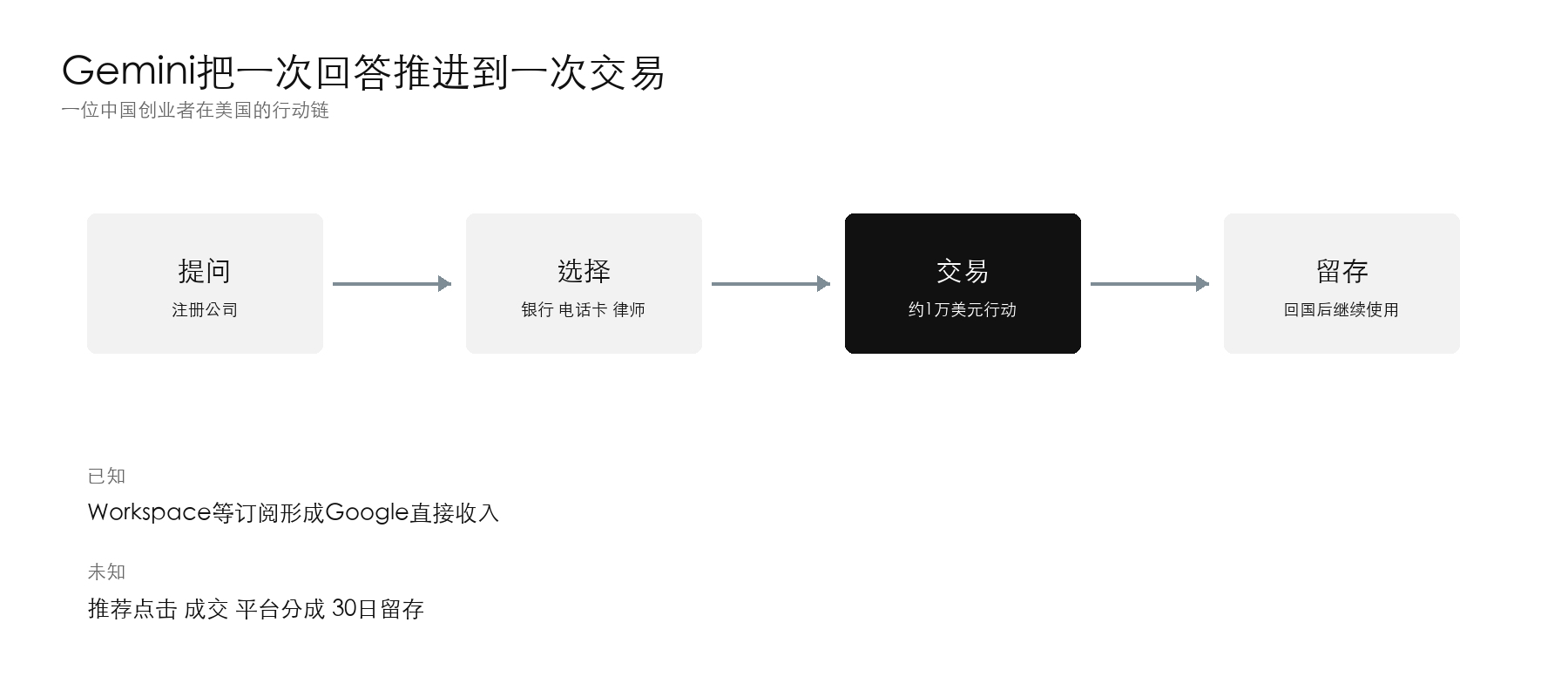
This is not a large sample, nor can it prove that Gemini is universally superior to its competitors. Its value lies in illuminating a product path: AI can not only produce answers but also break down goals into tasks and connect those tasks to real-world service networks.
Over the past two decades, Google has made money through “search distribution”: users enter keywords, and the advertising system directs those intentions to merchants. Generative AI is now pushing this distribution model forward. Users no longer search individually for things like “which phone card is better” or “how to get a bank to waive monthly fees”; instead, they set a clear goal: “I want to start a company in the United States and solve payment, communication, and trademark issues at a lower cost.”
In the SeanShu case, Gemini demonstrated the ability to break down targets, compare options, and connect with service providers. A real business opportunity is not just about getting one more click from a recommendation; it's about turning that click into a sale, that sale into repeat purchases, and then those repeat purchases into Google confirmed advertising revenue, subscriptions, cloud services, or transaction earnings. The direct revenue that can be confirmed now mainly comes from Workspace and other subscriptions; whether the remaining transaction value can be captured by Google remains unknown.
The advantage of Google lies in the connections between maps, merchant indexes, search data, email addresses, Chrome, Android, and enterprise software. However, its risks also reside in the same areas: if there is bias in recommendations, privacy controversies, or commercial payments affect the credibility of the answers, the more successful the distribution of actions, the higher the costs of regulation and trust-building will be. A closed loop is not the end of a moat, but rather the starting point for scrutiny.
Google Cloud The second curve that is ignored
What the market is watching is capital expenditure: $44.9 billion in the second quarter, with an annual guidance of up to $205 billion, and negative free cash flow per quarter. This is not noise; rather, it is the heaviest weight in the Alphabet valuation model.
Another curve, however, is rising at the same time. Google Cloud reported revenue of $24.768 billion in the second quarter, a year-on-year increase of 82%; operating profit was $8.814 billion, with a profit margin of about 35.6%. Rather than saying that Cloud is still striving to reach break-even, it would be more accurate to say that it has entered a phase of testing the quality of its profits: how much of its revenue comes from sustainable cloud consumption, and how much from TPU hardware; whether the profit margin can withstand depreciation, electricity costs, and capacity expansion.
In the same quarter, AWS reported revenue of $42.232 billion and operating profit of $16.621 billion, with a profit margin of approximately 39.4%. This means that Google Cloud's revenue was about 59% of AWS's, and its operating profit was about 53%, with the profit margin gap narrowing to around 4 percentage points; however, AWS still has a significant lead in scale. What Google Cloud has managed to "catch up" with is the slope (growth rate) and profit margin, not the overall size.
Alphabet was still confirmed in the second quarter, while TPU was delivered directly to the customer's data center for the first time by the system. This move has enabled Google to take a step from "reducing internal costs with self-developed chips" to "selling AI computing power systems," and it has also made Cloud's revenue composition more complex: hardware sales can quickly boost income, but they may not have the same gross margin and stickiness as subscription cloud services.
The two cloud curves of Google and Amazon will not simply overlap.
Some researchers have mentioned that Amazon's substantial investments in the internet era led to a decline in cash flow, but several years later it achieved substantial profits. Could this serve as a reference for Google?
AWS is the foundation of enterprises in the previous round of cloud computing. It grew by 37% in the second quarter, with revenue of $42.2 billion and operating profit of $16.6 billion, proving that established cloud platforms have not stopped progressing. It is basically accurate to refer to the revenue of Google Cloud as "60%" of AWS's revenue, but this is not a synonym for being on the verge of catching up.
The difference with Google is that it connects on one end to the infrastructure of AI, TPU, and Gemini Enterprise, and on the other end, it connects to Search, YouTube, Android, Chrome, Workspace, as well as the map and account systems. AWS is more like a toll station for computing power and software stacks; Google attempts to extend this toll station all the way to the user's intended entry point.
In the next six to eight quarters, what truly matters is not which company's launch event is more spectacular, but four key sets of hard data: cloud revenue growth rate, operating profit margin, capital expenditure and depreciation, and free cash flow. If Google Cloud maintains high growth but relies on hardware with low gross margins; or if its profit margin is eroded by depreciation, then what is known as the "second curve" of growth may merely be a steep accounting decline.
A fintech entrepreneur once participated in the first phase of Amazon Rainforest's startup support program, AWS, and also actually used AWS, Alibaba Cloud, and Google Workspace. Regarding this experience, the entrepreneur's team feedback was that the customer service of AWS was not as smooth as that of Alibaba Cloud, while Google Workspace was easier to get started with with the assistance of AI.
Therefore, the two curves will not simply overlap: AWS needs to prove that scale can still generate cash, while Google needs to prove that speed can ultimately cover the cost of capital. The former defends its throne, while the latter proves that catching up is not an illusion that can be bought with capital expenditure.
An observation dashboard where concepts cannot be misinterpreted
There is also no consensus in the market to "follow Buffett." Some people focus on the comprehensive entry point represented by Google, while others only see capital expenditures, dilution, and regulation. The founder of a financial data company that monitors the secondary market told the author that Google is too complex for them to study.
“The Gemini model is relatively outdated and shows some drift; indeed, it’s not as good as Anthropic and OpenAI,” a co-founder of a Silicon Valley unicorn told the author.
However, Google is the birthplace of this groundbreaking paper in this round of Transformer. Moreover, the person who made the greatest contribution to that paper, Noam, has returned to work at Google and is now a co-leader of Gemini. The changes at Google are worth studying and following up on.
To determine whether Alphabet is a good investment, one cannot rely solely on the price-earnings ratio, nor can one focus only on Berkshire Hathaway's cost structure. The key is whether the heavy asset investments can be converted into operating profits and free cash flow. Assuming we construct an observation framework, what should it consist of? The AI infrastructure recovery rate signal = operating profit over the past 12 months ÷ capital expenditures over the past 12 months.
It is necessary to first state the limitations before presenting the formula: it is not the AI return rate officially disclosed by Alphabet, nor is it ROIC in the strict sense, nor can it be directly used for stock trading. The Google Cloud profit is not equal to the total AI profit, and the company's total capital expenditures are not equal to the AI capital expenditures; a portion of the shared AI research and development costs remains at the Alphabet level. This ratio can only be used to observe the direction of "cloud profit catching up with capital investment."
Based on rolling calculations using the company's financial reports, from the third quarter of 2025 to the second quarter of 2026, Google Cloud is expected to have an operating profit of approximately $24.3 billion; during the same period, Alphabet's capital expenditures amounted to about $132.4 billion, with an agency ratio of around 18.4%. The numerator comes from the operating profits of the four quarters of Cloud's divisions, while the denominator is derived from the expenditures for purchasing properties and equipment in the cash flow statement for the same period.
15%, 25%, and 30% can be retained as observation benchmarks. This does not equate to 'the pattern is established', 'Berkshire's logic has been verified', or 'a re-evaluation is necessary'. A more cautious interpretation is: if these ratios continue to rise, Cloud's profits are catching up with its investments; if they stagnate or decline, then capital expenditure is expanding faster than visible profits. No threshold automatically corresponds to a specific direction for the stock price.
Is Google just burning money, or is it laying the foundation for future success?
The concerns of the bears are not illusory. Alphabet is increasing capital expenditures at a rate rarely seen in history, and depreciation and data center operating costs will be reflected in the income statement later on; AI model competition, migration of search entry points, advertising technology litigation, and privacy regulations may also pressure long-term profit margins. The net profit for the second quarter also includes approximately $99 billion in unrealized gains from equity investments, which should not be considered as core operating profit.
What the bulls really need to prove is not the nonsense that “Google is very strong,” but whether Google can turn a strong product lineup into a cash flow chain: TPU generates cloud revenue in conjunction with data centers, Gemini increases Workspace subscriptions and corporate adoption, while search and maps convert issues into actionable steps, which then settle into advertising, subscription, or transaction revenue. If any link in this chain only grows users without increasing cash flow, the valuation story will be flawed.
The approximately $10,000 worth of actions taken by SeanShu make the future vision tangible, yet it does not prove its scale. This indicates that Google has the foundation to move from being a problem to becoming a map, with outlets and service providers; the next step is to see if this capability can be replicated, as well as whether Google can generate revenue without compromising the credibility of its recommendations.
The logic that can be inferred from Berkshire Hathaway's public actions is that it is willing to invest long-term capital in such potential closed loops. However, Berkshire's purchases are neither a proof of the market bottom nor an investment decision made by the media on behalf of readers. Buffett may buy early, but he could also be wrong; the market may be correct in the short term, or it may just be punishing cash flows that are not yet visible.
The most counterintuitive aspect of Alphabet is that both bad news and good news come from the same source: the greater the capital expenditure, the worse the free cash flow; the faster the computing power is put into use, the more likely it is that Cloud and AI products will grow. You can't just choose one side of the equation.
So, whether Alphabet is affordable depends on which framework is adopted. Under the old framework, it was a search advertising company that was forced to re-asset; under the new framework, it could become a dual platform for AI infrastructure and action distribution.
In the next four quarters, if the improvement in Google Cloud's profits, service revenue, and free cash flow continues to outpace capital expenditures and depreciation, there will be reason for the market to re-evaluate the business model of Alphabet. However, this does not necessarily lead to a revaluation of the stock price. Conversely, if revenue is driven up by a surge in TPU hardware sales, profit margins weaken, and cash flow continues to deteriorate, then what was once seen as "laying the foundation" will more closely resemble "spending money recklessly."
What we are ultimately looking for is not a magic line that can predict stock prices, but a line of capital transformation: when to invest, when to start producing, and when to turn income into cash. Only those who can clearly draw this line truly understand Google; the rest are merely making bets based on Buffett's views or market sentiment.
(The author is the founder of Silicon Valley Far View Coremi)