
















Hengrui Medicine has licensed its independently developed oral GLP-1 / GIP dual-receptor agonist HRS-1596 to Novo Nordisk, the global leader in weight loss medications. The potential total transaction value could reach up to $2.6 billion, marking another significant step forward for Chinese innovative pharmaceutical companies in their international expansion in the weight loss market.
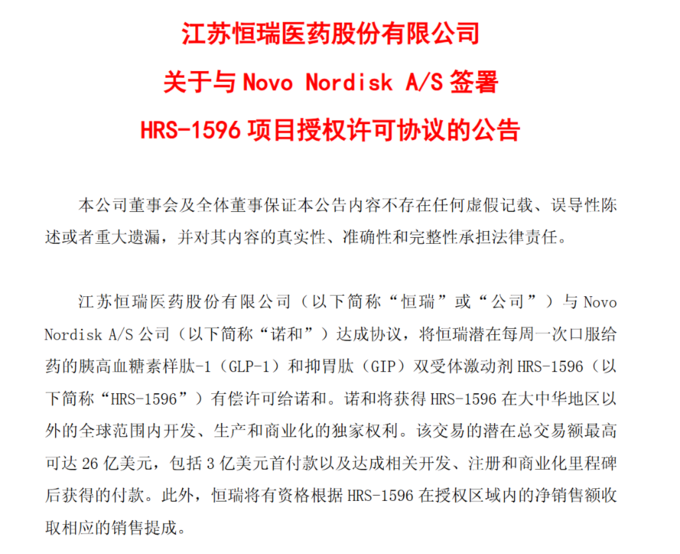
On September 29, Hengrui Medicine announced that the company has signed a licensing agreement for Project HRS-1596 with Novo Nordisk. According to the agreement, Novo Nordisk will obtain the exclusive rights to develop, produce, and commercialize HRS-1596 globally, excluding the Greater China region. The transaction includes an upfront payment of $300 million, as well as milestone payments for development, registration, and commercialization amounting to up to $2.3 billion, with a potential total transaction value of up to $2.6 billion. In addition, Hengrui will also receive sales commissions based on the net sales of HRS-1596 within the licensed area.
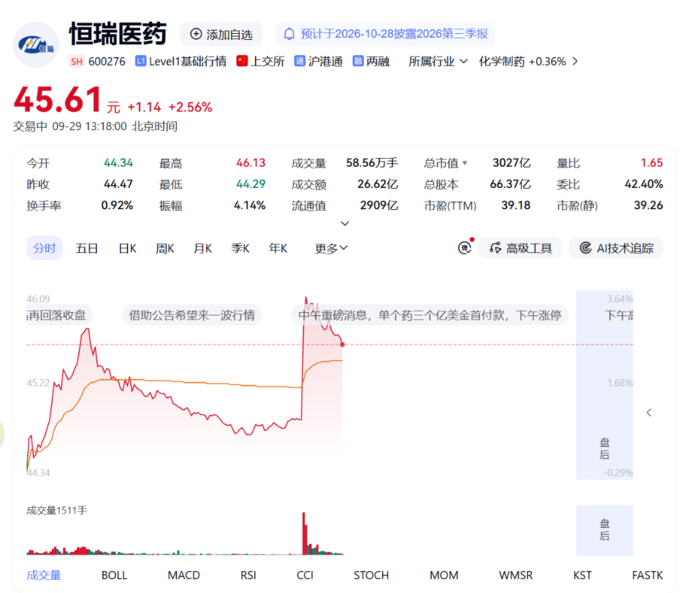
After the announcement of the news, the stock price of Hengrui Medicine soared, with an increase of over 3% at one point.
HRS-1596: Oral administration once a week, still in the early clinical stage.
HRS-1596 is a dual receptor agonist independently developed by Hengrui, namely GLP-1 / GIP. It aims to achieve weight loss and blood sugar control through multiple mechanisms such as suppressing appetite, promoting insulin secretion, and improving insulin sensitivity. It has the potential to be used for obesity, type 2 diabetes and other metabolic diseases.
The core differentiating advantage of this product lies in its method of administration. HRS-1596 is expected to enable once-weekly oral administration, which can significantly reduce the frequency of medication and improve patient compliance compared to existing injectable formulations. Currently, Hengrui has been approved in China to conduct Phase I clinical trials of HRS-1596 for weight management and type 2 diabetes; the product is still in the early stages of development.
Hengrui mentioned in the announcement that the process from drug development, clinical trial approval to production involves a long cycle and multiple stages. There is uncertainty as to whether HRS-1596 will ultimately be approved for marketing overseas. The milestone payments stipulated in the agreement also need to meet corresponding conditions, and the final amount remains subject to change.
$300 million down payment secured, delivery expected to be completed in the fourth quarter of 2026.
From a financial perspective, the initial payment of $300 million represents the most certain benefit in this transaction, while the remaining milestone payments of up to $2.3 billion are linked to subsequent development, registration, and commercialization progress. The sales commission will be calculated separately based on the actual net sales of HRS-1596 within the authorized region.
The agreement is subject to the laws of New York State, USA, and must be approved by the relevant regulatory authorities in accordance with the U.S. Hart-Scott-Rodino Antitrust Improvement Act, while also meeting other customary delivery conditions. Hengrui expects that the transaction will be completed in the fourth quarter of 2026.
It is worth noting that Hengrui retains all rights for HRS-1596 in the Greater China region (Mainland China, Hong Kong, Macau, and Taiwan), with the authorization scope covering only global markets outside of the Greater China region.
Novo Nordisk has been deeply involved in the GLP-1 field for many years, and this acquisition of Hengrui's oral GLP-1 / GIP assets is seen by the outside world as an important move to continuously strengthen its oral weight loss drug pipeline. For Hengrui, by leveraging Novo Nordisk's global commercialization network, it can effectively accelerate the advancement of HRS-1596 in overseas markets and achieve rapid transformation of its research and development results.
Hengrui stated in its announcement that the company adheres to a balanced approach of independent research and development as well as open cooperation. This collaboration is aimed at leveraging international leading partners to cover overseas markets, accelerating integration into the global pharmaceutical innovation network, and maximizing the value of its products.