
















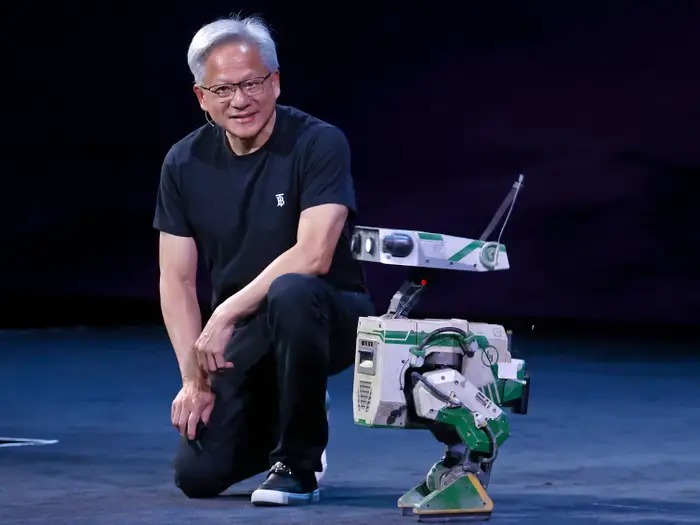
NVIDIA helped lay the foundation for physical AI. Today, many former employees are driving a new wave of robotics startups.
Like the AI intelligent entity and other applications, NVIDIA's strategy is to develop underlying technologies – the chips that power robots, as well as the software used for training them. This ecosystem has become a fertile ground for entrepreneurs.
The founder of Techable Ventures, a former NVIDIA employee, Amulya Vishwanath, stated that in recent years, some individuals who were involved in building the foundation for robotics within NVIDIA "are now splitting off to start their own companies." Vishwanath left NVIDIA last year to found a venture capital firm focused on AI. Techable Ventures.
NVIDIA's former Research Vice President Sanja Fidler left the company in July and, along with other former NVIDIA employees, founded Veeda AI. This startup creates simulation worlds for training robots, which is an extension of the research work Fidler conducted at NVIDIA. The Information reports that former NVIDIA researcher Joel Jang also founded Dream Labs, another company that is pioneering in this field.
NVIDIA alumni are making efforts in different directions within the field of robotics, ranging from providing software for deploying robots in warehouses to robots that perform physical tasks for enterprises.
NVIDIA has invested in some of these companies, including Flexion Robotics and Dyna Robotics.
Flexion, the Chief Executive Officer and Co-Founder, Nikita Rudin, stated that NVIDIA maintains close contact with this startup, holding meetings every two weeks and providing early-stage tools for testing.
Rudin said, "We're still doing the same things as before. We used to be beta users – now we're doing it again, only this time from the outside."
Why NVIDIA's robotics talents choose to leave
Rudin and co-founder David Hoeller left NVIDIA after being convinced that robotics technology had reached a turning point and was ready to be deployed.
Hoeller said, "We are not necessarily convinced that staying at NVIDIA is the fastest way to actually accomplish this task and deliver it."
A former NVIDIA robotics researcher, Arsalan Mousavian, provided a similar rationale. He described NVIDIA as a “hardware-first” company centered around AI chips, while he himself hoped to “focus intensely” on creating truly useful robots. The startup founded by Mousavian last year is still in an incognito state at present.
Siddhant Haldar, who once interned at NVIDIA and considered joining the company at one point, stated before founding Index Robotics that this field has long been limited by a lack of real-world training data. Nowadays, powerful AI models can take on some of the workload, and robotics venture capital financing is surging. He believes now is the right time to make a move.
According to the data from PitchBook, in the first half of 2026, global physical AI companies raised a total of 33.4 billion US dollars, which already exceeds last year's annual financing amount of 28.7 billion US dollars.
Haldar says that startups can also take risks and deploy imperfect robots, because large companies "have more to lose."
NVIDIA is not the only company that has nurtured a new batch of robot founders. Former Google DeepMind engineers founded Reimagine Robotics and Generalist, while a veteran from Waymo established Bedrock Robotics; as researchers in fields such as autonomous driving continue to flock in, talent in this area is also gathering at an accelerated pace.
NVIDIA's growing community of entrepreneurs has created a cycle: the more startups there are, the more likely NVIDIA is to benefit by selling them the necessary infrastructure.