
















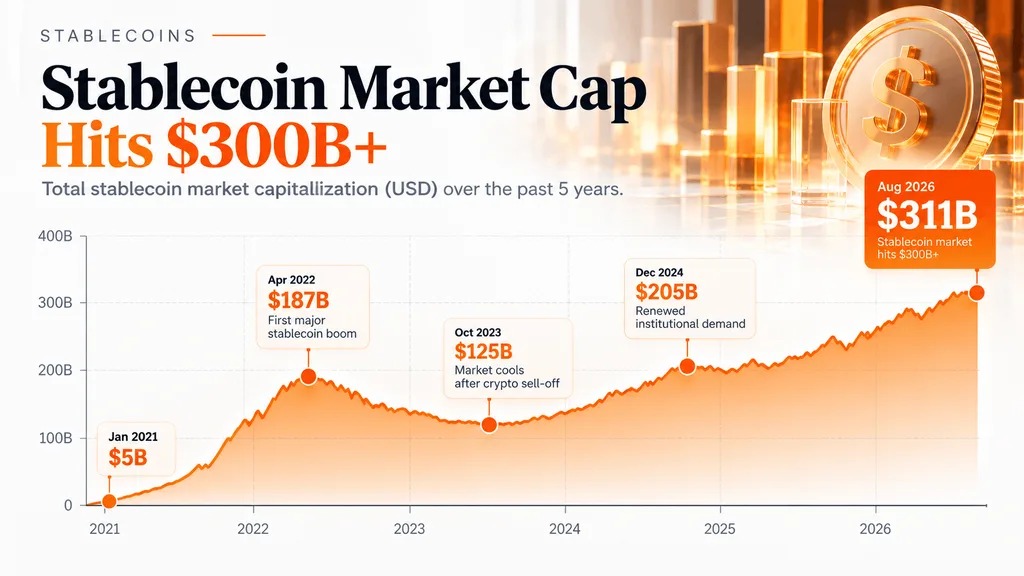
As stablecoins grow into a much larger financial market, this progress has also followed. According to data from CoinDesk Research, the total market value of stablecoins rose to approximately $311 billion in August, bringing blockchain-based "dollars" firmly into the tens of billions of dollars range.
Citi is bringing stablecoins into its corporate banking business
The significance of Citibank's move is not merely that another large bank is experimenting with encryption technology.
This new infrastructure is designed to connect ordinary corporate bank accounts more directly with blockchain-based currencies. Enterprises can receive fiat currency through accounts supported by Citibank and convert it into stablecoins, without having to set up separate banking and cryptocurrency systems on their own.
This fits into a broader trend. As we discussed earlier in "Why Wall Street Banks Want Their Own Digital Dollars," banks are increasingly viewing stablecoins as tools for 24/7 settlement, cross-border transfers, and tokenized financial markets, rather than simply products that originated in the crypto sector.
For Ripple, this trend is both a form of validation and a form of competition.
Ripple is also making arrangements around the same type of institutional transformation.
In the past few years, Ripple has continued to expand beyond its initial cross-border payment business, which was based on XRP.
Its current strategy already covers RLUSD, custody, fund management services, and other infrastructure for institutional finance. Coinpaper previously reported that RLUSD, FXRP, and lending services are changing the use of XRP Ledger, while the circulation scale of RLUSD approached $2.4 billion earlier this month.
Ripple is also increasingly describing itself as a broader institutional financial platform, rather than just a payment company. This shift is reflected in its expansion into areas such as custody, stablecoins, fund management, and principal brokerage services.
Marcus Hale
Marcus Hale is an author in the fields of cryptography and financial markets, covering reports on Bitcoin, Ethereum, digital assets, regulation, ETF, and institutional adoption. His work focuses on driving market developments, investor trends, and shaping the broader forces of the crypto economy.