















The stock price of Nike, a giant in sports apparel ( Nike, NKE ), has fallen by about 25% since the last financial report and is also about 53% lower than its peak from a year ago. A four-star Evercore ISI analyst Michael Binetti warns that Nike's upcoming update for the first fiscal quarter of 2027 could become another "reset moment," as retail orders seem to be weaker than expected. Nike had previously guided that revenue for the first fiscal quarter would decline by a single-digit to mid-single-digit percentage. Binetti believes that the company may need to further lower its expectations for the second half of the 2027 fiscal year as well.
The problem is that the market already anticipated that Nike's transformation would take time. Last quarter, Nike's revenue declined by 1%, to about $11 billion; on a currency-neutral basis, sales fell by 4%. Nike also warned that revenue would continue to weaken in this fiscal quarter before improving later in the fiscal year.
Wall Street currently expects that revenue in the first half of fiscal year 2027 will hit a bottom, about 4% lower than the same period last year, followed by a gradual return to flat growth in the second half of the year.
Binetti believes that the recovery may be delayed, as some retailers seem to have reduced or canceled orders for the spring of 2027. This could force Nike to lower its outlook for the second half of the year before the November investor day.
Nike still has several transformation issues that need to be addressed.
Nike is still dealing with the issue of weakened brand momentum. For example, football star Kylian Mbappé ( Kylian Mbappe ) recently ended his long-term partnership with Nike and switched to join the high-end sports brand On Holding ( ONON ). Meanwhile, Dick's Sporting Goods ( DKS ) recently warned that significant discounts offered by Nike have damaged certain areas of its business.
The importance of discount issues lies in the fact that Nike is attempting to reduce its old inventory while also persuading consumers to pay a higher price for new products.
In addition, analyst Stifel Peter McGoldrick identified another risk. He stated that the demand for Nike's new products remains insufficient, and the company's Hoops Classics business, which accounts for about 18% of revenue, continues to shrink.
Nike also recently replaced its Chief Financial Officer, which provides another reason for management to continue to maintain a conservative short-term outlook ahead of the investor events in November. According to data from Stifel, the current stock is trading at around 17 times earnings estimated for 2027, while the footwear segment is trading at around 11 times earnings.
Should one buy, sell, or hold Nike stocks?
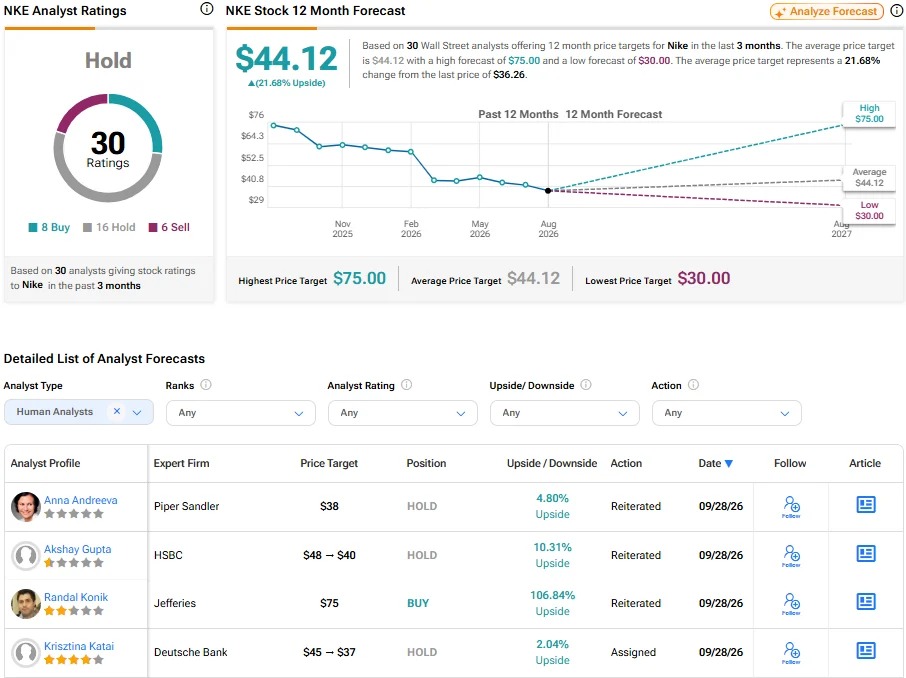
Back on Wall Street, over the past three months, there have been 8 buy ratings, 16 hold ratings, and 6 sell ratings. Analysts' consensus rating for Nike's stock is "hold." The chart below also shows that Nike's average target price is $44.12 per share, which indicates there is still 21.7% room for upside. (See Nike Stock Forecast)