
















As the European Commission's review and consultation process regarding the "Regulation on the Supervision of Crypto-Asset Markets" ( MiCA ) is coming to an end, Europe must decide whether these crypto regulations are protecting the market without simultaneously raising the costs too high for businesses operating within the continent.
After MiCA came into effect, it accomplished something that the European digital asset industry had not been able to achieve for many years: it established a set of unified and coherent rules.
This is the first time that an encrypted asset service provider ( CASP ) has been approved to offer its services throughout the European Union and the European Economic Area after being approved in a single member state. Customers within the entire region now have the option to choose from an increasing number of licensed and regulated service providers. This is indeed an achievement, and the industry should not take it for granted.
As the review and consultation process for MiCA is set to conclude on September 30th, the focus should now shift to calibration: retaining the effective parts and facing up to the fact that the growing burden of compliance has surpassed the risks that need to be addressed.
The value of a unified market
First, let's see what MiCA did right. Before that, companies wanting to operate across borders in Europe faced fragmented national systems and varying registration requirements; in some markets, there were even no specialized systems at all.
The unified market has changed the economics of serious business. It requires service providers to invest in just one set of authorization and compliance frameworks, rather than thirty sets; at the same time, it also truly benefits customers: they can choose among multiple service providers, who compete in terms of quality, price, service, and security, all while being subject to the same unified standards.
The "passage" mechanism has transformed 30 fragmented markets into one accessible market, reaching a population of approximately 450 million people. This is also the strongest reason why industries with high global liquidity choose to develop in Europe rather than elsewhere.
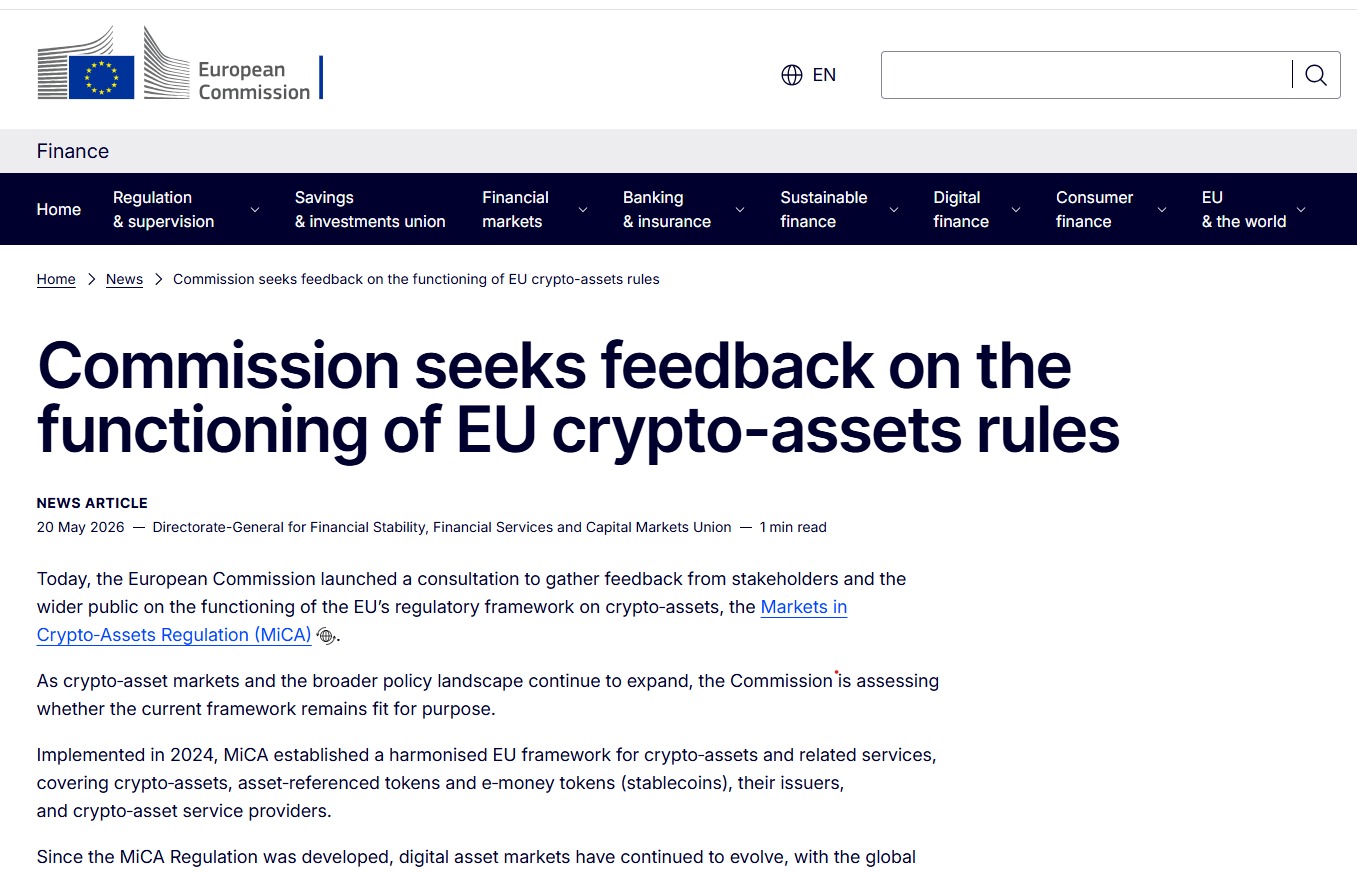
MiCA has raised the entry barriers as it requires a more stringent authorization and compliance framework. However, in return, the approved CASP does not merely gain access to the market of a single member country; rather, it obtains access to the entire European Union single market.
Therefore, the truly relevant question in this review is: whether the market access obligations are still proportionate compared to the market scale they facilitate.
Regulatory risks, rather than regulatory activities themselves
The principles that should guide this review are quite simple: regulation should apply where there is indeed a risk to market participants or to market stability, and it should be proportionate to those risks.
For services that involve customer funds, asset custody, market integrity, or financial stability, strict regulations are not only acceptable but also necessary. Regulatory attention should be focused on these areas, which are also the aspects where there is the least reason for the industry to complain.
In the end, the compliance framework should be judged by one standard: whether it has truly reduced risks?
Over time, frameworks tend to continuously accumulate rules, reporting requirements, and documentation obligations, often increasing complexity and costs without corresponding risk reduction benefits.
Therefore, the review should question each requirement individually, retaining only those rules that can address clear and significant risks. Rules that meet this standard should be kept; those that do not should be simplified, streamlined, or eliminated. The principle of proportionality is not a loophole, but rather a discipline that ensures the credibility of the rule manual.
Face the cost curve honestly
It must be publicly acknowledged that the compliance costs associated with CASP under MiCA have significantly increased. This in itself does not constitute a criticism. Some of these costs are considered a necessary entry fee for entering a vast and valuable market, and well-managed companies should be prepared to bear them. However, these costs are not neutral for the entire market.
Compliance expenses hit small companies and newcomers the hardest, yet it is precisely these participants who drive competition and innovation. When authorized fixed costs become too high, they no longer serve as a safeguard but instead become barriers to entry, consolidating the positions of existing players and diminishing the range of choices that a single market should otherwise have.
Therefore, what needs to be guarded against is not a single rule, but the overall regulatory direction. If scrutiny significantly increases the regulatory burden without clear risk grounds, the result is likely not a safer market, but rather a smaller market: with less innovation and fewer companies willing to build their business in Europe.
Digital asset companies have particularly strong liquidity, and some of them may gradually shift their new investments to jurisdictions with similar market access and lower friction. If this happens, European consumers will ultimately face fewer choices, and the share of global activities regulated by European authorities will also decrease, although such activities will continue to exist.
What does a good review look like?
The above is not an advocacy for relaxing regulation, but rather for conducting reviews based on the principle of proportionality: Take this opportunity to carefully examine those requirements that incur costs without corresponding benefits, to leave room for innovation and development for enterprises, and to ask at every step whether a certain obligation is truly intended to protect the market or merely to impose a tax on it. The following examples can illustrate this point:
- Regulation by tiering based on scale and risk:Small startups with only a few customers should not bear the same compliance burdens and prudential requirements as multinational corporations managing billions of dollars in assets. Introducing proportional stratification based on asset size, customer base, or system importance can lower the entry barriers for new participants while maintaining strict regulation in the most critical areas.
- Dual licensing of electronic currency tokens:The custody and transfer of electronic currency tokens (EMT) may trigger additional regulations such as the Payment Services Directive (PSD2) in addition to the MiCA license. This overlap results in duplicate compliance costs and legal uncertainties, without any clear benefits for consumer protection. A clearer definition—or a single licensing pathway—could reduce friction while still maintaining regulatory coverage.
- Rigid reserve requirements for stablecoins:Emitters must hold at least 30% of their reserves in bank deposits. In an environment of rising interest rates, this limits potential returns; during a banking crisis, it can lead to excessive risk concentration on the counterparty side. A more flexible allocation framework that allows for high-quality liquid assets, not just bank deposits, could enhance resilience without compromising the ability to redeem.
Europe has achieved a rare accomplishment: a sizable, unified, and well-regulated crypto asset market. The goal now is to ensure that it continues to be attractive to the companies that make it function.
It is crucial to strike the right balance that aligns the interests of both regulators and the industry, and the coming months are precisely the time to get this right.
MiCA
European Union
Europe
Cryptocurrency Exchange
Opinion
Policy
Regulation