CBN News, October 12, 2026, 17:05:31 - Listen to the news
Author: Hu Shujuan Editor-in-Chief: Liu Jia
"If GPT-7 comes out next year, it might directly solve the problem of embodied intelligence."
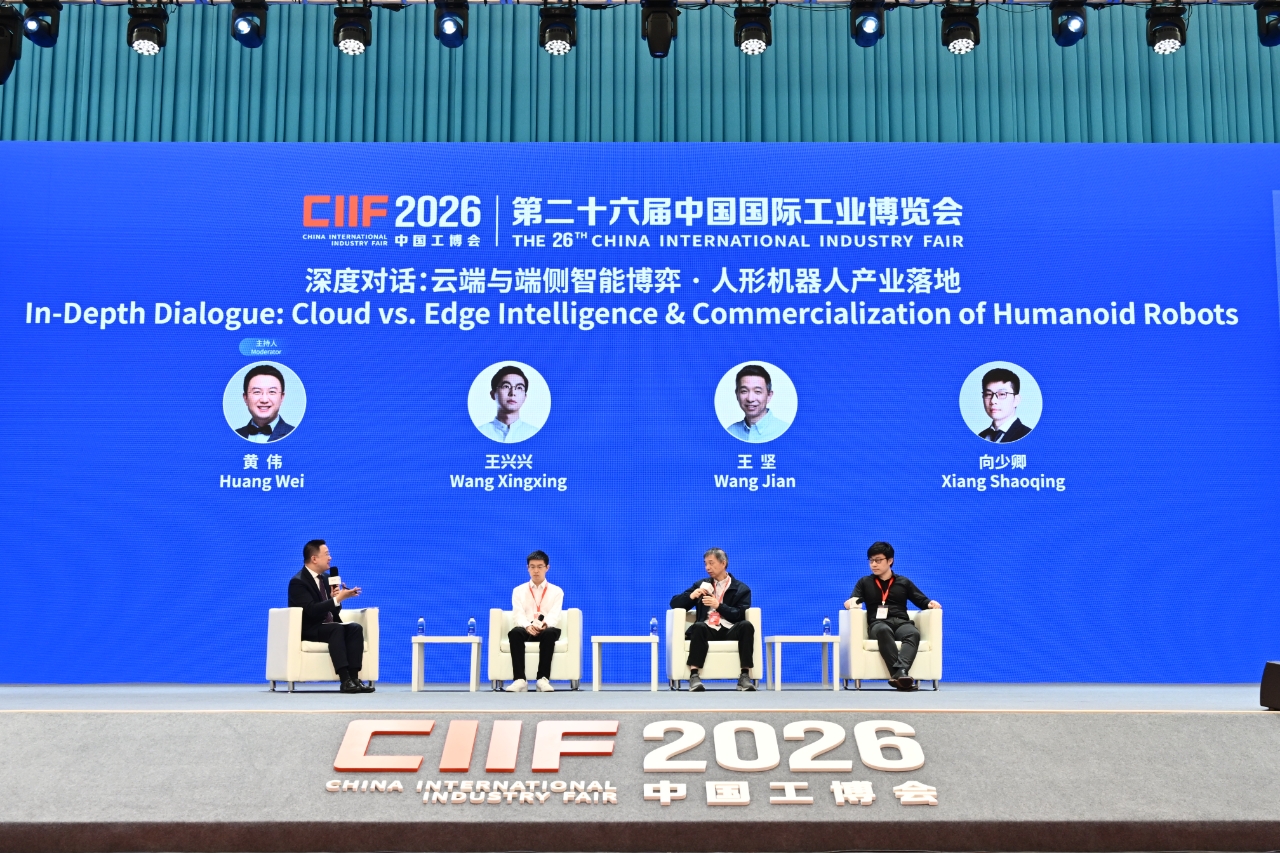
On October 12th, at the opening ceremony of the 26th China International Industry Fair, Wang Xingxing, the founder of Yushu Technology, shared the impact of technological advancements in AI on the development of embodied intelligence industries. In his view, the critical point of embodied intelligence is likely to arrive quite soon, perhaps within one or two years, but it still faces challenges regarding generalization and efficiency at present.
Some time ago, the release of the general large models GPT-6 and Astra sparked a wave of testing in the embodied intelligence industry, and also prompted industry professionals to discuss and reflect on technical approaches. At the same time, the direction of self-evolution research has also received considerable attention.
These topics were precisely the focus of in-depth discussions among several guests during the conference sessions at the Industrial Expo, where they attempted to answer the question of how far we are from the widespread adoption of robots.
Self-evolution requires data accumulation.
At the conference, Wang Xingxing revealed that the company's team has deployed GPT-6 on robots for testing, and the results have been quite good. He mentioned, "Now my personal belief in AI is growing day by day. The biggest mistake I made over the past decade or so was not having enough trust in AI. Perhaps many people still haven't fully utilized or embraced AI yet."
And this change may be confirmed by Wang Xingxing's recent repeated mentions of the concept of "physical AI self-evolution."
"The automation level of large language models or multimodal model training has now reached a very high degree. This year or next year, leading large model companies may have almost achieved a level of self-evolution." However, in the field of embodied intelligence, Wang Xingxing believes that this direction is still in a relatively primitive state, and the training and debugging of robot models still rely on human engineers. In fact, tasks such as writing code, training, and deployment can be automated using AI, while humans are responsible for evaluating the results and scoring them.
In Wang Xingxing's view, as the models accumulate more and more experience, human involvement may decrease.
Previously, industry insiders generally believed that one of the major bottlenecks in the development of embodied intelligence was the shortage of data. In this regard, Xiang Shaoqing, co-founder of Sharpa, mentioned during a dialogue session that self-evolution is a process that naturally forms over time as data accumulates.
Xiang Shaoqing believes that human operation of data, simulation data, and real-machine data is logically progressive. “The configuration of robots is similar to that of humans; human operation of data implies an understanding of the world's operating mechanisms and of the human body, which is very important for robots as an initial form of learning,” Xiang Shaoqing explained. The significance of simulation data lies in reinforcement learning and data augmentation, while real-machine data will address the Sim2Real Gap of simulation.
"Human operations on data construct the 'seeds' of intelligence, after which robots learn more knowledge in simulation environments and then trial and error in real-world settings to improve their intelligence. This is also a process of self-evolution," Xiang Shaoqing explained. Currently, the development and deployment of these three types of data are being carried out simultaneously.
Wang Xingxing mentioned that as a manufacturer of robotic bodies, Yushu Technology pays more attention to real-machine data. He stated that in order to truly deploy robots in the last few centimeters of the physical world and improve the success rate, real-machine data remains crucial.
It is worth mentioning that Wang Jian, an academician of the Chinese Academy of Engineering and the director of Zhijiang Lab, specifically called on manufacturing enterprises such as Haier and Schneider to open up their industrial data to robotics companies in the future.
"Now artificial intelligence can understand and write code, which represents a qualitative change. However, at present, AI is still quite far from the data used in the industrial sector, as this type of data is locked away in each company's 'drawers.' If this issue is not resolved, there will be significant challenges to their integration." Wang Jian believes that if robots are to undergo a transformation, then the data contained in these 'drawers' should be made available.
Several Barriers Faced in Large-Scale Implementation
Beyond data, the computational foundation of embodied intelligence is also a key focus in the on-site dialogue sessions, as it is related to the large-scale implementation of robots in the future.
It is understood that currently, the deployment of robot computing power mainly includes cloud, endpoint, and edge sides. Among these, the cloud side refers to placing tasks in cloud data centers, the endpoint side involves integrating computing power directly into the robot itself, while the edge side involves deploying computing resources near the robot.
The above three guests shared their views from different perspectives. Wang Xingxing mentioned that they consider the needs of customers. “Each model of robot is equipped with high computing power, which is actually a rather unappealing approach,” he said. He noted that the computing power of robots can be selected according to requirements. For some robots that focus on athletic capabilities, the demand for computing power is not particularly high, and they can be deployed on the robot itself; however, for tasks that require decision-making or large-scale deployments, cloud computing power is still necessary.
It was mentioned to Shaoqing that the deployment method depends on the required amount of computing power and latency. “When performing tasks, robots interact in real-time with the physical world. In terms of latency, the computing power should be as close to the robot as possible, ideally on the side of the device itself.” However, he noted that the current reality in the industry is that the computing power on the device side is not sufficient to handle the calculations that robots need to perform on their own, so for the time being, robots’ ‘thinking’ will still take place in the cloud. In the long run, if robots become commonplace in every household in 10 years, then more computing power may shift from the cloud to the device side.
Wang Jian believes that the embodied intelligence industry is still in its early stages, and the form of robots has not yet matured. It is still too early to discuss computing power at this time. 'The choice regarding the path of computing power should be based on pragmatism, which means considering how much capability one has and how many things can be accomplished effectively. The goal should still be to create a good robot.'
As for whether robots can achieve large-scale application in the future, Wang Xingxing believes that issues related to generalization and efficiency need to be addressed, and these problems will be solved in the coming years.
In Xiang Shaoqing's view, the foundations of a robot's generalization include the ability to work without the need to modify the environment and the capability to operate continuously. Previously, Sharpa deployed robots at a DQ store in Shanghai, where they produced ice cream step by step at their “workstations.” Xiang Shaoqing revealed that Sharpa plans to deploy 30,000 robots across three major scenarios: catering, retail, and hospitality. Moving from a single scenario to multiple scenarios will directly test the robots’ generalization capabilities. “After receiving the robots, companies can use them by collecting a small amount of data with the tools we provide and conducting some training; this is our next goal.”
Article Author
Wang Xingxing of Yushu Technology: The biggest mistake I made in the past was not having enough trust in AI.
Wang Xingxing of Yushu Technology: The biggest mistake I made in the past was not having enough trust in AI.
Nearly 300 new products and debut items are on display, and this year's Industry Fair will also announce a series of achievements.
Release of the Top Ten Achievements in High-Tech during the 14th Five-Year Plan Period, "Shanghai Industrial Map (2026 Edition)"
Robot manufacturers are accelerating the addition of "brains" to explore new scenarios and incremental growth opportunities.
"The development of embodied intelligence is a process of continuously addressing weaknesses."
Embodied intelligence data is surging, but model validation has not yet been fully achieved.
Compared to previous years, there has been a significant increase in the scale of industry data.
Robot performances cause injuries, who should be responsible for ensuring safety?
Industry insiders interviewed believe that it is necessary to establish a set of guidelines and norms for robot performances within the industry, as well as improve the accident tracing mechanism.