On Monday, Micron, which ranked first in U.S. stock trading volume, closed down 3.88% with transactions amounting to $23.47 billion.
On Monday, South Korea's two leading storage companies, SK Hynix and Samsung Electronics, faced pressure throughout the day in the Korean stock market, and the negative sentiment in the market also further spread to the U.S. stock market. Market analysts believe that a large-scale selling by foreign investors may be an important reason for the decline. Data from the South Korean Exchange shows that as of October 7th, the proportion of Samsung Electronics shares held by foreign investors had dropped to 46.37%, the lowest level since July 16, 2009, marking a new low in about 17 years.
The market has new concerns regarding the global competitive landscape in the field of memory chips, with Micron facing competitive pressures from rivals such as Samsung and SK Hynix.
Cao Kanyu, President of ChangXin Memory, announced at an industry event over the weekend that the company has made key progress in the next-generation 4F2 memory cell architecture and plans to launch server memory products based on this architecture by the end of 2026. This design uses proprietary vertically stacked gate transistors to suppress leakage, allowing more memory cells to be packed onto a single chip, which is directly aimed at the high-profit DRAM used in AI servers.
3rd place goes to Meta, with a gain of 3.38% and a trading volume of 18.479 billion US dollars.
The personal AI assistant of Meta manages to retain users at a level close to ChatGPT. According to data cited by Silicon Valley venture investor Deedy Das on X, the user retention rate of Muse exceeds 30% after 7 days, which is basically on par with ChatGPT; the 14-day retention rate is 22%, slightly lower than that of ChatGPT.
In addition, Meta has released the Muse Wonder model as well as the more powerful Wonder Full AI model. According to the test data published by Meta, both models have reached levels comparable to Fable 5.1, Opus 5.5, and GPT-6 Astra in multiple capability tests, and in some benchmark tests for intelligent agents and knowledge work, they even performed slightly better.
During the press event on Monday, Zuckerberg hinted that Meta would further increase its investment, stating that the company "is already taking steps to move on to the next level." He also mentioned that the pace of model development in the future "may seem to accelerate significantly."
NVIDIA, ranked 4th, saw a decline of 1.29%, with trading volume amounting to 15.866 billion US dollars.
NVIDIA and Cisco jointly launch a new type of pluggable optical module with the specification USFP (ultra-small pluggable), aimed at expanding the network capacity of AI factories. USFP is the first module to support 400Gb/s electrical signals per channel, with a single-module capacity of up to 12.8Tb/s, allowing AI builders to connect more computing systems without increasing the network hierarchy, while also reducing the power consumption per bit of data transmitted. Compared to the existing 200Gb/s optical modules, s-per-lane, the bandwidth density of USFP has been increased by 4 times, and energy efficiency has been improved by 1.3 times. NVIDIA and Cisco are working with TE Connectivity and Avago to build a multi-source hardware ecosystem around USFP.
6th place goes to Sandisk, with a decline of 5.97%, and trading volume of 12.933 billion US dollars.
7th place: SpaceX, with a gain of 0.52% and trading volume of 11.007 billion US dollars.
Morgan Stanley analyst Adam Jonas stated that Starship's 15th test flight, which is about to take place, could become an important step towards the full reuse of rockets and provide support for the company's satellite communications and artificial intelligence business expansion. This mission may attempt to use the launch tower's robotic arm to capture the returning Starship spacecraft; if progress is made, it is expected to reduce launch costs and accelerate the expansion of Starlink.
Morgan Stanley maintains the “overweight” rating and $300 target price for SpaceX, while also highlighting risks such as trial flight technical failures, research and development delays, and increased infrastructure expenditures.
Microsoft, ranked 8th, saw a gain of 1.14%, with trading volume reaching 9.884 billion US dollars.
Microsoft announced on Monday that a new generation of Maia 300 chips will begin to be deployed in data centers next year, specifically designed for AI inference tasks. Microsoft expects that the Maia 300 will be able to process a higher number of token per megawatt than mainstream GPU systems, by 40%, which means it will be capable of handling more AI workloads with the same level of energy consumption.
9th place: AMD, with a decline of 2.28% and trading volume of 9.083 billion US dollars.
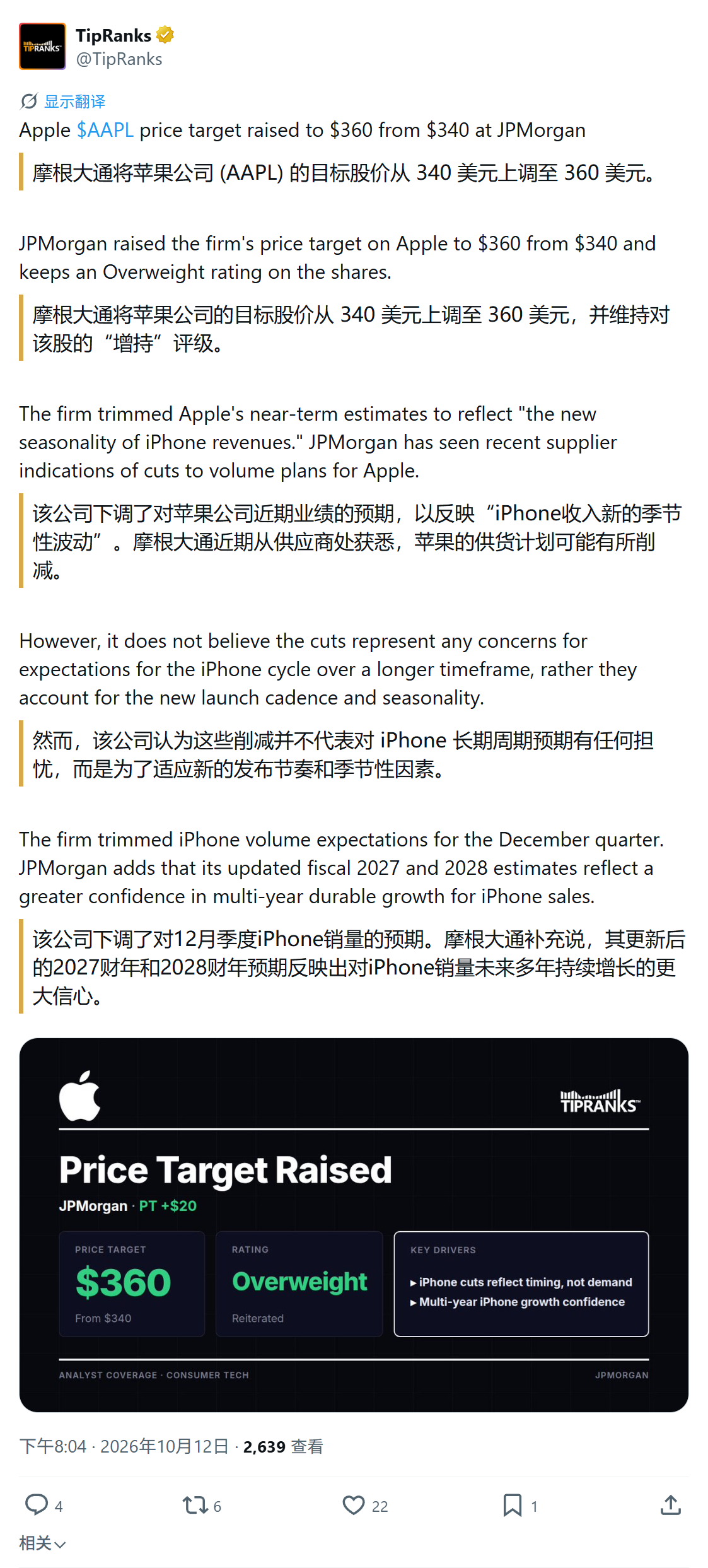
Apple, ranked 10th, saw a gain of 1.29%, with trading volume reaching 8.802 billion US dollars.
Apple has announced that it will hold a special "Welcome Home (Welcome Home)" event on Tuesday (October 13th), during which it is expected to launch new smart home products – this also marks Apple's latest updates in the smart home sector since John Ternus took over as Apple's CEO last month. It is reported that the devices to be released this time will include a new generation of Apple TV 4K, HomePod, mini, as well as a brand-new home hub device.
Tesla, ranked 11th, saw a decline of 1.22%, with trading volume amounting to 7.648 billion US dollars.
Intel, ranked 12th, saw a decline of 3.20%, with trading volume amounting to 7.481 billion US dollars.
Intel CEO Chen Liwu stated that the Token (term) cost of China's cutting-edge AI models is relatively low, and their adoption speed has always been very fast. Chen Liwu mentioned that the performance of China's AI models such as DeepSeek, Kimi, and GLM is already good enough, and he firmly supports open source, as it is the optimal path to improve efficiency. He also believes that the market will determine the application scenarios for different models.
Amazon ranked 14th, with a decline of 1.11% and trading volume of $6.906 billion.
Google A ranked 15th, with a gain of 0.30% and trading volume of 6.721 billion US dollars.