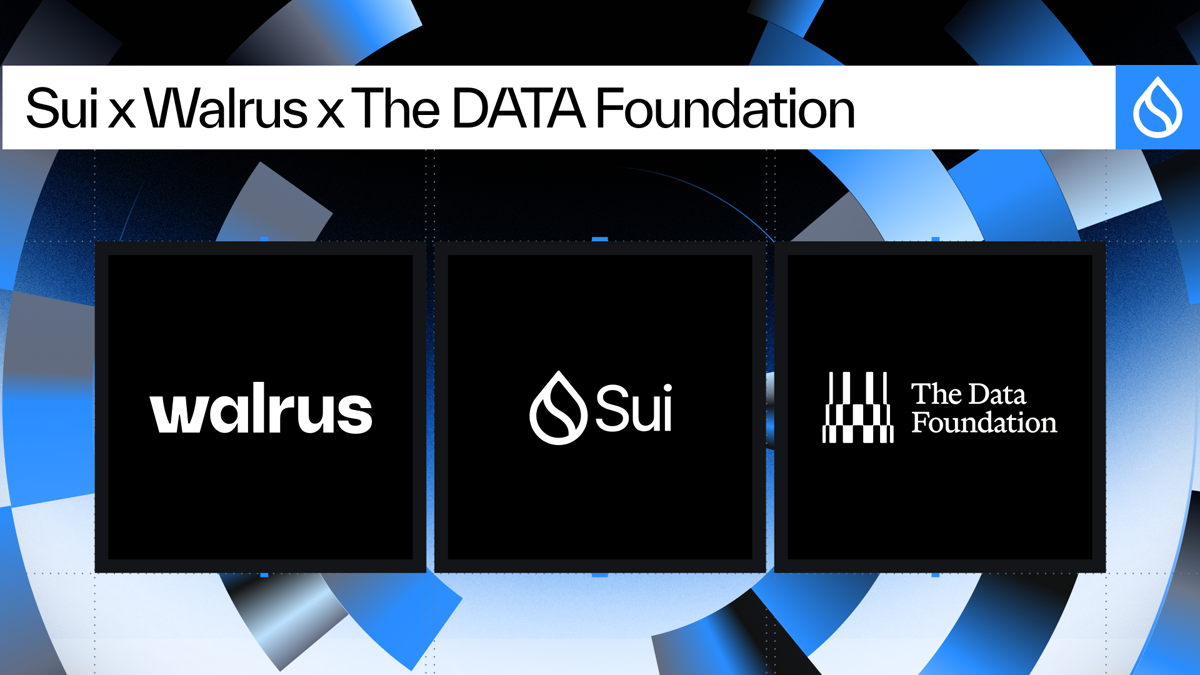


On October 12th, Sui announced that DATA Network would join the ecosystem of Sui and Walrus. The announcement covered a strategic investment of $30 million from Sui Foundation, as well as plans to gradually upgrade DATA Network's existing business to Sui and make Walrus the default data layer for DATA Foundation applications. This is an integrated plan with a clear direction, rather than being a completion news story about a closed chain where all data has already been migrated. For the AI data market, what is truly challenging is not just issuing a cooperation announcement, but rather ensuring that data sources, rights, and verifiable records are connected on a long-term basis.
DATA's subsidiary, Trace, has accumulated over 250 million contributions and more than 3 million receipts per day on average, according to the operational figures provided by the project team in their announcement. These figures indicate that the platform has reached a certain level of activity, but they do not independently prove that each piece of data has legal authorization or that the quality meets the requirements for model training, nor can they be used to estimate future revenue. Sui intends to integrate this business into its own network, both as a way to attract developers and trading activities, and also with the hope of providing Walrus's data capabilities with more real-world application scenarios.
Moving from an independent chain to Sui, the most important thing is the order of migration.
The announcement describes a phased upgrade: the applications and infrastructure of DATA Network will be transitioned to Sui; the existing independent chain is expected to be retired after the upgrade is completed. The term "after that" is crucial here. The official has not yet announced a final migration date that can be used to claim completion, and current users should not assume that their wallets, assets, and historical records have automatically moved to the new chain based on this news. Technical migrations often involve account mapping, contract reconstruction, indexing, node operation, and adjustments with external partners, and any error in any of these steps may result in a temporary inconsistency between the balance displayed to users and the backend records.
The announcement also states that the existing tokens will be carried over to the new environment in a one-to-one ratio. The proposed ratio indicates the quantitative relationship, which is not equal to the number of new tokens that can be claimed today, nor does it mean that any third-party links are trustworthy. The project team will need to provide an official migration path, timeline, contract address, supported wallets, and risk warnings later on. Users should not authorize the transfer of assets based on “pre-exchange” links found on social media before this information is fully disclosed. This is especially true for rewards related to data contributors; the migration is not only a technical issue but also affects whether their historical contributions will be correctly recorded.
Walrus has been selected as the default data layer for the DATA Foundation application, with the aim of providing storage and retrieval capabilities for a large amount of raw data. The Sui chain itself is suitable for recording states and transactions; however, massive files cannot be simply uploaded to the chain. It is more practical to keep the files on a dedicated data network, while on the chain, only verifiable references and rights relationships are preserved. However, "verifiable references" do not automatically mean that the data is genuine or that there is a license to use it. Hashes can only indicate whether the obtained files match a previously recorded version; they cannot determine whether a photo was taken by the person in question, whether text violates copyright, or whether the data contains personally identifiable information that should not be made public.
Officials mentioned that encrypted original files and hash values that can be recalculated in the future are of great value for auditing: if the authorization chain is clear, model developers can later verify whether a training material corresponds to the content initially submitted. The issue is that there is still a gap between “having this capability in the future” and “all historical data being verifiable today.” Key management, data withdrawal, version updates, and changes in permissions can all affect practical usability. Especially in the AI training scenario, traceability of the source does not mean that unauthorized data can be used legally.
What the data market needs is not more receipts, but a blockchain that allows for accountability.
Generative AI manufacturers require high-quality, licensable data, and data providers also hope to obtain measurable returns. The “contribution-receipt” mechanism of Trace attempts to keep a record between both parties; Sui and Walrus provide the transaction and storage infrastructure. However, whether the market will succeed depends on whether buyers are willing to pay a premium for clearer proof of rights, and whether contributors can truly understand the scope of authorization. If the system is only good at counting but unable to handle disputes, revocations, and re-licensing, billions of receipts may merely be operational indicators.
A $30 million investment is a bet by Sui Foundation in this direction; it does not mean that DATA's applications have already achieved equivalent revenue, nor does it mean that all the funds have flowed into on-chain transactions. The scale of this investment can help with team building, migration, and ecosystem development, but the verification of the ecosystem's value depends on the actual results delivered. Key indicators to observe include: whether the migration progress is made public, whether historical contributions and token mappings can be independently verified, the actual amount of data available on Walrus, whether third-party model developers are using this data, and whether there are clear rules for handling disputes that may arise. Without these pieces of data, it is insufficient to infer a complete business cycle based solely on the concepts of “AI + Web3” mentioned in the announcements.
For users with the identifier Sui, the practical significance of this news lies in the integration of an already operational AI data service plan, rather than expecting large-scale income to appear on the blockchain tomorrow. For contributors with the identifier DATA, the most important thing is to wait for official confirmation of the migration details, to preserve their existing accounts and contribution records, and not to grant authorization to unidentified contracts. As for investors, they should consider the current Trace activity level, future upgrade commitments, and truly verifiable business demands as three separate aspects. This collaboration brings data rights confirmation, storage, and settlement onto the same roadmap, but to move from this roadmap to a sustainable market, it will still need to go through technical migrations, rights audits, and verification of actual buyer purchases.