

In October, Bitcoin briefly broke above $87,000, and the crypto market appeared prosperous. But did you know that in September alone, global crypto platforms lost as much as $766 million to hacker attacks, the highest record of the year? In addition, Bitget exchange was hacked for approximately $388 million due to a third-party zero-day vulnerability, making it the most organized exchange attack so far in 2026. Facing such a security landscape, how should you choose a crypto exchange? Among the top five platforms—Binance, Kraken, Coinbase, OKX, and Bybit—which one is more suitable for your trading needs, from security defenses to fee structures?
2026 Top 5 Exchange Comprehensive Strength Ranking
According to FastBull's August 2026 global cryptocurrency exchange comprehensive ranking, the top five are: Binance (92/100), Kraken (89/100), Coinbase (88/100), OKX (87/100), and Bybit (85/100). These five platforms together account for about 75% of global CEX trading volume, but their positioning differs significantly.
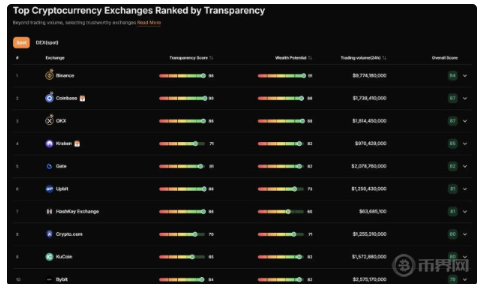
Image: FastBull August 2026 Global Cryptocurrency Exchange Comprehensive Ranking
Head Platform Landscape: Five Strong Contenders
Binance: 600+ coin coverage, A+ liquidity, overall top ranking. But in our view, regulatory compliance is the biggest variable. Its $4.3 billion settlement with the US Department of Justice in 2023 is still under deep review by an independent compliance monitor.
Kraken: Founded in 2011, zero platform-level security breaches to date, a security benchmark. But its Pro-level base fee of 0.25%/0.40% is higher than Asian competitors.
Coinbase: Nasdaq-listed, high compliance transparency, leading institutional custody. But base fees are relatively high, and regional restrictions are more numerous.
OKX: Spot fees of 0.08%/0.10%, the lowest in the industry; most frequent PoR disclosure, including Merkle tree verification, a clear differentiated advantage.
Bybit: Deep liquidity in derivatives, spot fees of 0.10%/0.10%, lower futures fees, attracting a large number of active traders.
From our perspective, no single exchange can simultaneously cover security, low fees, and all-scenario needs. Users must make trade-offs based on their own trading frequency and risk preferences.
Security and Fees: Deep Comparison of Core Dimensions in 2026
The five-strong exchange landscape is clear, but security and fees are key to asset survival. Below we look at their PoR and real fee rates.
Security Defenses: From PoR to Real-World Testing
In our view, Proof of Reserves (PoR) is the basic threshold for exchange security.
Binance's October 2026 update shows BTC reserve ratio at 100.35%, USDT at 103.88%, and USDC at 108.26%. All major assets are covered 1:1, and users can independently verify through zk-SNARKs. OKX has published PoR monthly since October 2022, using zk-STARK cryptographic proof technology, with reserve ratios maintained between 103% and 110%, audited by third-party security firms such as Hacken. Kraken uses Merkle-tree PoR, combined with its 14-year zero-security-incident record, earning an A-grade security rating.
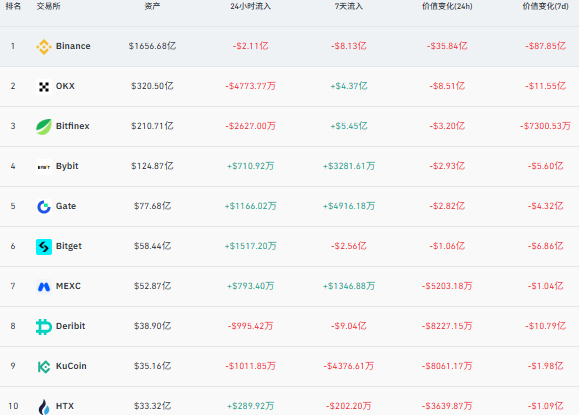
Image: Top 10 Crypto Exchange Asset Transparency Proofs
However, theoretical security architecture still faces severe tests in practice.
September 2026 became the most devastating month for crypto industry security. PeckShield and CertiK statistics show losses exceeded $766 million that month. Among them, Bitget exchange was hacked for approximately $388 million due to a third-party security product zero-day vulnerability. Although cold wallets and private keys were unaffected, and user balances were not damaged, we believe the incident still exposed systemic shortcomings in supply chain security at centralized exchanges.
Fee Comparison: Surface Rates vs. Actual Costs
From the table above, OKX and Binance have clear advantages in fees, while Coinbase's base fee (0.40%/0.60%) is almost five times that of OKX. But surface rates are not the full cost.
| Exchange | Spot Maker/Taker | Futures Maker/Taker | Special Offers | Security Score |
|---|---|---|---|---|
| Binance | 0.10%/0.10% | 0.02%/0.05% | 25% off with BNB | 9.5/10 |
| Kraken | 0.25%/0.40% | — | None | 9.2/10 |
| Coinbase | 0.40%/0.60% | — | Advanced can reduce to 0% | 8.8/10 |
| OKX | 0.08%/0.10% | 0.02%/0.05% | None | 9.0/10 |
| Bybit | 0.10%/0.10% | 0.02%/0.055% | Deep derivatives focus | 9.0/10 |
Coinbase's standard buy button also adds a spread of up to 1.49%, making actual trading costs far higher than the fee schedule suggests. Taking a monthly spot trading volume of $80,000 as an example, the annual fee on Kraken Pro Tier 1 is about $720, while Binance's annual fee for the same volume is only about $120, a 6x difference.
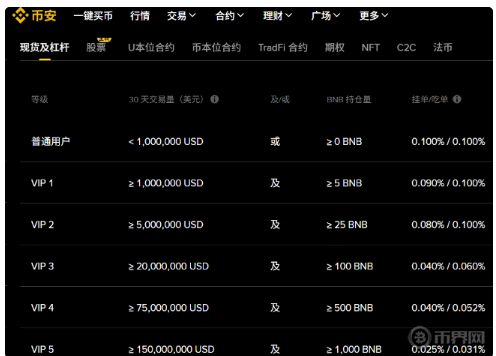
Image: Binance Exchange Fee Rates
Our view is that fee differences are sharply amplified in high-frequency trading scenarios, but low fees should not be the sole decision criterion. For example, Kraken's higher fees buy a trust premium from 14 years of zero security incidents, which is worth far more than the fees saved in extreme market conditions.
Scenario-Based Exchange Selection Strategy and Risk Warnings
After understanding exchange security and fees, choosing an exchange depends more on individual needs. We match strategies for three scenarios—holding, high-frequency trading, and derivatives—and highlight regulatory risks.
Matching Platforms by Need
Based on the above analysis, we recommend that 2026 exchange selection follow a "security-fees-scenario" three-dimensional decision framework:
| User Type | Recommended Platform | Core Reason |
|---|---|---|
| Long-Term Holders | Kraken or Coinbase | Leading security records and compliance transparency; the peace of mind is worth the premium |
| High-Frequency Traders | OKX or Binance | Low fees combined with deep liquidity significantly reduce trading costs |
| Professional Derivatives Traders | Bybit | Sufficient perpetual contract depth; 0.02% maker fee is industry-competitive |
Regulatory Risks Cannot Be Ignored
In February 2026, eight Chinese government departments, including the People's Bank of China, jointly issued the Notice on Further Preventing and Disposing of Risks Related to Virtual Currency and Other Activities (Yinfa [2026] No. 42), clarifying that virtual currency-related business activities are illegal financial activities. Overseas entities and individuals may not provide virtual currency-related services to domestic entities in any form. In the EU, the MiCA regulation fully took effect on July 1, 2026, reducing EU crypto operators to 244 licensed companies and requiring exchanges to stop providing stablecoin services that do not comply with MiCA standards by January 8, 2027.
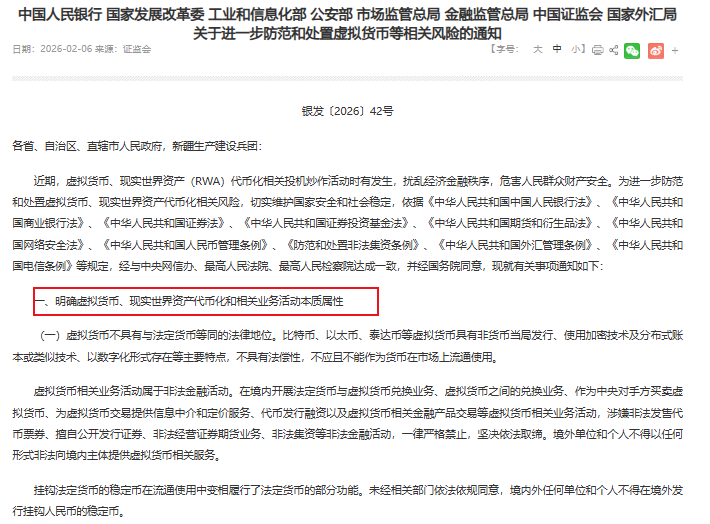
Image: Yinfa [2026] No. 42
It is clear that exchange compliance capability will become a more important long-term competitiveness indicator than fee rates. We recommend that users in mainland China fully understand the relevant legal risks, and overseas traders should also pay attention to the licensing qualifications of their chosen platform in the target market.
Crypto Exchange FAQ
Can stolen exchange funds be recovered?
Answer: Not necessarily; recovery rates are usually extremely low. Take the September 2026 Bitget incident as an example: approximately $388 million was stolen, but as of early October, only about $1.1 million had been frozen, and the frozen assets had not yet been returned to the exchange.
Can Proof of Reserves guarantee fund safety?
Answer: It cannot fully guarantee it. PoR only proves that platform assets covered user deposits at a certain point in time, but it cannot prevent hot wallet vulnerabilities or internal management oversights. The September 2026 Bitget incident is an example: the platform's PoR reserve ratio was 122%, but its hot wallet was still attacked. PoR is a security bottom line, not a sufficient condition.
Are small exchanges more dangerous than large ones?
Answer: Most likely yes. In 2026, multiple small and medium-sized platforms experienced withdrawal freezes or delays, such as WebSea and JuCoin, both of which have been involved in withdrawal disputes, with ordinary users and internal personnel receiving inconsistent withdrawal treatment.
Conclusion
The 2026 crypto exchange landscape is a multi-dimensional contest of security, compliance, and transparency. Through the comprehensive security and fee comparison in this article, we can clearly see: Kraken builds a trust barrier with its 14-year zero-security-incident record; OKX wins the favor of high-frequency traders with the industry's lowest fees and most frequent PoR disclosure; and the full implementation of MiCA regulations has filtered 244 licensed platforms from over 3,000 competitors. We recommend that every reader prioritize verifying a platform's PoR verifiability, confirm regulatory licensing qualifications, and adhere to the basic principle of "not storing all assets on a single platform."
Disclaimer: Readers are strictly advised to comply with local laws and regulations. This article is compiled based on public market data for reference and educational purposes only, and does not constitute investment advice. Follow CoinMeta for the latest updates.