Aptos has been launched on the mainnet, introducing a feature that allows users to hide the details of pending transactions before validators finalize the transaction ordering; meanwhile, its native token, APT, has fallen by more than 11% in the past 24 hours.
Aptos indicates that Encrypted Mempool has been launched on the mainnet, allowing for the protection of transaction details before validators complete the sorting process.
Users can enable transaction encryption separately, yet the sender's address and network fees will remain publicly visible throughout the process.
Aptos stated that in tests involving 50 verifiers, the system experienced an increase in latency of approximately 20 milliseconds.
Bitquery identified 6.9 million instances of the Solana sandwich attack during its investigation, which affected 2.2 million wallets.
Aptos confirmed that this feature will be launched on October 12th, stating that this optional feature is intended to protect traders from front-running, sandwich attacks, and other forms of maximum extractable value (MEV). The system will encrypt the content of transactions before they enter the network, preventing validators and external observers from viewing the relevant instructions while the transactions are waiting to be sorted. Once the block is finally confirmed, the validators will jointly decrypt its content and execute the transaction.
Aptos Encrypted Mempool Hide pending transactions to prevent bots from spying.
With this new feature, users can encrypt transaction instructions before submitting them to the Aptos blockchain. Details such as asset types, transaction amounts, and smart contract functions will be hidden while verifiers determine the order of transaction execution. The sender's wallet address and network fees remain visible throughout the process.
Aptos explains that trading robots typically monitor blockchain transactions to be processed in order to identify profitable opportunities before executing them. Some robots attempt to trade before large orders, while others execute trades before and after user transactions to profit from price fluctuations.
In the announcement, Aptos warns: "Robots use this visibility to trade with you or copy your strategies." The network states that the target users of Encrypted Mempool include institutional traders handling large transactions, individual users who wish to guard against MEV attacks, automated trading agents, as well as blockchain application developers.
The project describes this feature as a native implementation of the protocol, utilizing the existing Aptos validator network to simultaneously complete transaction sorting and decryption. Unlike systems that rely on external committees or private transaction builders, this mechanism operates through validators that are already responsible for ensuring the security of the blockchain.
As early as May 2026, Aptos outlined its plans to protect transactions from preemption, describing the proposed technology and its intended use in institutional trading at that time. The launch in October indicates that this feature has moved from the development stage to live operation on the mainnet.
Encrypted transactions require higher gas fees.
In the new system, compatible wallets will first encrypt transaction instructions on the user's device before sending them to the network. Subsequently, verifiers reach an agreement on the transaction order without knowing the hidden content. Once block consensus is achieved, the verifiers will merge their respective decrypted shares to restore and execute the transactions.
Aptos indicates that no single verifier is capable of decrypting pending transactions independently. Its encryption model requires the participation of a majority of verifiers calculated based on their stake weights, which adheres to the security assumptions used by the existing consensus mechanism of that blockchain. This implementation is documented in AIP-144, which is the technical proposal regarding the processing of encrypted transactions on the network.
According to the project developer's documentation, the minimum price for each gas unit of encrypted transactions must be 200 octas, which is twice the network's basic minimum value. In addition, each transaction incurs an additional decryption cost of 375 gas units, and this fee is calculated separately from the gas consumed in executing the transaction command.
Online reports indicate that in tests involving 50 nodes, each block experienced an average increase of about 20 milliseconds in latency. Aptos It should be noted that this result was obtained by comparing it with the AptosBFT consensus mechanism used in its production environment, which typically completes the final confirmation of a block in less than 1 second. Before going live, this encryption system also underwent independent security audits by ZKSecurity.
For developers, Aptos has introduced support for encrypted transactions through the TypeScript software development toolkit version 7.0.0 and later. Existing Move smart contracts can support this feature without any modifications. Petra is the first wallet to directly provide encrypted functionality within the transaction signing process, while the perpetual contract exchange Decibel based on Aptos plans to use it for private pending orders.
Aptos aims to counter the 'sandwich attack' that causes traders to lose millions of dollars
This launch is stemming from research on the financial losses caused by automated trading manipulation across blockchain networks. In a 'sandwich attack', robots identify upcoming transactions, buy the target assets before users execute them, and then sell them at a higher price afterwards.
Blockchain analysis firm Bitquery identified that between October 30, 2025, and October 7, 2026, approximately 6.9 million 'sandwich attacks' occurred on Solana. Their investigation found that over these 11 months, 2,545 bot wallets targeted around 2.2 million wallets, and before deducting transaction costs, they stole a total of 29.7 million US dollars.
Other blockchain projects have also introduced different transaction protection schemes. Flashbots Protect of Ethereum directs transactions to private infrastructure, while Gnosis Chain uses the encrypted memory pool technology of Shutter. Aptos indicates that the difference in their implementation lies in the fact that the existing set of validators is responsible for both transaction sorting and decryption.
In addition to Encrypted Mempool, this network also offers Keyless Accounts and Confidential APT as independent optional privacy features. The former addresses account access issues, while the latter hides transfer amounts that meet certain criteria. Encrypted Mempool focuses on hiding transaction instructions before they are executed, although information about completed transactions can still be publicly audited.
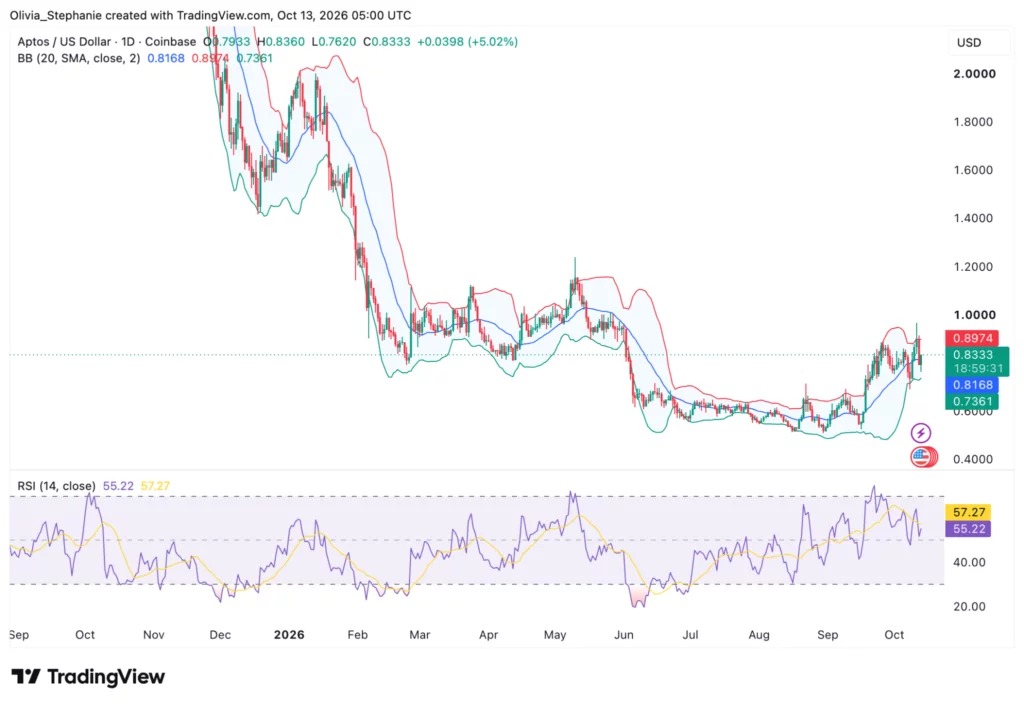
Despite the mainnet going live, the price of APT has still fallen below $0.80.
After the feature was launched, APT continued to face selling pressure, trading at $0.7995, a decrease of 11.5% over the past 24 hours. According to CoinGecko data, the token's trading range during this period was from $0.7974 to $0.9135, with a trading volume of nearly $98.91 million and a market value of about $697.14 million.
Meanwhile, the previous Relative Strength Index ( RSI ) reading was 54.87, indicating a slightly positive momentum before the latest decline. This RSI was still below its signal average of 57.25, suggesting weaker buying momentum at that point in time. The APT subsequently fell below $0.80, also bringing it below its previous 20-day moving average; however, to confirm the current technical position, new indicators need to be recalculated.
In May this year, Aptos Foundation and Aptos Labs committed to investing over $50 million in the development of their ecosystems, which includes transaction infrastructure, AI agents, and blockchain research. The plan encompasses Decibel and Shelby; both institutions support financial applications and automated systems built on Aptos.
The project indicates that Decibel has exceeded a cumulative trading volume of 1 billion US dollars during its development period, while Shelby is being built for data-intensive applications. Under the newly released Encrypted Mempool system, Aptos confirms that Decibel will use encrypted transactions to hide order details until execution, and Petra will provide users with the option to enable encryption when signing transactions.
Disclosure:This article does not constitute investment advice. The content and materials in this article are for educational purposes only.