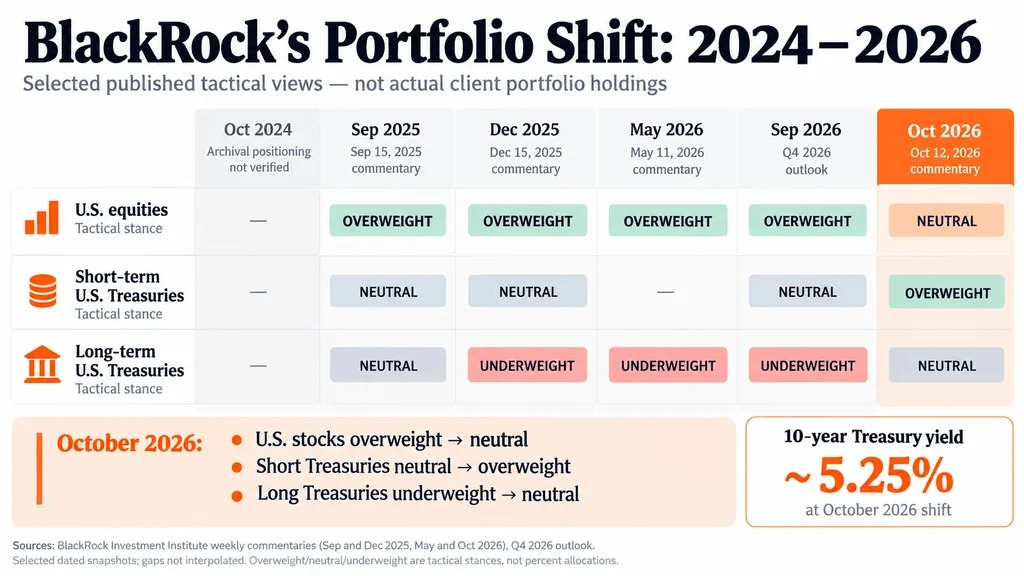
BlackRock has downgraded its outlook on U.S. stocks from 'overweight' to 'neutral' due to increased market volatility, and as investors re-evaluate the risks surrounding artificial intelligence, the returns on government bonds are becoming increasingly attractive.
In its market commentary on October 12, the world's largest asset management firm upgraded its rating of short-term U.S. Treasury bonds to "overweight" and downgraded long-term Treasury bonds to "neutral." This adjustment came as the yield on 10-year U.S. Treasuries rose to around 5.25%, offering investors yields significantly higher than in previous years.
BlackRock reduces stock exposure as U.S. Treasury yields rise to 5.25%
BlackRock is reducing its "long position" in U.S. stocks that it has held for a long time in order to provide funds for increasing its exposure to U.S. Treasury bonds. The company now prefers government bonds with shorter maturities, as these bonds not only offer returns but also reduce sensitivity to further interest rate hikes.
This decision was made after significant changes in the bond market. Since October 2020, BlackRock has maintained a "reduce holdings" stance towards long-term U.S. bonds, at a time when the yield on 10-year bonds was still below 0.9%.
Currently, with a yield of around 5.25%, government debt has become a more competitive alternative to stocks. This reversal is particularly noteworthy for those investors who still prefer stocks despite rising borrowing costs and high valuations.
When the NASDAQ index set a new high despite U.S. Treasury yields exceeding 5.3%, this pressure became evident, highlighting the market's high dependence on large technology companies.
AI Stock Volatility Brings More Pressure to the U.S. Market
As the AI stock once again faces selling pressure, this difference becomes even more important. During trading on Monday, all 30 constituent companies in the PHLX Semiconductor Index fell, with NVIDIA's stock price declining by approximately 1.7%.
Concerns regarding the return on investment in infrastructure surrounding AI have also dragged down semiconductor valuations. Previously, uncertainties over the revenue prospects related to OpenAI led to declines in the stock prices of NVIDIA, AMD, and other technology companies.
The decision of BlackRock reflects these broader risks, but it does not mean that the investment cycle of AI has come to an end.
What does downgrading the rating to S&P 500 mean for BlackRock?
This adjustment came before the release of the U.S. inflation report on Wednesday, and the data could affect the Federal Reserve's expectations and U.S. Treasury yields.
If inflation exceeds expectations, it may further suppress technology stocks with higher valuations, especially at a time when the high weight of AI makes the S&P 500 increasingly dependent on a few companies.
Ethan Mercer
Ethan Mercer is a financial journalist who covers cryptocurrency, stocks, and the global economy. He studied economics and finance before turning to market reporting, with a particular focus on Bitcoin, stocks, monetary policy, and investor sentiment. His work primarily explains daily market fluctuations and the broader trends behind them.