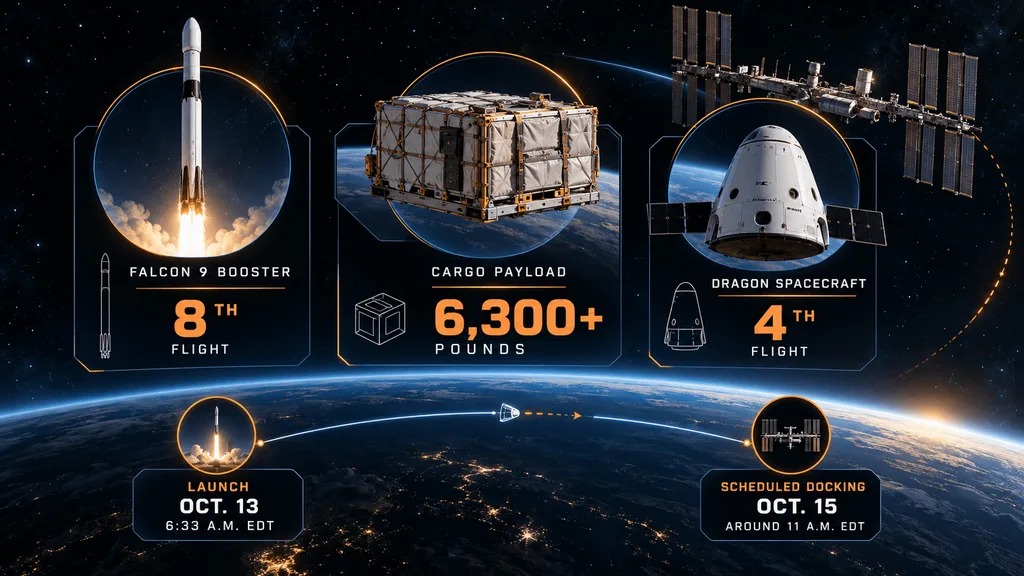
SpaceX successfully launched its 35th commercial resupply mission for NASA on October 13th, delivering over 6,300 pounds of scientific equipment, supplies, and hardware to the International Space Station ( ISS ).
SpaceX Falcon Launches 6,300 pounds of cargo to the International Space Station
According to the official announcement of NASA, the Dragon spacecraft separated from the second stage of the Falcon rocket about 9 minutes after liftoff, beginning its journey to this orbital laboratory.
As planned, the spacecraft will autonomously dock with the Harmony module of the space station around 11 a.m. on October 15th, Eastern Time, after approximately 52 hours of flight.
The cargo carried this time includes the final two sets of Roll - Out Solar Arrays (expandable solar panel arrays) for the International Space Station, which will help to enhance the space station's power generation capacity once installed.
NASA also transported equipment used for experiments with artificial retinas, three-dimensional heart tissues, and brain organoids. These studies may contribute to vision restoration, drug testing, and research on neurological diseases.
It is expected that the spacecraft will dock at the space station until mid-November, after which it will bring scientific samples and other materials back to Earth.
Reusable Falcon Completed the eighth task.
This launch also demonstrates the importance of reusable hardware for the commercial operations of SpaceX.
According to the task details of SpaceX, this is the eighth flight for the Falcon 9-stage booster, which has previously supported military, scientific, and Starlink launch missions.
At the same time, this is the fourth flight of the Dragon spacecraft. Previously, it has completed the CRS-26, CRS-29, and CRS-33 missions for the NASA.
Reusing boosters and spacecraft allows SpaceX to spread the costs of hardware research and development as well as manufacturing over multiple missions, however, there are still expenses associated with refurbishment, launch operations, and recovery.
This business model contrasts with the company's longer-term Starship ambitions, which rely on a much larger set of reusable rocket systems.
Why are the tasks of NASA and SpaceX so important to their business?
In addition to the International Space Station supply contract, the Falcon Heavy mission of SpaceX also demonstrated its capability to carry out higher-energy scientific launches using reusable rocket technology.
Its continuously expanding launch service portfolio also supports the deployment of Starlink satellites, and the future launch infrastructure remains at the core of its long-term expansion strategy.
Adrian Cole
Adrian Cole has been engaged in financial market reporting for over 6 years, with a focus on cryptocurrencies, stocks, and macroeconomic trends. He tracks Bitcoin, major altcoins, the U.S. stock market, interest rates, commodities, as well as data points that affect the market. Over the years, he has written hundreds of market updates and analysis articles, with an emphasis on price trends, investor sentiment, and the connections between traditional finance and digital assets.