The wave of selling in chip stocks, which had just eased during trading on Tuesday, intensified again on Wednesday. Storage chip stocks such as Micron Technology and SK Hynix weakened once more, and the industry benchmark, the Philadelphia Semiconductor Index (SOX), tumbled more than 4% at one point during trading, setting the stage for a sixth consecutive day of declines.
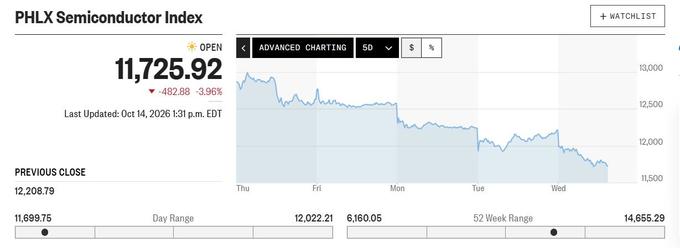
The media pointed out that with concerns such as rising interest rates, high valuations, and high costs of AI infrastructure construction accumulating, the total market value of SOX constituent stocks is at risk of evaporating by over $1 trillion. On Wednesday, March 14th, Eastern Time, when SOX fell by more than 3%, the index's cumulative decline over the past six trading days reached 10%, and more than half of the SOX constituent stocks saw a decline of at least 10% within those six days.
This round of adjustments is evolving from a short-term profit-taking exercise to a comprehensive test of the investment logic behind AI. In September, U.S. CPI inflation exceeded expectations, further reinforcing market concerns that the Federal Reserve may continue to raise interest rates; Broadcom's CEO Chen Fuyang had previously warned that the industry might face capital constraints; and even though the leading semiconductor equipment company ASML delivered strong performance and raised its full-year sales forecast, it was not able to effectively boost chip stocks.
What the market is truly questioning is no longer just whether the demand for AI is strong, but whether the huge capital expenditures can be transformed into sustainable profit growth, and whether the current valuation has already overdrawn future earnings.
SOX Facing Six Consecutive Drops, Global Chip Stock Market Value at Risk of Evaporating Trillions of Dollars
During Wednesday's trading session, the Philadelphia Semiconductor Index hit a new daily low, with a decline of nearly 4.2%, setting the stage for a sixth consecutive day of losses. This marks the longest streak of consecutive daily declines since May 2025.
At the individual stock level, the adjustments have spread from memory chips to the fields of chip design and manufacturing equipment. Bloomberg data shows that over the past six trading days, more than half of the constituent stocks of SOX have seen a decline of at least 10%. Arm ( ARM ) has fallen by nearly 20% during the same period, Applied Materials ( AMAT ) has fallen by about 15%, Intel ( INTL ) has fallen by about 11%, while GlobalFoundries ( GFS ) is the only constituent stock that has risen during this period.
During midday trading on Wednesday, Arm fell by more than 6%, and Intel fell by more than 4.6%. After the decline in storage stocks eased during midday trading on Tuesday, they weakened collectively again: SK Micron's U.S. stock (SKHY) fell by more than 5.8% at one point, SanDisk (SNDK) fell by 4.9%, Micron Technology (MU) fell by 3.5%, and Western Digital (WDC) and Seagate Technology (STX) both fell by more than 3% during the session.
From South Korea and Japan to the United States, stocks in the storage chip sector have previously undergone significant adjustments. Now, the downward trend has further extended to chip design and equipment manufacturers, indicating that investors are reducing their risk exposure to the entire semiconductor sector.
Bloomberg pointed out that based on recent declines, the constituent stocks of SOX are at risk of losing more than $1 trillion in market value. This does not mean that the entire related market value has evaporated, but rather that if the downward trend continues, the global semiconductor industry may face an astonishing valuation pullback.
Inflation heats up, concerns about interest rate hikes resurface, and the high valuations of AI are under pressure.
One of the factors driving the continued decline in chip stocks is the tightening of the macro interest rate environment once again.
U.S. inflation data in September exceeded market expectations, with consumer price increases reaching their highest level since April, with rising fuel costs being a major driving factor. This data has strengthened market expectations for the Federal Reserve to possibly raise interest rates further in the future. Even if the Fed decides not to take any action at its later meetings this month, investors' views on the future interest rate path have already changed.
For technology stocks with high valuations and profit expectations that rely heavily on future growth, rising interest rates mean a decrease in the discounted value of future cash flows, as well as an increase in the costs for companies to raise funds and expand. Semiconductor companies benefit from the AI infrastructure construction, but they also face substantial capital investments and longer return cycles, making them particularly sensitive to changes in interest rates.
At the same time, the AI transaction itself is also facing re-examination. Broadcom's CEO Chen Fuyang compared some of the investors who were caught up in the AI craze earlier this week to casino gamblers and warned that the industry might face capital constraints. This statement has further exacerbated market concerns about the sustainability of the AI investment boom.
In the past few years, investors were willing to pay high valuations for the rapidly growing demand for computing power; today, the market has begun to more rigorously assess a company's financing capabilities, the scale of capital expenditures, and the speed at which actual profits are realized. When inflation drives up interest rate expectations, rising funding costs coincide with valuation pressures, even if the long-term demand in the industry remains strong, related stocks may still experience significant adjustments.
ASML has strong performance, so why can't it still save chip stocks?
This week, as the decline in chip stocks intensified, ASML, a leader in semiconductor equipment, announced strong quarterly results and raised its annual sales forecast. Customer demand for equipment is also quite robust for the coming years. However, this financial report still failed to reverse the downward trend of the entire chip sector.
Barron's Weekly analyzes that the key point is that ASML is located in the upstream of the semiconductor industry chain. The strong demand for its lithography equipment indicates that chip manufacturers are still planning to expand production capacity, but it does not directly prove that the downstream customers of chip manufacturers will continue to purchase chips at the same rate.
Customers of ASML include chip manufacturers such as TSMC and Intel, while the key end-users driving the current AI investment cycle are large cloud service providers like Microsoft, Google, Amazon, and other ultra-large data center operators. For chip manufacturers, equipment orders and long-term production capacity planning are certainly important, but what directly affects revenue and profit is whether downstream customers can continue to purchase chips, and whether these purchases can generate sufficient returns.
ASML Strong performance indicates that the demand for related equipment AI still has resilience, but this does not completely dispel market concerns about the efficiency of AI capital expenditure. In other words, the visibility of orders from equipment manufacturers and the realization of profits by chip companies are not the same thing.
In addition, the strong demand for ASML could have another impact: if the tight supply of equipment drives up product prices, the future equipment procurement costs for customers such as TSMC and Intel may also increase accordingly. For companies that already need to invest substantial funds in building advanced manufacturing capacity, this could further increase the pressure on capital expenditures.
Therefore, the fact that the ASML financial report failed to boost the entire chip sector does not necessarily mean that demand for AI has weakened. Instead, it indicates that the market is no longer satisfied with just seeing growth in upstream orders; it also hopes to confirm that the entire industrial chain can achieve sustainable profits from investments in AI.
Wall Street cuts forecasts: AI investments need to shift from expenditure to profitability
Ulrike Hoffmann-Burchardi of UBS's Chief Investment Office pointed out in a research report on Wednesday that the pressure on global chip stocks has been increasing recently. She believes that intensified competition in the AI sector, rising financing needs, and higher interest rates may all occasionally amplify market volatility, but this round of adjustments is more like a recalibration of market expectations rather than a fundamental break in the AI investment logic.
This judgment reflects the current divisions in the market: on one hand, the infrastructure construction led by AI is likely to continue for many years; on the other hand, investors are beginning to question whether the growth rate of capital expenditure is sustainable, and whether the resulting returns can meet the previously overly high expectations.
Bloomberg points out that the next important observation window for the market is an investor event reportedly to be held in San Francisco on Anthropic this Wednesday. Wall Street hopes to gain insights into the revenue growth rate of this AI company from its disclosures, in order to more accurately assess whether the revenue growth of AI can support the continuously expanding expenditure on computing power.
UBS advises investors to focus on whether the expenditures associated with AI can indeed be transformed into sustainable profit growth, as well as whether the application of AI at both the corporate and consumer levels continues to expand. Compared to simply tracking the scale of capital expenditures, these indicators are more helpful in determining whether the current investment boom can lead to stable commercial returns.
If AI companies are able to continuously expand their revenue, improve their profitability, and demonstrate that the substantial investments in infrastructure yield reasonable returns, then the current adjustments may be more about recalibrating valuations and expectations. Conversely, if spending grows faster than revenue and cash flow improves, the market's tolerance for high valuations may further decline.
The performance of AI has not yet been disproven, but the market is raising the threshold for returns.
From the continuous decline of SOX, to the lack of sector rebound brought about by the strong financial reports of ASML, and then to the renewed pressure from inflation and interest rate expectations, the current chip stock market indicates that investors are shifting from chasing AI growth to examining the actual economic returns of AI investments.
This does not mean that the demand for AI has collapsed. The order and sales prospects for ASML still indicate that there is strong resilience in the demand for semiconductor equipment. However, for chip manufacturers and AI infrastructure companies, the market now requires more substantial evidence to prove that the increasing capital expenditures can lead to corresponding revenue, profits, and cash flows.
Against this backdrop, a potential market value loss of over one trillion dollars not only reflects the scale of recent sales but also highlights a change in market pricing logic: AI may still be an important driver of long-term growth, but related companies can no longer rely solely on their growth stories to obtain valuation premiums.
Next, the revenue growth rate, return on capital expenditure of AI companies, as well as their financing capabilities in a high-interest-rate environment, will become key determinants of whether chip stocks can stabilize.