In the AI arms race, Apple, which deliberately maintained restraint, was the first to reach the summit of $5 trillion.
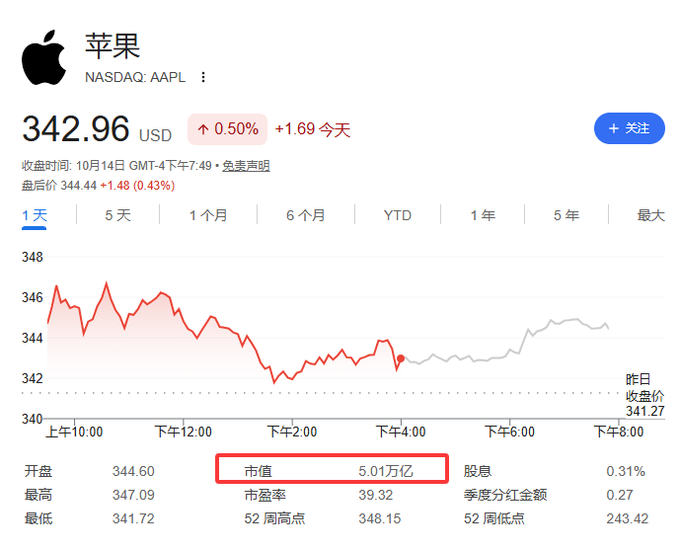
On Wednesday, Apple's market value at the close of trading officially exceeded $5 trillion, making it the second company in the world to surpass this milestone, following chip giant NVIDIA. According to Dow Jones Market Data, Apple's market value at the close of trading that day was $5.005 trillion, and its stock price reached a record high.
It is worth noting that this breakthrough occurred against the backdrop of overall pressure on U.S. stocks – on that day, the S&P 500 index fell by 1.1%, the Nasdaq 100 index tumbled 2%, and the chip index experienced six consecutive declines. Tech giants such as NVIDIA and Meta all saw losses of over 3%.
Previously, Apple had reached the $5 trillion mark six times during July, but was unable to hold that level at the close of trading. It wasn't until Wednesday that they finally broke through that milestone. This timing coincides with the end of the Tim Cook era and the beginning of the new CEO John Ternus era.
The legacy left by Cook
Cook officially stepped down on August 31 of this year, having held leadership over Apple for a period of 15 years.
During this period, Apple's market value increased by 13 times. Annual iPhone sales nearly quadrupled. The annual revenue from its service business grew from $10 billion to over $100 billion. The combined annual revenue from the Apple Watch and AirPods product lines exceeded $30 billion. At the same time, Apple has repurchased shares and distributed dividends totaling over $1 trillion.
Analysts point out that the reason why Apple's stock can trade at a premium to the overall valuation of the S&P 500, despite its revenue growth rate being lower than the index average, lies in the market's perception of it as a highly defensive asset with high certainty.
The core logic of the Cook model lies in strict control of capital expenditures. While tech giants such as Microsoft, Google, and Meta are competing to spend enormous amounts of money building data centers during the AI boom, Apple has always focused on hardware devices and high-profit services. The value of this strategy has become even more evident in the AI era.
The price increase logic has been recognized by the market.
Apple is currently facing a real pressure: the demand for memory and storage chips in data centers has surged, leading to a shortage in supply, and the cost of chips used in iPhone, Mac, and iPad has risen significantly.
Apple's response was to raise prices across the board, including for the older iPhone models which are usually discounted.
There are theoretical risks to this measure – consumers may delay upgrading their devices. However, since the initial price increase, Apple's stock price has risen by 25% in total.
An analyst from Bank of America, Wamsi Mohan, interprets this as follows: “Investors believe that Apple users will be willing to accept higher prices, and even if profit margins decline, Apple’s overall profit volume could remain stable or even grow.” He also added that Apple’s upcoming foldable new devices, iPhone and Duo, are expected to be well-received by the market, and the brand-new Siri AI will also drive users to upgrade their devices.
AI: The Untimely Death of Achilles' Heel
AI has long been a weakness of Apple that has been criticized by the outside world.
Apple's attempts to develop its own cutting-edge large models ended in failure, and Siri was also left far behind after ChatGPT emerged. According to The Wall Street Journal, Apple released a new version of Siri this fall that utilizes Google's technology, but it still lags behind its competitors in several key indicators.
Apple's advantage lies in the fact that the new Siri is directly embedded within the iPhone used by billions of users every day, and Apple possesses a large amount of personal data, which theoretically could be utilized to create more attractive AI features.
But the threat is approaching. OpenAI is preparing a series of hardware devices driven by AI and has poached hundreds of employees from Apple. In July this year, Apple filed a lawsuit against OpenAI on charges of stealing trade secrets. OpenAI responded, stating that "there is no evidence to support this lawsuit," and in new legal documents on Wednesday, it alleged that Apple had poached one of its employees who took confidential documents with them when they left. Apple, however, said that it has not found any evidence to support these new allegations.
The Wall Street Journal points out that AI will be the main battlefield for Ternus to prove its own value – it will either usher in a new era of innovation and growth for Apple, or watch helplessly as the company that defined the way human-computer interaction works lose its iconic status.
A market value of $5 trillion is the starting point that Cook has given to Ternus, and it is also a benchmark that he must maintain and surpass.