Bespoke Investment Group This week, in the latest survey by the National Federation of Independent Businesses ( NFIB ) in the United States, a concerning trend was discovered: an increasing number of small businesses are listing "weak sales" as their "number one problem." The asset management firm stated that among all the options surveyed, "weak sales" is what businesses least wish to face as their primary issue. "During previous economic downturns, we saw a significant rise in this 'weak sales' indicator. As shown in the chart below, although it is still relatively low at present, it has recently begun to pick up again."
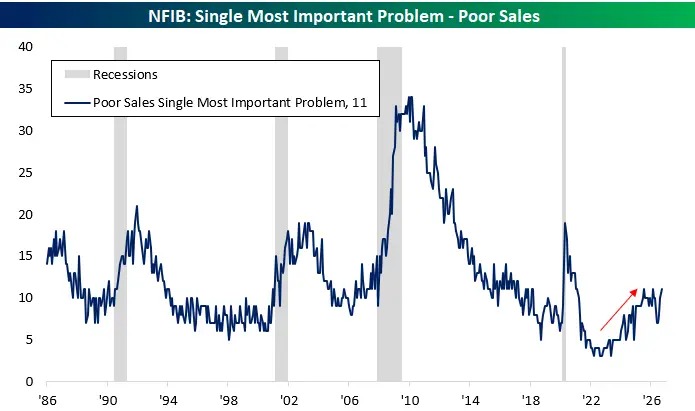
NFIB The index fell to 97.9 in September, lower than 98.7 in August. Samuel Tombs and Oliver Allen from Pantheon Macroeconomics indicate: "Other major business surveys also generally show that the momentum of activity weakened slightly at the end of the third quarter, possibly due to the rebound in global energy prices." They also noted that only 411 companies responded to this survey, which is lower than the approximately 1,200 companies that responded ten years ago.
Employment growth outside of healthcare is "almost zero"
Moody's Analytics believes that the U.S. economy is "fragile." He is particularly concerned about the labor market: "Over the past year, the average monthly non-farm employment growth has been around 40,000; if we exclude the healthcare industry, the growth is almost zero. Recruitment has stagnated, and working hours are very low. Moreover, although the unemployment rate remains low, this reflects a decline in labor force participation [due to increased retirements and reduced immigration]," he recently told Goldman Sachs's Allison Nathan.
In addition, he is also concerned that the higher interest rates required by the Federal Reserve and the bond market could drag down AI capital expenditure. "As capital costs rise, investment becomes more expensive, and declining valuations make it even more difficult to raise the capital needed to maintain the current AI construction pace, AI capital expenditure also faces vulnerabilities," he said. "If interest rates remain at the current level or higher for more than a quarter or two, AI could become the factor that drags down the economy."
Inflation out of control: "We have to end two wars before we see any relief"
A scenario of "higher and longer" interest rates seems to be taking shape. In September, the Consumer Price Index ( CPI ) rose by 3.7% year-on-year, higher than the 3.4% of the previous month and also exceeding analysts' expectations. The Federal Reserve may feel the need to raise interest rates further.
The Jamie Cox of Harris Financial Group stated in an email to Fortune: "Inflation is 'adding fuel to the fire.' The sources of the inflationary shocks are now very clear, but before we see any relief, we must first end two wars. The Federal Reserve made the mistake of calling inflation temporary during the COVID period, and it now seems that they are preparing to make the same mistake in reverse regarding the energy supply shocks."
The Tiffany Wilding of Pimco also expressed concern: "This is not a positive data point for the Federal Reserve. Members of the Federal Open Market Committee have been hinting that it is unlikely they will raise interest rates later this month. After the release of the CPI report, the market estimated a 50% probability of another interest rate hike by the central bank in October."
Traders selling tech stocks triggered global selling pressure
In the past 24 hours, traders seem to have suddenly lost interest in tech stocks, leading to a global sell-off. The South Korean KOSPI index, which has a high weight of tech stocks, fell by 8%, and trading was temporarily suspended at one point during the session. Nasdaq futures fell by 1.03% this morning, indicating that the sell-off may continue after the opening of trading in New York. CoreWeave fell by 15.46% yesterday and then another 5.89% overnight; Oracle fell by 8.83%, and continued to decline by 1.57% in after-hours trading. Chip manufacturers generally saw significant declines.
Ironically, despite some positive news in that sector, selling still occurred: Chip manufacturer TSMC ( TSMC ) reported better-than-expected third-quarter results today and indicated that capital expenditures will increase over the next two years. In addition, Apple's stock price closed at a record high, making it the second company with a market value of $5 trillion, following Nvidia. Anthropic stated that the company achieved profitability (on an adjusted basis), although its revenue growth ($17 billion in the third quarter) seemed slower than previously estimated.
This volatility also extended to the bond market, where investors found it difficult to determine whether the benchmark U.S. 10-year Treasury bond was serving as a safe-haven asset or providing a risk premium. The yield on this Treasury bond once rose to 5.32%, before falling back to 5.08% this morning – which is a significant fluctuation for an asset that is usually stable.
S&P 500 index futures fell 0.24% this morning. The index fell 1.11% yesterday.
In Europe, the Stoxx index fell by 0.10% in the early session, while the UK FTSE 100 index rose by 0.48% before lunch.
Asian markets: South Korea KOSPI fell 7.57%; Japan's Nikkei 225 fell 4.90%; India's Nifty rose 1.68%; China's CSI 300 fell 1.23%.
Brent crude oil is priced at $106 per barrel.
Bitcoin fell to $81,265.