Key Points
- TSMC expects its revenue in the fourth quarter to reach up to $54.3 billion.
- Despite record demand for semiconductors, AI chip stocks still saw a decline.
- Rising financing costs are threatening market confidence in investments in AI.
Taiwan Semiconductor Manufacturing Co., Ltd. ( NYSE : TSM ) expects its revenue in the fourth quarter to reach up to $54.3 billion. This indicates that despite the sell-off of semiconductor stocks on a global scale, the demand for artificial intelligence chips remains strong.
The world's largest wafer foundry released the above outlook on October 15th. Previously, the company reported third-quarter revenue of $46.72 billion and a record net profit of approximately $23.6 billion. However, TSMC's stock price fell by about 2% in Taiwan, and NVIDIA, AMD, as well as other chip stocks, once again faced selling pressure.
This contrast highlights an increasingly widening divide: on one hand, there is the financial performance of semiconductor companies; on the other hand, there are investors' concerns about the sustainability of the investment boom in AI.
TSMC expects its revenue in the fourth quarter to reach up to $54.3 billion.
According to TSMC's official financial data, revenue for the fourth quarter is expected to be between $52.3 billion and $54.3 billion.
Calculated at a median of $53.3 billion, this guidance indicates a month-on-month increase of about 14% and a year-on-year increase of 58%.
The company has also raised its annual revenue growth forecast to approximately 44% in US dollars, which is higher than the previous forecast of around 40%.
Its latest 2-nanometer manufacturing technology contributed 8% of wafer revenue in the third quarter, while in the second quarter this proportion was only 3%.
However, expanding the production capacity of advanced manufacturing processes is costly. TSMC expects its gross margin for the fourth quarter to be between 65% and 67%, and the initial mass production costs for 2-nanometer technology, as well as the expansion of overseas factories, may put pressure on profitability.
Investors question the spending boom, AI chip stocks fall
Despite TSMC's strong outlook, semiconductor stocks continue to face pressure in major global markets.
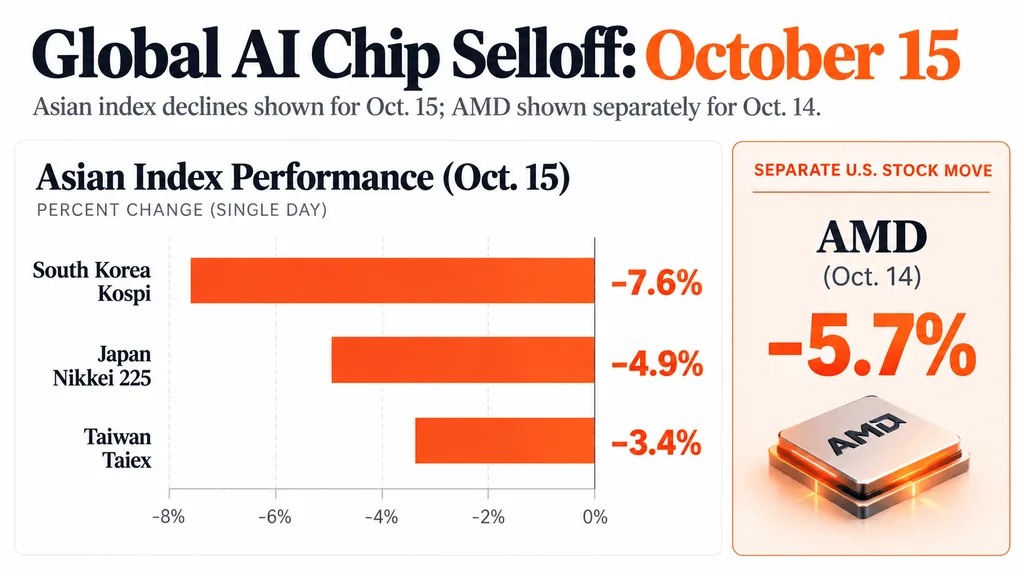
On October 15th, the South Korean Composite Stock Price Index ( Kospi ) fell by about 7.6%, the Japanese Nikkei 225 Index fell by 4.9%, and the Taiwan Weighted Index ( Taiex ) fell by 3.4%.
In the U.S. market, following the decline in the tech sector on Wednesday, NVIDIA, Broadcom, and AMD also faced selling pressure.
This decline continues the broader wave of selling off AI chips. Previously, despite the strong quarterly performance of Dutch equipment manufacturer ASML (ASML), its stock price was also affected.
Investors are increasingly questioning whether tech companies can obtain sufficient returns from the billions of dollars invested in data centers, specialized processors, and power infrastructure.
TSMC maintains a capital expenditure of up to $64 billion
TSMC still maintains sufficient confidence in future demand and has kept its capital expenditure budget for 2026 unchanged at $60 billion to $64 billion.
Management expects that in the coming years, investment will continue to increase as customers' demand for greater manufacturing capacity and advanced packaging technologies rises.
The company also outlined its large-scale expansion plans in Arizona. As the strategic importance of the semiconductor supply chain increases, TSMC has also raised its long-term investment commitments in the United States.
However, if AI customers ultimately slow down their ordering pace, the continuous rise in capital expenditures will also pose risks.
The author, Ethan Mercer, mentioned at the end of the article that he is a financial journalist who covers cryptocurrency, stocks, and the global economy, with a focus on Bitcoin, stocks, monetary policy, and investor sentiment.