

In this financial reporting season, investors may start to have fewer complaints about the capital expenditures of large technology companies.
As the third-quarter financial reports approach, the largest spender in the AI sector may be able to breathe a little easier, thanks to Meta's agent-based AI product Muse. Compared to traditional chatbots that have become ubiquitous over the past four years, this product represents a step forward for AI.
For most people, AI has always been more like a more advanced search engine with smoother expression; whereas Muse and other proxy-based AI tools represent a technological leap, as they are capable of taking action without explicit instructions.
So far, consumers have been very fascinated by it.
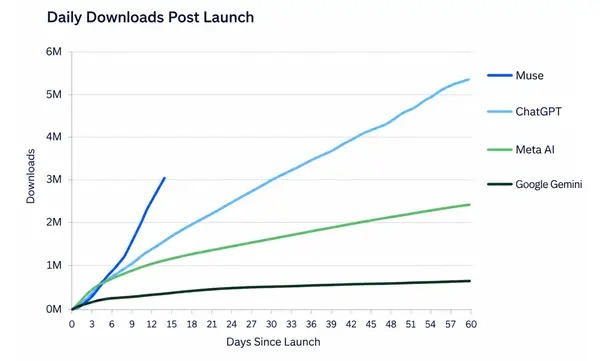
And this enthusiasm may help investors remain more calm regarding the billions of dollars invested in the construction of AI during this financial reporting quarter.
The success of Muse may send a signal to the market that Meta – as well as other large-scale cloud service providers such as Microsoft, Alphabet, and Amazon – are not just throwing cash into a black hole.

Baird Investment Strategist Ross Mayfield indicates that investors' recent skepticism may ease as they see clearer paths to realizing profits. He describes Muse as the first major application of the AI era and compares it to the disruptive momentum that came with the initial launch of Uber.
Mayfield to Business Insider says: 'This is a very good start, and in theory, it should be able to alleviate some of the concerns that 'it's all been for nothing.' At least you can see that there is a product that is very popular and clearly very useful to people. It has more value than just making funny pictures or asking questions.'
The success of Muse means that other companies will also attempt to replicate it (Amazon has already blocked it on its platform, which indicates that Amazon itself may also be developing similar proxies), and this also means that more capital expenditure will continue to flow towards the infrastructure companies of AI.
However, not everyone believes that as AI proxies become a hot topic, hyperscale cloud service providers will be able to easily pass the test of capital expenditure. RIA Advisors's Chief Investment Officer, Lance Roberts, stated that although companies such as Meta, Alphabet, Microsoft, and Amazon have quite impressive performance records, investors should keep this in mind. Nevertheless, during this financial reporting quarter, capital expenditure will still be a key focus, as investors have not yet seen whether Muse and other future products can be effectively monetized.
IDX Advisors Chief Investment Officer Ben McMillan also shares a similar view. He stated that Meta still needs to come up with a plan to explain how to turn the currently free Muse into a money-making machine.
McMillan to Business Insider says: 'The user base that comes with Meta has bought them some time, but it's only a limited amount of time, especially as yields start to compete with investors' capital. Compared to other companies, Meta may indeed have a more direct path to generate higher advertising revenue through Muse, but they need to prove that.'