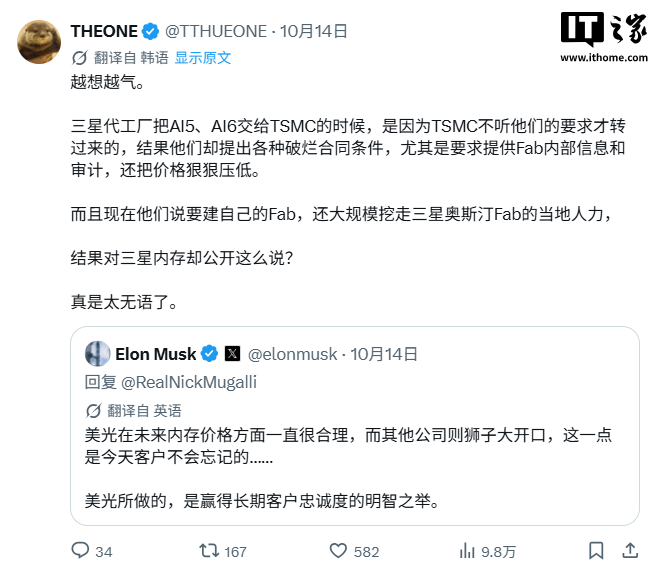
According to Tweaktown, a South Korean semiconductor engineer has alleged that Tesla attempted to secure extremely favorable terms when signing a chip manufacturing contract with Samsung: not only to obtain sensitive manufacturing process information and audit access, but also to demand lower quotes. The engineer, who posted on the X platform under the account @TTHUEONE, also claimed that Tesla's Terafab project poached a large number of employees from Samsung's factory in Taylor, Texas.
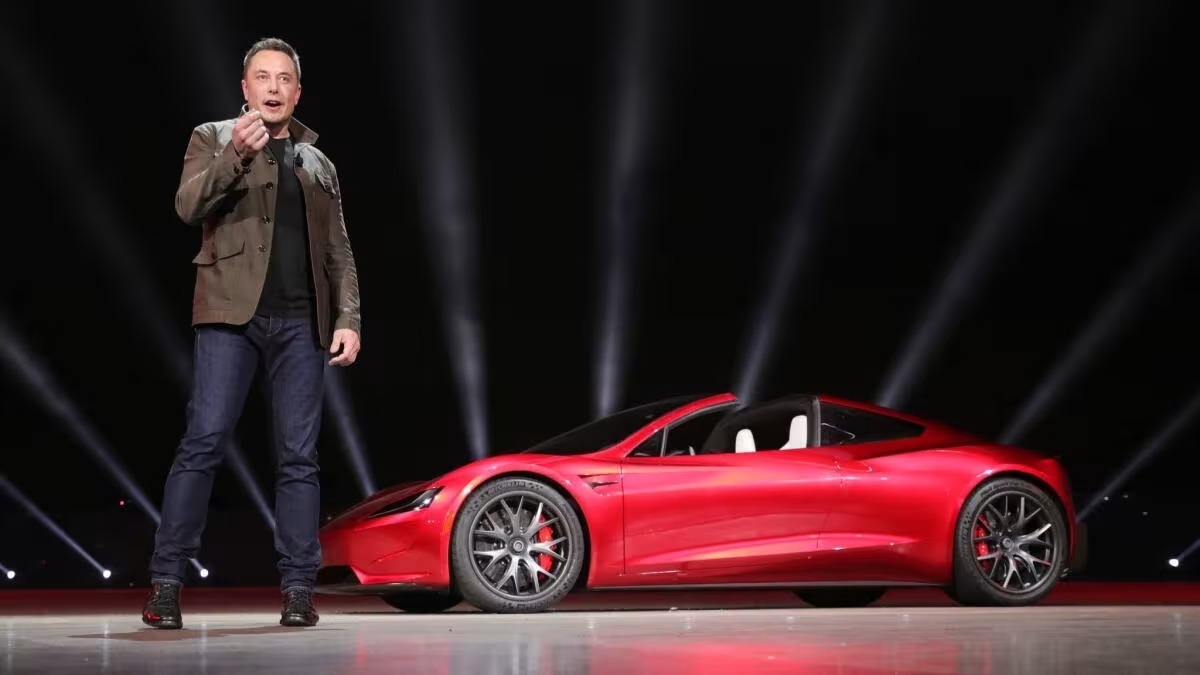
Before these accusations surfaced, Elon Musk ( Elon Musk ) had just gone through a busy week. He publicly praised Micron Technology, stating that they have a "rational attitude towards pricing future storage chips, whereas other manufacturers are asking exorbitant prices," a statement that was generally interpreted as a veiled reference to Samsung. He also hinted that TSMC might be involved in the Terafab project—a major semiconductor collaboration between Tesla and SpaceX, but at the same time ruled out the possibility of TSMC holding shares or participating in its operation.
IT has noticed that the claims of talent poaching are not new. A report by Business Post in March this year pointed out that two factories, being geographically close to each other, posed a structural risk to Samsung, mentioning that Terafab would compete for labor and supplier resources in the same area. At that time, Tesla was already recruiting semiconductor R&D engineers for this project.
Recently, there have been reports that Samsung has dispatched engineers with advanced manufacturing process knowledge from its home base in South Korea to the Taylor factory to supplement the staff, in preparation for the mass production of 2-nanometer chips planned to begin in 2027.
Regarding the chip foundry contract at the heart of the dispute, Tesla's AI5 chips are already in trial production at Samsung's Taylor factory, with the goal of achieving mass production by 2027. The design of this chip is approximately half-mask size, featuring a large central computing die surrounded by 12 memory modules, and it aims for a computing power of 2000 to 2500 TOPS.
Elon Musk claims that the performance of this chip is about three times that of NVIDIA chips of the same level, and the cost is only one-tenth of the latter's. However, these figures have not yet been independently verified by third parties. The AI6 and AI6.5 chips are expected to use TSMC's and Samsung's 2-nanometer manufacturing processes respectively, with a significant increase in on-chip static random access memory capacity, and the memory size has been reduced to 144GB.
Neither Tesla nor Samsung has confirmed or denied the allegations against this engineer. This incident also highlights that, in the race for artificial intelligence computing power, the tensions between chip designers and wafer foundries within the semiconductor supply chain are intensifying.