The Australian data center industry is facing a trust crisis triggered by community protests. Amid the boom in infrastructure investment during the AI period, the "triple bottleneck" of land, funding, and power permits is pulling the narrative of high growth back to reality.
Called the "Australian version of CoreWeave," AI, a benchmark for infrastructure projects, disclosed on Wednesday that due to the continuous obstruction by residents in Melbourne's inner city areas to the construction of high-voltage power transmission lines, the power supply plan for its important project M3 has been postponed until the 2028 fiscal year, resulting in the FY2027 performance forecast being significantly reduced by more than one-third. The company also announced a suspension of all new development projects and land acquisitions, and is evaluating whether force majeure clauses can be invoked regarding the relevant contracts.
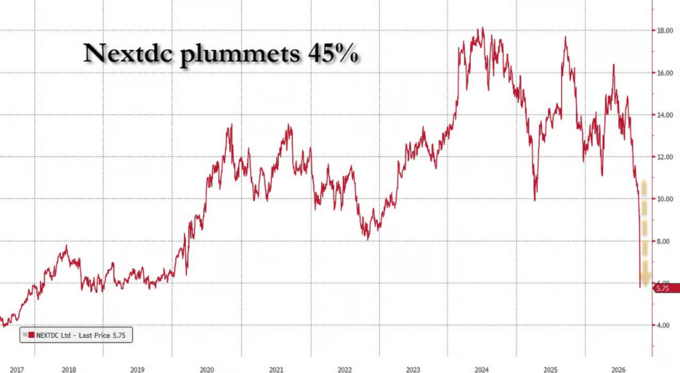
After the announcement of the news, the stock price of NextDC tumbled immediately after a two-day suspension in the Sydney market, plummeting by 45% to 5.07 Australian dollars at one point during trading, bringing the stock price back to 2019 levels and dragging down the local industry as a whole.
This incident further confirms the common delivery challenges faced by the global data center industry – with the GPU in place and customer contracts in hand, what often halts projects are grid access permits and opposition from surrounding residents. According to Bloomberg, in just the first half of this year alone, at least 106 data center projects in the United States have been hindered or delayed due to community opposition, involving an investment scale of about $198 billion.
The forklift was blocked by residents and couldn't move forward: The "low-tech" collapse of the M3 project
The fuse that triggered the collapse of NextDC's stock price was a rather dramatic scene of community confrontation.
To supply power to the M3 project, the power grid operator Jemena Electricity Networks needs to erect high-voltage transmission poles on the residential streets in the inner western area of Melbourne, at Maribyrnong. In September this year, local residents used private cars to block the construction vehicles and filled in the excavated trenches again. Jemena subsequently suspended construction on the grounds of "safety concerns and obstructed access to the construction site," stating that work is not expected to resume until at least February 2027. As a result, the next phase of power grid capacity expansion for M3 has been postponed to FY2028.
The local council is still awaiting further community consultation before granting planning approval. The planning decisions for phases six and seven of M3 have been postponed until 2027, which coincides with the period when the Victorian state government will enter a caretaker government ahead of the general election on November 28th.
The financial impact on NextDC is rapidly becoming apparent. According to documents submitted by the company to the Australian Securities Exchange, the net revenue guidance for FY2027 has been lowered from A$615 million to A$640 million to A$475 million to A$500 million; the base EBITDA guidance has been reduced from A$385 million to A$410 million to A$245 million to A$265 million, with a median decrease of about 36%; and the capital expenditure guidance for FY2027 has been narrowed from A$5.25 billion to A$5.75 billion to A$4.5 billion to A$5 billion.
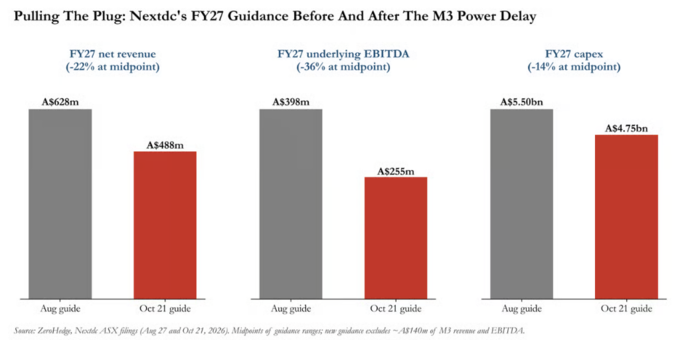
The new guidelines exclude approximately 140 million Australian dollars in revenue and EBITDA related to the contracts affected by M3, which includes some capacity that has already started to be billed. The company also warns that if it is necessary to pay customers for service level breach compensation, EBITDA may face further pressure. The company stated during an investor teleconference:
"We will not continue any work on any site that does not have the commitment of existing customers."
Goldman Sachs has long warned that funds remain the "brake"
Just eight days before this sharp decline, the team of Goldman Sachs analysts led by Chris Boulus released a comprehensive report on the digital infrastructure in Australia and New Zealand. The report predicted that the demand for IT in this region would expand to 5.2GW by 2030, resulting in a supply-demand gap of 0.7GW. They also characterized the overall capital expenditure cycle for data centers as ranging from 50 to 65 billion Australian dollars.
It is worth noting that in the same report, Goldman Sachs had already given a cautious rating to NextDC. At that time, Goldman Sachs initiated coverage of Goodman Group and Megaport with a "buy" rating, but only started tracking NextDC with a "neutral" rating and a target price of 11 Australian dollars, on the grounds that "the market loves the macro demand narrative, but funds are the real brake." The report estimated NextDC's FY2028 and FY2029 EBITDA to be 3% to 5% lower than market consensus, and indicated that the company faced a potential financing gap of over 1 billion Australian dollars. It also questioned whether "risk-averse capital partnerships" or "potential dilutive equity financing" would become its way out.
Currently, NextDC still has $8.7 billion in liquidity on its books, of which $6.7 billion is undrawn preferred debt. The company states that it still complies with the contractual terms. However, the company also warns in the documents that if there are substantial changes to the billing arrangements—such as a revenue shortfall due to delays by M3—it may limit its ability to draw down the aforementioned preferred debt.
According to UBS' forecast cited by Market Index, NextDC is not expected to achieve profitability until at least FY2031. The peak of long-term debt is projected to swell to 11.2 billion Australian dollars in FY2030. Based on the current stock price, NextDC's FY2027 EV / EBITDA valuation is around 37 times, whereas according to Goldman Sachs data, the average valuation for similar pure data center operators globally is 22 times, and this comparison does not yet take into account the latest 1.1 billion Australian dollar convertible notes. Therefore, Market Index points out that even if NextDC falls another 40%, it would only return to the global industry valuation level.
"Force majeure" is becoming a new term in the data center industry.
NextDC The invocation of the force majeure clause is not an isolated case.
On September 24th of this year, Oracle issued a force majeure notice regarding its large-scale “Project Jupiter” campus in New Mexico, due to the same reasons: permit delays and obstacles to power access. Subsequently, it became known that the company had to transport natural gas to the data centers to maintain operations. At the beginning of October, Finnish authorities ordered Google to suspend construction work on two of its data centers. Now, the same situation is recurring in Melbourne.
According to Bloomberg, Morgan Stanley previously estimated that in 2025 alone, there were $156 billion in data center projects around the world that were canceled or postponed, and this figure further rose to $130 billion in the first quarter of 2026. Texas has directly ordered a suspension of new data center construction.
RBC made a clear statement on this, stating that the delay in M3 is strong evidence that "the community opposes the real risk posed to the delivery time of the contracted capacity of the data center." Mark Luet, the head of investment banking for Citibank in Japan, North Asia, and Australia, said in an interview with Bloomberg TV that investors will be "more discerning" in the future, and also added, "We have no doubt that the topic of AI infrastructure will continue to be pursued."
Whether you bring your own power supply or not, you still can't get in.
In the industry's view, the fundamental solution to the difficulties in connecting to the power grid lies in "self-provided power sources." The Australian government introduced mandatory national regulations in July of this year, requiring data center operators to "fully fund their own power needs and provide guarantees for new power generation projects."
Goldman Sachs also adjusted its forecasts in its Carbonomics report. Analyst Michele Della Vigna raised the forecast for global data center “back-end power supply” ( behind-the-meter ) to 67GW by 2030. By then, on-site gas turbines, reciprocating engines, and fuel cells will meet 25% of the global data centers’ power demand, whereas this proportion was “almost zero” in 2025. The logic behind this is that the waiting time for grid connection has increased from about two years historically to more than seven years today, while the construction cycle for data centers themselves only takes two to three years.
The M3 project is a microcosm of this contradiction: the main structure of the building is roughly completed, and the client contract is in hand, but what is missing is a 66-kilovolt power grid capacity expansion line – which is blocked from the street by several private cars and a few shovels.
Meanwhile, Andrew Hauser, the deputy governor of the Reserve Bank of Australia, recently listed the "boom in data center construction" as one of the three major upward risks to inflation in Australia. This has prompted economists at Goldman Sachs Australia to revise their previous expectations of a pause in interest rate hikes, and they now predict that the RBA will raise rates by 25 basis points to 4.85% in November. This means that the boom in data center investment is raising the financing costs of the data center industry itself – and for an industry that Goldman Sachs has long pointed out is "most constrained by capital," this feedback loop is far from ideal.
NextDC The board of directors will announce the results of the capital expenditure review at the annual general meeting of shareholders on November 20th. Whether "selling development plots that are not needed in the near term" will become the starting point for a series of asset sales at that time is worth close attention from the market.