

Hardware wallets are not the only way to protect encrypted assets, but from ETF, passkey to multi-signature accounts, each alternative comes with its own set of risks and trade-offs.
In the past few months, over $200 million in crypto assets were stolen due to tampered Ledger devices and Coldcard seeds that were not truly random. This has severely shaken people's confidence in hardware wallets. These Bitcoin and crypto asset holders did everything right: they purchased products from official channels, properly saved their seed phrases, and believed in the principle that "if it's not your key, it's not your coin," yet they still suffered losses. These theft incidents indicate that even the most cautious crypto asset holders using hardware wallets can face risks beyond their control.
As the number of physical attacks on crypto asset holders increases—this year, there has been an average of one "5-dollar wrench attack" in France every 2.5 days—the disadvantages of storing crypto assets in hardware wallets become more apparent. Not to mention how many crypto asset holders have lost their wallets and mnemonic phrases over the years—of course, "accidents" for tax purposes are not included in this count.
However, all alternative holding methods also have their shortcomings. Therefore, by distributing your assets across different addresses and holding them in various ways, you can at least reduce potential losses if one method is compromised.
The following are five alternative solutions for storing encrypted assets.
1. Encryption ETF: Trusting BlackRock might now be an option.
The most important premise of this alternative to hardware wallets is that, strictly speaking, it is not a true way to “store” crypto assets. Even if you deposit Bitcoin directly, it will be converted into shares of a financial product, which in turn holds the crypto assets through a custodian institution. What you ultimately hold are rights to net asset value denominated in US dollars, represented by ETF, rather than Bitcoin itself. Therefore, there is a trade-off involved here.
On one hand, using encrypted exchange-traded funds ( ETF ) can eliminate many troubles associated with direct holding, such as having to protect mnemonics, back up wallets, or constantly worrying about every knock at the door.
On the other hand, encryption ETF also comes with its own risks, such as relying on centralized providers, third-party hosting arrangements, fees, and there may be discrepancies between the price of shares and the market price of digital assets.
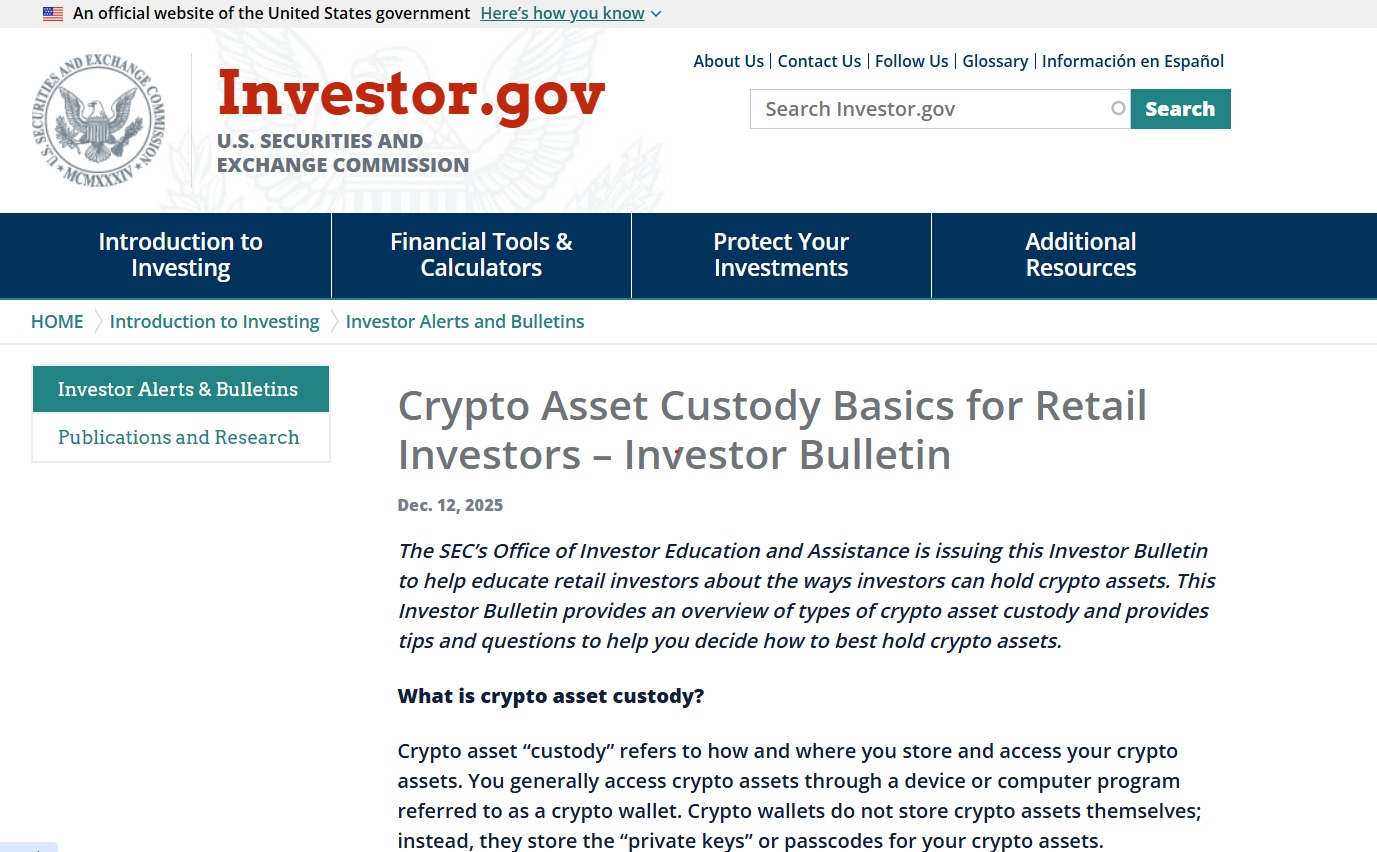
Encryption ETF also carries its own risks. Source: SEC
However, "the ability to use crypto assets on the blockchain" and "exposure to certain risks for the issuer" are among the main considerations when making a choice. She also stated that security depends on the provider, and when selecting a product, control measures surrounding the wallet infrastructure should be "an important factor."
The pseudonym Bitcoin stock-to-flow (creator of the S2F model) transferred his BTC to ETF in 2025 and stated that he faced widespread criticism for this decision. However, after the Ledger and Coldcard incidents, he said, "I have no regrets about choosing ETF. I feel very at ease."
2. Wallets based on passkey: Get rid of mnemonic phrase management
Passkey Allows users to access their accounts using encrypted credentials stored on their devices, typically through Apple or Google's passkey, and are often protected by fingerprint, facial recognition, or PIN. Unlike hardware wallets, they do not require a dedicated device to store the encrypted keys offline. Passkey are more common on chains that support smart contracts.
Some solutions based on passkey include Coinbase Wallet's Smart Wallet, Clave, and Infinex; they each differ in design and recovery options.
Although passkey may bring a smoother user experience, it is not a panacea; the loss of a device or passkey can still cause problems. Therefore, users should check how backups work and whether restoring access requires trusting a third party.
In June 2024, Bitcoin, the CEO of Blockstream, a infrastructure provider, questioned Coinbase's Smart Wallet and asked what would happen if passkey were to get hacked; he said, "It sounds like it's basically just a hosted wallet, they're just putting a better sales narrative on it."
3. Multi-signature wallets: Distribute control across multiple keys
As the name implies, a multi-signature wallet requires multiple keys to authorize transactions. In the common setup with 2–of-3, three independent signatories hold the keys, and any two of them must approve a transaction for the funds to be transferred.
Multiple signatures can reduce dependence on a single key or device, but they do not always completely eliminate the need for hardware wallets. For example, Casa provides multiple signature management for individuals and families, setting up combinations that include hardware wallets, mobile phones, and a key held by Casa.
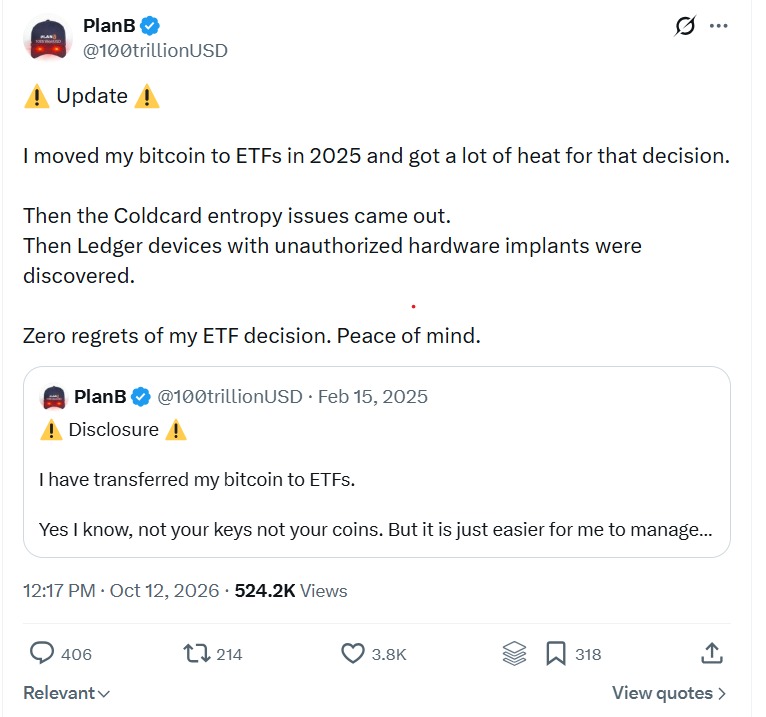
PlanB says there's no regret in transferring BTC to ETF. Source: PlanB
Many of the largest Ethereum ecosystem projects manage their fund repositories through the Safe wallet (formerly known as Gnosis Safe) – this is a multi-signature scheme for on-chain smart accounts, which comes with a web interface.
While this setup can reduce the risk of a single key being stolen or lost, multi-signature arrangements also have their disadvantages.
For example, multiple parties may require that signatories remain available; smart contract wallets may have vulnerabilities in their code or configuration; and if attackers manage to compromise a sufficient number of signatories, they can still authorize transactions.
Coordinated approval can also slow down the transfer process, which is particularly disadvantageous when time is tight, especially when signatories are located in different places and time zones.
Casa The Chief Executive Officer Nick Neuman stated earlier this month to Cointelegraph that even with multiple signature settings, users should still diversify their risks across multiple providers rather than relying on just one.
4. Centralized exchanges: Let others be responsible for custody.
Storing encrypted assets on centralized exchanges shifts the responsibility for private key management to the company, relieving you of most of the burden of ensuring security yourself. This is undoubtedly more convenient for active traders or holders who do not wish to manage backups and recovery phrases.
But the old saying “If it’s not your key, it’s not your coin” is particularly applicable here. The brief history of the cryptocurrency industry is filled with incidents of exchanges being hacked and vulnerabilities being exploited. From exchange owners taking users’ assets with them to their graves, to one of the largest hacker attacks in Bitcoin’s history, investors are still waiting 13 years later to get their coins back.
Of course, the operational security of centralized exchanges has made great progress. Nowadays, many platforms release reserve certification reports or establish emergency funds to help cover losses.
Many centralized exchanges release reserve certification reports. Source: Binance
However, reserve certificates cannot truly prove a company's overall financial health or its ability to fulfill all its obligations.
In addition, as the requirements for reporting on crypto assets increase, including the 'Crypto Asset Reporting Framework' established by the Organization for Economic Co-operation and Development (OECD), exchanges are required to obtain customers' identity, residence, or tax information. Failure to comply may result in account restrictions or suspension of withdrawals.
5. Paper wallets: Offline, but not necessarily safer
A paper wallet traditionally refers to printing a cryptocurrency address and its corresponding private key on paper.
Although paper wallets can keep the key material offline without the need for specialized hardware devices, secure generation is not easy, as compromised computers, malicious generators, or insufficient randomness may all lead to the private keys being leaked before printing.
Moreover, paper is also very susceptible to loss or damage; you certainly wouldn't want to light a celebratory cigar next to such an encrypted storage method (however, engraving the mnemonic phrase on metal is a good alternative). If the private key is imported into a connected wallet, it may also compromise security when spending funds.
Therefore, although paper wallets are an alternative to hardware wallets, they are not a better choice for most users; they are not suitable compared to more manageable offline storage solutions.
After all, there is no perfect way to store encrypted assets; for each holder, it depends on their individual circumstances and needs. As Snyder said:
"Self-managed users can generally be divided into two categories: one is the long-term native crypto users who have a strong opinion about their personal security practices; the other category includes everyone else."
If you don't belong to the first category, she suggests that self-hosting is generally not suitable for you. However, holding a portion of your crypto assets in both centralized exchanges and ETF can be "a very useful tool as part of a portfolio of crypto assets."
Magazine: "Bastion Mode" Cannot Protect Your Cryptocurrency Assets, Critics Say
Self-hosted
Bitcoin walletPaper walletHardware walletBitcoin ETFBitcoin