

According to DWF Labs, the daily capital flow of the US spot Bitcoin exchange-traded funds (ETF) is not a reliable indicator for the next trend of Bitcoin, as investors tend to chase high prices during rises and withdraw their funds during declines.
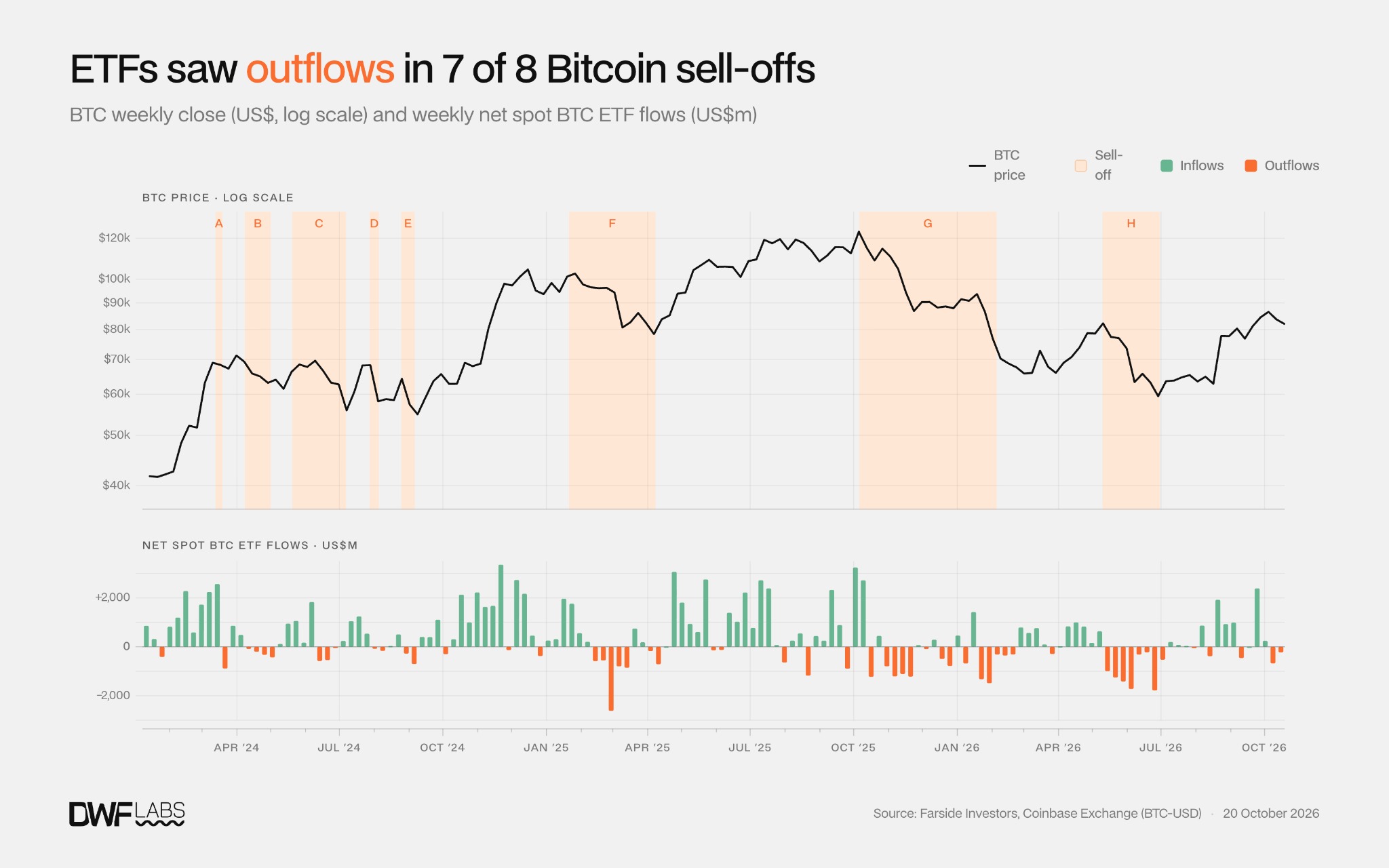
In a research report released on Thursday, the institution stated that in 8 instances where the price of Bitcoin fell by at least 15%, funds flowed out of these funds on 7 occasions; whereas during 9 similar increases, there were net inflows in all cases. The analysis reviewed 694 trading days since the first launch of Bitcoin in the United States in January 2024.
DWF said in the report: 'ETF confirms the trend of capital flows; they do not predict trends. The evidence largely indicates that investors are reacting to prices, rather than driving them.'
Research shows that investors tend to buy Bitcoin ETF after its price rises and redeem it after the price falls. Such capital flows provide almost no clues as to whether Bitcoin will rise or fall in the next 5 trading days.
There is a moderate correlation between the ETF cash flow of each day and the Bitcoin price changes in the 5 trading days prior to that day, with a correlation coefficient of 0.54; however, in the following 5 trading days, this correlation coefficient is only 0.03, which is nearly non-existent.
During Bitcoin's 7 declines, ETF experienced capital outflows each time. Source: DWF Labs
ETF The outflow of funds does not indicate who is selling.
The largest scale of redemptions occurred during the most recent two periods of decline. DWF indicates that investors withdrew a net amount of $6.9 billion between October 2025 and February 2026, and then another $8.2 billion during the decline from May to June.
These data do not indicate whether it was institutional investors or retail investors who drove the selling pressure. DWF did not distinguish between these two types of investors in its analysis.
DWF Labs A spokesperson told Cointelegraph: "We are unable to clearly distinguish between the specific buyers/sellers of ETF."
The frequency of Bitcoin selling is slowing down.
The report states that since the listing of these ETF, Bitcoin has experienced approximately 3 sell-offs each year where the decline reached or exceeded 15%, which is lower than the around 4 times per year from 2022 to 2023, and the 8 times in 2021.
These declines also became more gradual, but the magnitude of losses remained similar. The report shows that the median selling range was 21.3%, compared to 19.4% from 2022 to 2023.
The spokesperson stated, "These changes are not entirely caused by ETF." He pointed out that before these funds were launched in 2024, volatility and the frequency of selling off had already been on the decline.
Magazine: 5 Alternative Solutions for Storing Bitcoin Using Ledger