On Thursday, October 22nd, the escalation of tensions in the Middle East triggered a wave of risk aversion that swept through the U.S. stock market, with the AI industry chain becoming a hard-hit area. The market re-evaluated the return prospects of the massive capital expenditures associated with AI, and Meta investments that had seen increased participation also came under selling pressure. Retail investors had concentrated their purchases of AI sector stocks in the preceding week, making these popular tech stocks more vulnerable to shocks when risk appetite plummeted. At the same time, funds seeking safety flocked to U.S. Treasury bonds, with the yield on 10-year Treasuries falling below 5%, indicating that market pressures had spread from AI concept stocks to the broader macro interest rate market.
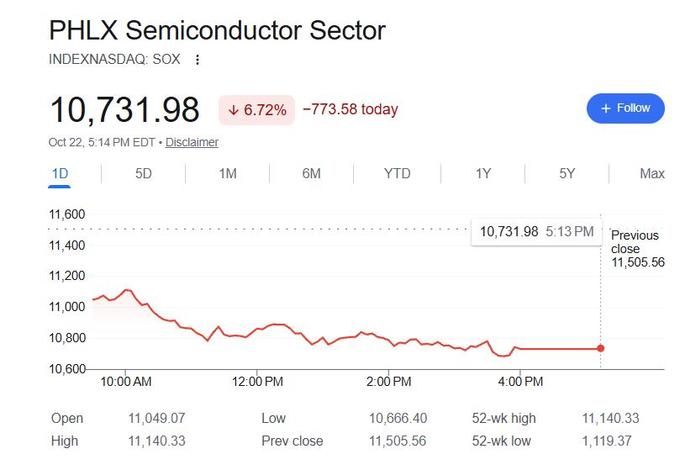
Chip stocks became a hard-hit area. The Philadelphia Semiconductor Index ( SOX ), which rebounded by about 2% on Wednesday, and the semiconductor industry ( ETF SOXX ) closed down nearly 7% on Thursday. Among individual stocks, NVIDIA ( NVDA ) fell 4.4%, AMD ( AMD ) fell 8.1%, Lam Research ( LRCX ) fell about 11.8%, and CoreLogic ( KLAC ) fell nearly 9.6%; storage chips, optical communications, and AI cloud computing sectors all suffered significant losses.
Meta (META) tumbled more than 8% at one point during the session, and the price of the company's five-year credit default swap (CDS) soared to record highs, highlighting investors' concerns regarding the scale of investment in AI, future financing needs, and the return cycle.
The core of this round of selling is that the market has begun to re-evaluate the costs, financing pressures, and return cycles of the investment boom in AI. Meta exceeded expectations in both revenue and profit for the third quarter, yet further raised its annual capital expenditure guidance and disclosed that future spending commitments have risen to $825 billion; Lam Research, on the other hand, has sparked concerns among the market regarding the pace of growth realization for semiconductor equipment companies due to supply constraints.
At the same time, the attack on Saudi Arabia pushed Brent crude oil prices above $110 per barrel, bringing renewed attention to energy costs and inflation risks. The uncertainty of investment returns, supply constraints in the industrial chain, and geopolitical risks have prompted investors to reduce their exposure to high-valued tech assets and shift towards relatively safe bonds. AI
Bloomberg pointed out that the market performance on Thursday was not merely a reversal of the AI trading logic; a more significant feature was the selling of risk assets driven by risk aversion. During the session, the Nasdaq 100 index fell by 3%, and the S&P 500 index dropped by over 1%, while the equal-weight S&P 500 index actually rose by 0.2%, indicating that the selling was mainly concentrated in large growth stocks such as tech giants. At the same time, bonds rose and yields declined, reflecting investors' shift towards safer assets.
Themis Trading, a partner and co-head of stock trading, stated: "I feel that today is a day for risk aversion, and tech stocks are always the first to be hit." He also pointed out that the rise in bonds confirms that the market is adopting a risk-aversion strategy. Investors are concerned that "after the mid-term elections, the Iran conflict could escalate and may last longer than expected."
Middle East risks drive up oil prices; hedging trades hit tech giants
The attack on Saudi Arabia has heightened market concerns about an escalation of conflicts in the Middle East, with Brent crude oil prices breaking through $110 per barrel during trading. The rise in oil prices has reignited fears of inflation, and with the mid-term elections in the United States less than two weeks away, the increase in energy prices may further increase market concerns regarding inflation and policy prospects.
Against this backdrop, funds began to reduce their exposure to risky assets and tended to shift to relatively safe government bonds. Tech stocks, due to their higher valuations and greater reliance on future growth expectations, were the first to come under pressure. The rise in U.S. bond prices and the decline in U.S. stocks occurred simultaneously on Thursday, further highlighting the risk-aversion characteristics of the market that day. Therefore, although the significant drop in the semiconductor index occurred within the AI industry chain, it cannot be simply attributed to a market-wide bearish outlook on AI.
Rising oil prices not only increase the cost pressure on the global economy but may also boost inflation expectations, raising concerns that central banks such as the Federal Reserve have limited room for interest rate cuts. At the same time, AI infrastructure construction itself requires a large amount of capital, electricity, and equipment, and rising energy prices along with financing costs may further affect the calculation of investment returns.
For the concept stocks of AI, this constitutes a dual pressure: on one hand, the market requires companies to prove that huge investments can yield returns; on the other hand, rising oil prices and potential interest rate pressures may increase future investment costs and narrow the valuation space.
The general decline in chip stocks on Thursday indicates that the trading of AI has entered a phase where greater emphasis is placed on profit realization, capital efficiency, and the sustainability of financing. Strong demand remains an important support for the industry, but demand growth alone is no longer sufficient to enable all companies in the supply chain to continue to enjoy a valuation premium. In the coming weeks, the financial reports of large technology companies, their capital expenditure plans, and the outlooks of chip equipment manufacturers regarding the supply chain and orders will be key factors in determining whether the trading of AI can stabilize.
Chip leaders experience widespread declines, with equipment stocks leading the decline in the industry chain.
The semiconductor sector saw a significant decline on Thursday, with stocks in chip design, manufacturing, equipment, and storage all under pressure. By the close of trading, Broadcom (AVGO) fell 4.3%, Marvell Technology (MRVL) fell 8.7%, Intel (INTC) fell 8%, and TSMC's US stock (TSM) fell 4.5%.
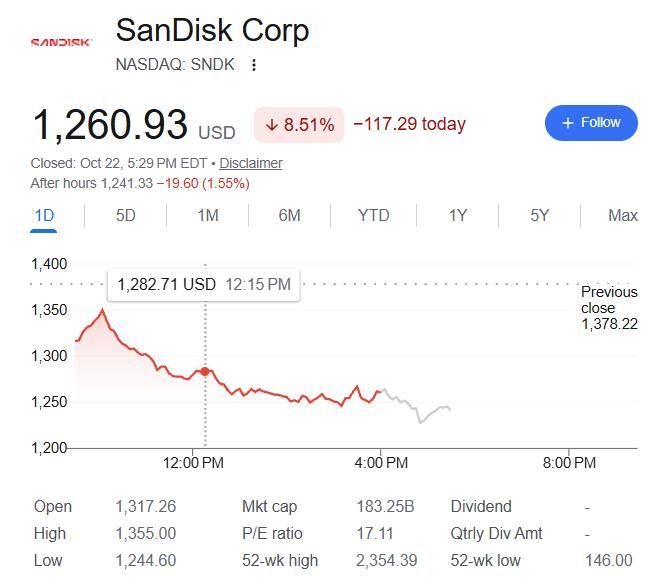
Semiconductor equipment stocks saw even more significant declines. In addition to Lam Research and CoreLogic, which both fell by nearly 10%, application materials company AMAT fell by 8.2%. Among storage chip stocks, SanDisk (SNDK) fell by 8.5%, SK Hynix' US stock (SKHY) fell by 8.1%, Seagate Technology (STX) fell by 7.9%, Western Digital (WDC) fell by 6.4%, and Micron Technology (MU) fell by 6.3%.
Equities related to optical communications and AI infrastructure also saw heavy selling. By the close of trading, Coherent ( COHR ) fell by 12.5%, Lumentum ( LITE ) fell by 11.5%, Credo ( CRDO ) fell by 10.7%, and Corning ( GLW ) fell by 8.1%. AI, a cloud computing service provider, CoreWeave ( CRWV ), closed down about 10%, and Nebius ( NBIS ) fell by 7.2%. By the close, Dell ( DELL ) fell by about 6.8%, Supermicro Computer ( SMCI ) fell by 5.2%, and Oracle ( ORCL ) fell by about 2.8%.
The widespread decline across the industrial chain indicates that market concerns have expanded from the valuations of individual chip companies to the entire AI infrastructure investment chain. The growth expectations of chip designers, equipment suppliers, storage manufacturers, optical communication companies, and cloud service providers are closely linked to the ability of large technology companies to continue investing in AI infrastructure. Once investors begin to question the speed of return on such expenditures, related assets may be impacted simultaneously.
Meta Capital expenditure increased, $825 billion in future spending commitments raise financing concerns
Meta became another focal point of pressure for AI trading on Thursday. The company's revenue in the third quarter increased by 26% year-on-year to $64.6 billion, exceeding market expectations; earnings per share (EPS) were $3.83, also higher than analysts' forecast of $3.57. However, the strong performance in the current period failed to dispel market concerns about future investment costs, and Meta's stock price fell by more than 8% at midday, closing down about 7%.
Meta has raised its capital expenditure guidance for 2026 to $135 billion to $145 billion, and increased the lower limit of the previous guidance range from $130 billion. The company disclosed that future expenditure commitments, including leasing, computing power transactions, and energy agreements, have risen to $825 billion.
Market attention is shifting from whether the AI business can grow to how much capital is required for growth and when sufficient returns will be generated. Meta CEO Zuckerberg stated that the company's investments are yielding results, the core business remains strong, and products such as AI Assistant Muse also show growth potential. However, the company also acknowledges that the return period for some new AI investments will be longer than that of the core business.
The credit risk indicators of Meta also deteriorated accordingly. Bloomberg data shows that the five-year CDS price of Meta once rose by about 8.9 basis points to around 119.3 basis points, hitting a record high. The increase in price means that investors' hedging costs for related debt default risks have risen, reflecting the market's greater caution regarding the company's ongoing expansion of AI investments and potential financing needs.
Meta also announced the distribution of a new class of non-voting shares to existing shareholders, which could be used in the future for financing, employee compensation, and potential acquisitions. This arrangement has further drawn market attention to how the company will raise funds for the expansion of AI.
Next, Google's parent company Alphabet, Microsoft, and Amazon will successively announce their quarterly earnings. The financial reports of these large technology companies will not only test whether the demand for AI continues, but also reveal whether capital expenditures are continuing to accelerate, as well as whether companies can gradually prove that their investments are being converted into revenue, profits, and cash flow. For the market, the key to AI transactions is no longer just how fast demand is growing; it also includes whether the scale of spending is sustainable.
Lam Research supply limited, expectations for growth in device shares are being re-evaluated
Lam Research has become one of the leaders in the decline in the semiconductor equipment sector. After the company announced its quarterly results, the stock price fell by more than 10% in the morning session and approached 12% by the close of trading. The company's outlook for future performance and supply constraints have made investors more cautious about their expectations for industry growth.
It is reported that after the financial report was released, the management of Lam Research stated that without the recent supply constraints, the company's performance guidance could have been even higher. The supply constraints mean that even though there is a strong demand for AI related chips, equipment manufacturers may not be able to deliver products and recognize revenue at the expected pace. This has led the market to re-evaluate whether the strong orders can be translated into actual performance in a timely manner.
The valuation of semiconductor equipment companies heavily relies on the expansion of wafer factories and investment in advanced manufacturing processes. Previously, the construction of AI data centers drove an increase in chip demand, which in turn led to increased production capacity by wafer factories and supported the growth of orders and stock prices for equipment companies. However, limitations in equipment delivery or adjustments to customers' expansion plans could affect the revenue realization over the coming quarters.
Application materials, and stocks in the same industry such as Kelai also tumbled simultaneously, indicating that investors have not limited their concerns to just Lam Research. The equipment sector had previously benefited from the capital expenditure expectations of AI, and stock prices were relatively sensitive to future growth; however, when the market began to worry about supply bottlenecks, the pace of capital expenditure, and valuation levels, related stocks were also prone to amplified corrections.
However, supply constraints do not necessarily mean that the demand for AI chips has weakened. What is more noteworthy at present is whether device manufacturers can alleviate delivery bottlenecks, and whether large technology companies' investments in data centers will continue to support wafer factory capacity expansion. Subsequent financial reports and management guidance will help the market determine whether this round of adjustment is merely a correction of valuations and positions, or whether there are beginning to be changes in the growth expectations of the AI industry chain.
Retail investors rushed to buy AI shares a week before selling off, putting hot trades under even greater pressure
Bloomberg cited data from JPMorgan strategist Arun Jain stating that in the week leading up to the sharp decline on Thursday, from last Thursday to this Wednesday, individual investors significantly increased their purchases of semiconductor companies, "new cloud" ( neocloud ) enterprises that provide next-generation cloud computing services, and storage device companies. At the same time, their buying momentum for the "Big Seven" tech companies in the U.S. stock market weakened. Jain pointed out in a report to clients on Wednesday that the retail buying volume of individual stocks in the tech sector had risen to its highest level since the market momentum trading began to break down in July.
Retail investors' demand for technology ETF is even more prominent. The net inflow of related ETF reached the second-highest level on record this week, partly due to investors taking advantage of the decline to buy in the latter half of last week. On Friday last week, technology ETF recorded the largest single-day capital inflow in its history, pushing the weekly buying volume to 2.1 standard deviations above the historical average. VanEck Semiconductor ETF ( SMH ) is also one of the funds that attracted a large amount of capital.
The individual stocks with the highest concentration of retail purchases include SanDisk, TSMC, and Nebius. All three stocks fell by at least 4% on Thursday. Nebius had previously attracted attention on social media investment forums; SpaceX was also among the favorite stocks of retail investors before Tuesday. However, after the company released positive financial reports and its stock price rose by 7.8% on Tuesday, retail investors turned to selling on Wednesday.
These capital flows indicate that retail investors have not completely abandoned AI trading, but have instead shifted from the “Big Seven of U.S. Stocks” to a broader AI ecosystem. Integrity Asset Management portfolio manager Joe Gilbert stated that as AI ecosystem companies have demonstrated more sustainable profitability than initially expected, investors have moved away from the Big Seven towards a wider range of tech stocks. He believes that in an environment with higher interest rates, tech companies outside of the Big Seven could also achieve strong profit growth, while their valuation multiples are relatively lower.
However, this rotation also brings new vulnerabilities: when funds flow into popular sectors such as chips, storage, and new cloud technologies, if geopolitical risks suddenly intensify and the market begins to question the returns on capital expenditures in AI, the positions accumulated earlier may face simultaneous adjustments. The concentrated buying by retail investors cannot alone explain the decline on Thursday, but it does mean that stocks in the AI industry chain, which were previously sought after, are more likely to face selling pressure when risk appetite reverses.
Hedge funds have flocked to U.S. Treasuries, with the yield on 10-year bonds breaking below 5.0% for the first time in nearly a month.
The risk-aversion trading on Thursday was not limited to the stock market. With a significant decline in stocks related to AI, pressure on the French bond market, and renewed tensions in the Middle East, U.S. Treasury bonds strengthened across the board, recording their best performance in over a year. Yields on some maturities fell by up to about 20 basis points, and the yield on 10-year U.S. Treasury bonds dropped below the key level of 5.0% for the first time in nearly a month. There was also buying interest in U.S. Treasury bond futures, which further propelled the market upward.
What is more noteworthy is that market expectations for the Federal Reserve's interest rate hikes have also shifted backward. According to a Bloomberg report, traders are now anticipating a 25-basis-point interest rate hike that was previously scheduled for December to be postponed until January next year. Previously, rising energy prices were generally seen as a driving force behind inflationary pressures and increasing bond yields; however, on Thursday, investors began to view high oil prices more as a risk that could drag down economic growth, and they hedged by buying U.S. Treasury bonds.
TJM Institutional Services Interest Rate Strategist David Robin stated: "The situation is changing. Hedging is one thing, but growth risk is another entirely." This distinction highlights the deeper meaning of the bond market trends of the day: The market is not only seeking safe assets due to rising risks but is also beginning to worry about the sustainability of AI investments and the potential impact of energy price shocks on the overall economic outlook.