Benefiting from the massive data storage demand driven by the AI craze, Western Data's revenue surged by 55% in the first quarter of its fiscal year 2027, and its guidance for the next quarter far exceeded expectations. Management revealed during a conference call that the visibility of orders from core customers has extended into the years 2030 to 2031.
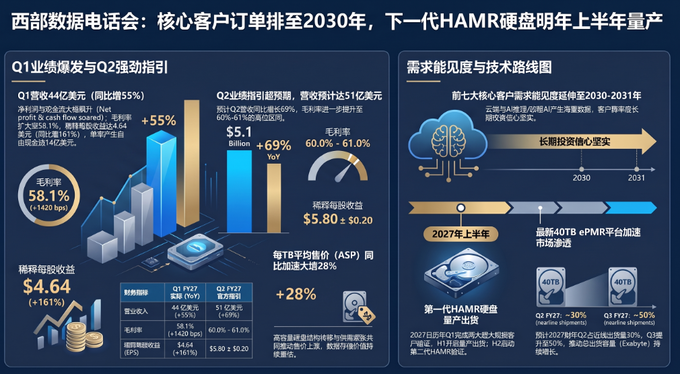
After the U.S. stock market closed on October 22, Western Digital released its financial report for the first quarter of fiscal year 2027. The company's revenue was $4.381 billion, a year-on-year increase of 55%, exceeding analysts' previous forecast of $4.14 billion; non-GAAP earnings per share were $4.64, a year-on-year increase of 161%, also above the expected $4.11.
During the teleconference, CEO Irving Tan stated that AI is essentially a data system, and any workload will generate more data, which brings HDD more sustainable market opportunities than just computational power alone.
He stated that the growth in storage demand has surpassed the scope of traditional core clouds and ultra-large-scale customers, and is accelerating its penetration into enterprise-level environments, cloud service providers, as well as cutting-edge laboratories like AI. Taking the company's top seven customers as an example, Western Digital's visibility into the needs of these seven customers has extended to the period from 2030 to 2031.
In response to market concerns about potential overcapacity in the industry, management stated that the company will continue to improve areal storage density by enhancing head and magnetic medium technologies in order to meet long-term supply and demand growth, rather than making blind investments to increase unit capacity.
AI drives long-term demand; visibility of orders from the top seven customers extended to 2030-2031
Irving Tan stated at the meeting that market discussions regarding AI mainly focused on computing power, but the company believes that a more sustainable opportunity lies in the data itself.
He said, " AI is essentially a data system. Every workload generates more data, and this data must be stored, managed, and accessed in a scalable and economical manner."
He stated that this demand not only exists in traditional cloud and supercomputing centers but is also rapidly spreading to cloud services, cutting-edge laboratories such as AI, as well as physical AI applications like robotics and autonomous driving.
Irving Tan said, "If we take the top seven customers as an example, we have a good visibility among these seven customers until 2030 and 2031. In fact, we see that the demand signals are continuously strengthening quarter by quarter."
When talking about physical AI, he also mentioned that the company's customers in the field of autonomous driving in Asia are seeking to increase their demand in order to support their physical AI plans. He noted that NVIDIA has recently emphasized the revenue opportunities in the field of physical AI amounting to around $10 billion, "If you see this happening on the computing power side, there is obviously also a need for storage to support that computing power."
Pricing continues to strengthen, with Q1 experiencing an average price increase of 28% year-on-year every TB.
Against the backdrop of tightening supply and demand, Western Data indicates that its pricing environment remains strong.
Chief Financial Officer Kris Sennesael stated that in the first quarter of fiscal year 2027, the blended average price per TB increased by 28% year-on-year, exceeding the high single-digit to double-digit growth rates seen in the previous quarter.
Irving Tan indicates that "the current quarter we are seeing can be considered the bottom of the growth in shipments (at the EB level). We expect this to accelerate in the remaining time of this fiscal year."
In terms of the product roadmap, the company is advancing two technical lines: ePMR and HAMR.
- ePMR: The latest generation of this platform offers a maximum capacity of up to 40TB, and it has started mass production with strong momentum. Management expects that by the second fiscal quarter, this platform will account for approximately 30% of the shipments of online hard drives, and by the third quarter of the 2027 fiscal year, that figure is expected to reach 50%.
- HAMR: The first-generation HAMR products are expected to complete certification with two ultra-large-scale customers in the first quarter of 2027 and mass production and shipment will begin in the first half of 2027. The second-generation HAMR products will adopt an 11-disk platform with 5TB per disk, and certification is expected to start in the second half of 2027.
Kris Sennesael means: 'Whether it's shipping HAMR or ePMR, the price remains the same. We will not offer any discounts on HAMR products.'
Regarding the sustainability of gross margin, Irving Tan indicates that the long-term driving forces mainly include three aspects: periodic price increases under long-term agreements and strengthening spot prices for non-long-term agreements, customers migrating towards higher capacity and higher profit margins, as well as the scale effects brought about by increased storage density.
He said, "When you combine these three factors, we are very optimistic about the continued expansion of gross margin."
Capital expenditure will be higher than the long-term average, but it will not be used to expand unit production capacity.
In the face of concerns about potential overcapacity in the industry and rumors of competitors expanding production, Western Data reiterated during a teleconference that its strategy is to invest in technology rather than increasing unit capacity.
Kris Sennesael indicates that capital expenditures over the next two years will be slightly higher than the long-term average of 4% to 6% of revenue over a five-year period, but the purpose of the funds is very clear: 'These capital expenditures will be used for headsticks, magnetic media technology, and factory automation, rather than increasing unit capacity.'
Irving Tan further states that the best way to meet the requirements is by increasing the surface storage density and the capacity of a single disk, which not only provides customers with the best total cost of ownership but also brings the maximum profit to the company.
He stated that if other market participants do not have the capability to manufacture magnetic media and read/write heads independently, as well as to increase the storage density of surfaces, they may have to maintain their market share by increasing the number of units sold. Western Data, on the other hand, will continue to adhere to its commitment not to increase incremental production capacity.
Key points to note during the phone call
Management stated that in the first quarter of fiscal year 2027, revenue amounted to approximately $4.4 billion, a year-on-year increase of 55%; shipments reached 248 exabytes, a year-on-year increase of 22% and an 8% increase from the previous quarter. Among these, cloud business revenue was $3.9 billion, accounting for 88% of total revenue, with a year-on-year increase of 54%; client business revenue was $320 million, accounting for 7%, with a year-on-year increase of 119%; consumer business revenue was $193 million, accounting for 5%, with a year-on-year increase of 19%.
The company's gross margin in the first quarter was 58.1%, an increase of 1,420 basis points year-over-year; operating expenses amounted to $391 million, accounting for about 9% of revenue; operating profit was $2.2 billion, a year-on-year increase of 152%; and the operating profit margin expanded to 49.1%.
Interest and other expenses amounted to 10 million US dollars, with an effective tax rate of 17%. Calculated based on 383 million diluted shares, the earnings per non-GAAP share were 4.64 US dollars, representing a year-on-year increase of 161%.
The company generated $1.4 billion in free cash flow this quarter and returned $1.1 billion to shareholders through share repurchases and dividends. The board of directors approved a 17% increase in the quarterly cash dividend, from $0.15 per share to $0.175 per share, which will be distributed to shareholders registered as of December 4, 2026, on December 17, 2026.
In terms of the balance sheet, the company stated that its net cash position at the end of the quarter was $500 million and mentioned that it had further simplified its capital structure by significantly reducing the remaining convertible notes for 2028.
Second Quarter Guidance
For the second quarter of fiscal year 2027, Western Digital expects revenue to be $5.1 billion, with a range of plus or minus $100 million, corresponding to a year-over-year increase of 69%; gross margin is expected to be between 60% and 61%; operating expenses are expected to be $400 million to $410 million; interest and other expenses are expected to be $15 million; and the tax rate is expected to be 17%.
Based on 380 million non-GAAP diluted shares, the company expects diluted earnings per share for the second fiscal quarter to be $5.80, with a range of plus or minus $0.20.
Management stated that as the migration of technology and products progresses, it is expected that the supply growth of ByteDance will continue to accelerate throughout the fiscal years 2027 and 2028.
Q&A Session Summary
During the Q&A session, management expressed 'great satisfaction' with the progress of HAMR, and it is anticipated that the first generation of HAMR products will complete certification with two customers in the first quarter of 2027, with mass production and shipment to begin in the first half of 2027. At the same time, there are plans to initiate certification processes with two additional customers in the first half of 2027 as well.
Regarding cost issues, Kris Sennesael stated that the company's long-term goal remains to achieve a year-on-year cost reduction of about 10% per TB. However, in the short term, due to the increase in raw material costs such as DRAM and NAND, the recent cost reduction per TB will be less than 10%.
Regarding concerns about industry competition and potential capacity expansion, Irving Tan stated that there has been no change in the long-term fundamentals as perceived by the company. The compound annual growth rate of demand still exceeds 25%, and the supply environment remains tight. The company will continue to rely on head and magnetic medium technology to increase the storage density per unit area, rather than adding new production capacity.
In terms of order visibility, Irving Tan reiterated that taking the top seven customers as an example, the company has a good visibility extending from 2030 to 2031 for all seven customers, and the demand signals are strengthening quarter by quarter.
Regarding pricing trends, Kris Sennesael indicates that a strong pricing environment is evident in both online and offline businesses, including consumer and client markets. Some businesses are under long-term agreements, while others are about to have their long-term agreements expire and will be renegotiated. There are also some cases where Abylet is not covered by these contracts, but even in these instances, pricing remains strong.
Regarding capital expenditure, management has repeatedly emphasized that in the next two years, capital spending will be slightly higher than the long-term average. This is mainly due to the fact that the production process for HAMR heads and magnetic media involves more steps and longer cycles, which requires corresponding investment to support the technical roadmap, rather than to expand unit production capacity.
In his concluding remarks, Irving Tan stated that the first phase of investment by AI focused on the infrastructure required for training models. The next phase will involve the large-scale implementation of AI, moving from inference to intelligent agents, and then to physical AI. As this process progresses, data will continue to grow exponentially, encouraging customers to make longer-term plans and adopt products with higher capacity. The company believes that this creates sustained opportunities for Western Data that far exceed the initial AI infrastructure construction phase.