

Tesla's third-quarter financial report is a mixed bag: Its energy storage business fell far short of Wall Street's expectations, dragging down overall revenue growth and causing it to stagnate. However, the company delivered a "surprise" with improved free cash flow, and its profit margin also exceeded expectations.
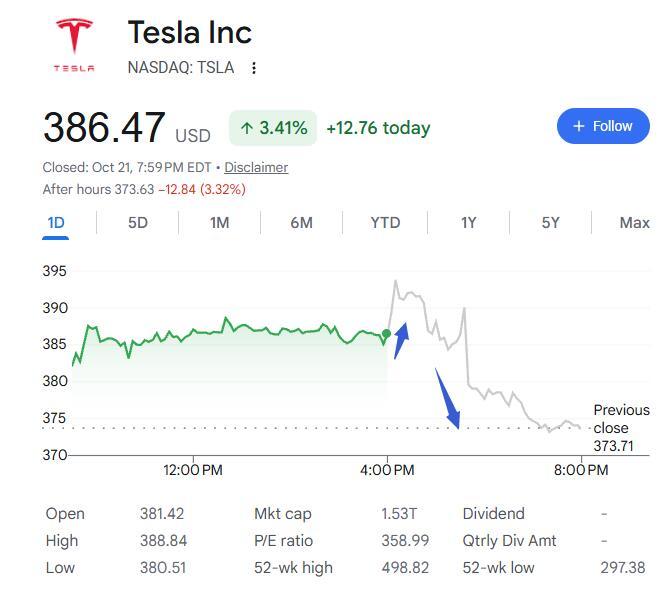
On Wednesday, September 21st, Eastern Time, Tesla announced that in the third quarter of 2026, which ended in September, its revenue was $28.05 billion, showing virtually no growth year-on-year, slightly lower than analysts' forecast of $28.13 billion; however, the adjusted earnings per share ($EPS) were $0.48, about 9% higher than expected, and operating profit was nearly 20% higher than anticipated. The gross margin for that quarter was 19.6%, showing a rebound from previous quarters that exceeded market expectations by nearly 2 percentage points.
More importantly, there is the cash flow. In the third quarter, Tesla's free cash flow was $1.53 billion, which analysts had previously expected to be negative $4.99 billion, an further expansion from the negative $1.09 billion in the second quarter; the operating cash flow for that quarter reached $6.26 billion, driving the cash, cash equivalents, and short-term investments at the end of the quarter to $45.45 billion, an increase of $1.9 billion from the previous quarter.
In terms of business structure, automotive revenue amounted to $20.56 billion. Although the year-on-year growth rate turned negative, it was still nearly 4% higher than market expectations. In other words, the decline in revenue was not as severe as analysts had anticipated. Service and other revenues saw a slowdown in year-on-year growth to 33%, which was still more than 7% higher than market expectations. However, energy generation and energy storage revenues decreased by 16% year-on-year, returning to negative growth, and were more than 26% lower than analysts' forecasts, which was the main factor contributing to the subpar third-quarter results.
Tesla also emphasized that for the second consecutive quarter, it has achieved rolling revenue of over $100 billion in the past 12 months.
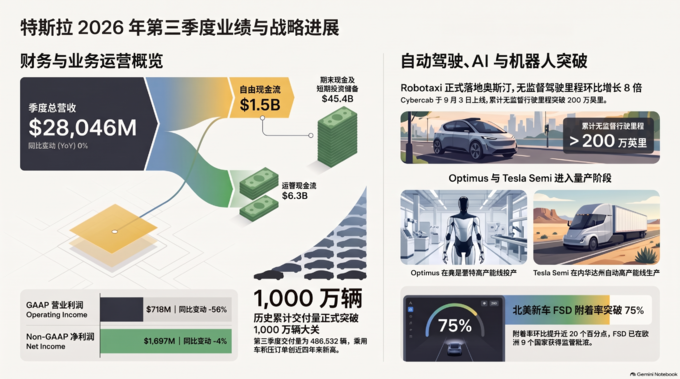
During regular trading on Wednesday, Tesla's stock price rose by more than 3%. After the release of its post-market financial report, it continued to climb, reaching a gain of over 2% at one point. However, during the earnings call, the stock price turned down, falling by more than 3% at one stage. Analysts believe that the market's initial reaction was to reward the recovery in gross margin, the EPS exceeding expectations after adjustments, the significant turnaround in free cash flow, and the continued progress of long-term narratives such as FSD subscriptions and Robotaxi commercialization.
Subsequently, the stock price turned down, prompting investors to re-evaluate several issues: 1. Total revenue was still slightly below expectations, with EPS and operating profit declining significantly year-over-year; 2. One of the key reasons for free cash flow exceeding expectations was that capital expenditures were lower than anticipated. If the annual target of around $25 billion CapEx remains unchanged, cash flow pressure may increase significantly in the fourth quarter; 3. Automobile deliveries declined year-over-year, and ASP continues to face pressure, with room for further verification regarding the explanation of "battery supply constraints"; 4. Energy business revenue was significantly lower than expected; 5. Although progress is positive in AI, Robotaxi, and Optimus, commercialization still requires time, and related expenses have already been reflected in the financial statements.
Revenues fell slightly short of expectations, but adjusted profits exceeded expectations; however, GAAP's profit margin declined by over 40%.
Tesla's total revenue in the third quarter was $28.046 billion, lower than the market's expectation of $28.13 billion, and almost the same as it was a year ago, with a slight decline of nearly 0.7% compared to $28.236 billion in the second quarter.
Looking at different businesses, the automotive sector remains a core pillar:
- Automobile business revenue amounted to $20.56 billion, a year-on-year decrease of 3%, but it was higher than the market's expectation of $19.83 billion, and there was a year-on-year increase of 23% in the second quarter;
- Energy generation and energy storage revenues amounted to $2.88 billion, lower than the market's forecast of $3.91 billion, a year-on-year decrease of 16%. Following a 12% decline in the first quarter, this is another quarter of negative growth this year, while in the second quarter there was a year-on-year increase of 13%.
- Service and other revenues amounted to $4.61 billion, higher than the expected $4.3 billion, representing a year-on-year increase of 33%. This growth rate is slower than the 50% increase seen in the second quarter.
In terms of profitability, Tesla's adjusted net profit was $1.697 billion, with an adjusted EPS of $0.48, which is higher than the market expectation of $0.44, but still lower than the $0.50 from the same period last year. Under the GAAP metric, the net profit was $787 million, a year-on-year decrease of 43%; the GAAP EPS was $0.22, also a year-on-year decrease of 44%.
The main differences here come from adjustments other than those marked with GAAP. In the third quarter, the after-tax impact of Tesla's equity incentive expenses was approximately $982 million. In addition, this also includes unrealized gains on digital assets, unrealized losses on SpaceX equity investments, and certain tax adjustments. In other words, despite the decent profit performance after these adjustments, GAAP profits are still burdened by high-intensity investments and incentive costs.
The biggest highlight is the restoration of gross profit margin: automotive gross profit has rebounded, while the contribution from regulatory points has decreased.
In the third quarter, Tesla's total gross profit was $5.494 billion, a year-on-year increase of 9%; the total gross margin was 19.6%, which is 160 basis points higher than 18.0% in the same period last year and also a significant improvement from 16.8% in the second quarter.
The gross profit margin of the automotive business has also significantly improved. In the third quarter, the gross profit margin of the automotive business was 18.5%; after excluding regulatory credits, the gross profit margin for automobiles was 18.1%, which is higher than 16.3% in the second quarter and also higher than 15.4% during the same period last year. This is an important signal for the market: the improvement in Tesla's automotive gross profit margin does not mainly rely on regulatory credits.
Regulatory compliance points revenue in the third quarter was only $113 million, a significant decrease of about 73% compared to $417 million in the same period last year, and also lower than the $146 million in the second quarter. As the pressure on some traditional automakers to pay for fuel economy fines diminishes, regulatory compliance points, once a high-profit source of income, may find it difficult to continue to be a source of profit flexibility in the future.
The company attributed the improvement in gross margin to a better regional and product mix, as well as growth in FSD subscription revenue; however, negative factors still include a decline in the average selling price of vehicles ( ASP ). In other words, the rebound in gross margin is real, but the pressure on prices has not completely disappeared.
Free cash flow exceeded expectations significantly, but "spending less" also made a significant contribution.
Cash flow is another highlight of this quarter. In the third quarter, Tesla's operating cash flow was $6.263 billion, roughly the same as the same period last year; free cash flow was $1.531 billion, which is significantly better than the market's expectation of -$4.99 billion and represents a clear turnaround from the negative value of $1.092 billion in the second quarter. At the end of the quarter, cash, cash equivalents, and short-term investments totaled $45.447 billion, an increase of about $1.9 billion from the previous quarter.
However, this excess free cash flow needs to be analyzed in detail. In the third quarter, capital expenditures amounted to $4.732 billion, which represents a year-over-year increase of 110%, but it is still lower than the $5.789 billion spent in the second quarter and significantly below the market's previous expectation of around $7.77 billion. In other words, the substantial excess in free cash flow comes largely from the money that was not spent in the third quarter.
This isn't a bad thing – spending less money and generating positive free cash flow is certainly better than a deteriorating cash flow situation. However, if these capital expenditures are only deferred rather than canceled, there may be pressure in subsequent quarters.
Previously, Tesla's management stated that capital expenditures in 2026 would exceed $25 billion. According to the financial reports, Tesla's capital expenditures for the first three quarters were approximately $13 billion, with about $8.28 billion in the first half of the year and $4.73 billion in the third quarter. If the annual figure is still to reach around $25 billion, then nearly $12 billion in capital expenditures would be needed in the fourth quarter, which is about 2.5 times that of the third quarter.
Therefore, the question that re-emerged in the market during the conference call is: is Tesla lowering its annual capital expenditure plan, or will it face greater free cash flow pressure in the fourth quarter? This is also one of the key reasons why the stock price turned from rising to falling after the market closed.
Delivery and Capacity: Delivery volume decreased year-on-year, but inventory improved and backlogs rose to a four-year high.
From the operations side, in the third quarter, Tesla's total production was 464,400 units, a year-on-year increase of 4%; the total deliveries were 486,500 units, a year-on-year decrease of 2%, but there was a slight increase from 480,100 units in the second quarter.
Among them:
- Model With a production volume of 457,400 units in 3 months, a year-on-year increase of 5%;
- Model 3/Y delivered 478,200 units, a year-on-year decrease of 1%;
- 8,295 units of other vehicle models were delivered, a year-on-year decrease of 48%.
Although total deliveries declined year-on-year, inventory indicators improved significantly. In the third quarter, global vehicle inventory was 11 days, lower than 15 days in the second quarter and 27 days in the first quarter. Tesla also stated that at the end of the third quarter, backlogs of passenger vehicles reached their highest level in four years, and the company produced and delivered its 10 millionth car during that quarter.
On the supply side, Tesla indicates that battery supply remains a key factor limiting the increase in vehicle production. The company states that it is working to ensure future battery supply and improve factory utilization rates. The Berlin factory has achieved record production, and the high-production lines in Nevada have also begun mass production of Tesla Semi; Cybercab, Cybertruck, Model Y, etc., remain the focus of capacity deployment.
Energy Business: Revenue Far Below Expectations, but There Are Still Highlights in Energy Storage Orders and Gross Margin
Energy business was the most prominent weak point in the third-quarter financial report. In the third quarter, revenue from energy generation and energy storage amounted to $2.881 billion, a year-on-year decrease of 16%, significantly lower than the market's expectation of $3.91 billion. The company stated that part of the year-on-year revenue decline was affected by refunds from customers related to tariffs.
However, the volume of business has not weakened accordingly. In the third quarter, the deployment of energy storage reached 13.7 GWh, a year-on-year increase of 10%, slightly higher than the 13.5 GWh in the second quarter. The company also stated that both the order rate and the backlog of orders for its energy storage business have reached record highs.
More positively, there is the gross margin. In the third quarter, the energy business generated approximately $954 million in gross profit, with a gross margin of around 33%, which represents a significant improvement from the second quarter's level of about 20%. In other words, although the revenue from the energy business fell short of expectations, the quality of profitability has improved.
In terms of production capacity, Tesla's facility in Megafactory in Texas has already started production, with a planned capacity of 50 GWh. The company is also advancing its supply chain in the United States, stating that it has shipped the first batch of Megapack products manufactured using LFP battery cells produced at its Nevada factory. Tesla emphasizes that the increasing demand for data centers, limited grid connectivity, and higher requirements for power stability will continue to drive the demand for energy storage products.
FSD: Subscription numbers exceed expectations, with the option adoption rate for new cars in North America exceeding 75%
FSD is the strongest indicator in this quarter's software narrative.
In the third quarter, Tesla's active FSD subscription count reached 1.74 million, exceeding analysts' forecast of 1.57 million, a year-on-year increase of 67%, and continued to rise from 1.48 million in the second quarter.
Tesla stated that the option rate for the FSD Supervised Version ( Supervised ), which still requires active driver supervision and does not represent full autonomous driving, has exceeded 75% in new car deliveries in North America, an increase of nearly 20 percentage points from the second quarter. North America is Tesla's most mature market ( FSD ), and therefore this metric is regarded by the market as an important validation of the software's monetization capability.
Tesla also stated that since the end of the second quarter, it has received approval from four additional European countries, including Croatia, Slovenia, the Czech Republic, and Slovakia. Currently, FSD is available in nine EU countries, with over 100,000 users and a cumulative driving distance of more than 160 million kilometers.
From a financial perspective, the additional revenue from automobiles generated by FSD has already made a positive contribution to income and profits. The financial report also clearly states that the growth in additional automobile sales is mainly driven by an increase in subscriptions from FSD.
Robotaxi: Cybercab has been launched in Austin, with unsupervised mileage increasing by eight times month-on-month.
Robotaxi is another key narrative of this quarter. Tesla stated that the company began providing Robotaxi services using Cybercab in Austin on September 3rd.
As of the end of the third quarter, the cumulative unsupervised driving mileage of Robotaxi service approached 2 million miles, representing an eightfold increase from the previous quarter, mainly driven by continuous double-digit weekly growth. The service hours in Austin are currently from 6 a.m. to midnight. The company plans to reduce waiting times by increasing the fleet supply and optimizing the Robotaxi scheduling algorithm.
Tesla also emphasized that Grok has been integrated into Cybercab. Users can use Grok Bot and Connectors to manage emails, calendars, files, chats, and tasks via voice commands. The company aims to redefine Cybercab not only as a mode of transportation but also as a mobile workspace and a "second living room."
This is also where Tesla's AI narrative and its business development narrative converge: FSD is responsible for driving capabilities, Robotaxi is in charge of commercial operations, while Grok and the in-car experience aim to enhance the service value per travel time.
SI, Computing Power and Semiconductors: AI Investment is Driving Up Costs, but It's Also at the Core of Valuation
Tesla mentioned SI multiple times in its financial reports, which refers to Super Intelligence (Super Intelligence). The company does not list "AI revenue" separately, but investments related to AI are clearly reflected in research and development expenses, capital expenditures, and infrastructure construction.
Tesla plans to achieve 400MW of SI training computing power by the end of this year, to support the autonomous software development of vehicles and humanoid robots. Currently, the Cortex in Texas has a planned capacity of over 105MW, and the Cortex in Cortex has a capacity of over 120MW, both of which are in production. In addition, the company is continuing to build the Fab in Austin, with plans to start equipment debugging in 2027.
This means that Tesla is extending its AI capabilities from software training to more fundamental infrastructure and chip manufacturing capabilities. A key change in the financial report is that Tesla is increasingly becoming a composite company of "automobile + energy + AI infrastructure + robotics", rather than just an electric vehicle manufacturer.
But the cost is also obvious: research and development expenses and equity incentive expenses have increased significantly, compressing the profits of GAAP. In the third quarter, research and development expenses increased substantially year-on-year, and overall operating expenses increased by 39% year-on-year. Therefore, AI investment is a short-term profit pressure, but in the long term, it is one of the main sources of Tesla's valuation premium.
Optimus: Starting to produce robots that meet mass production quality standards in California
Substantial progress has also been made in the robotics business Optimus. Tesla stated that Optimus has begun production on the high-capacity line in Fremont, California, and the robots produced there are the first batch to meet the company's mass production quality standards.
The company stated that although they will continue to iterate on hardware and manufacturing processes, the current Optimus manufacturing process has already been proven suitable for commercial products.
In terms of production capacity, Tesla disclosed that the Optimus site in California is in the early ramp-up phase, while the Optimus project in Texas is in the construction phase. The financial report did not disclose the revenue, orders, or delivery volume for Optimus; therefore, this business is still mainly in the stages of technical verification and capacity preparation.
But for the market, the transition of Optimus from demonstration to production line is an important milestone in Tesla's robotics narrative. It also explains why Tesla continues to invest in SI training computing power: the same set of AI infrastructure serves both autonomous driving in cars and the autonomous capabilities of humanoid robots.