

On Friday, October 23rd, the crypto market was characterized by a large-scale reallocation of institutional funds against the backdrop of profit-taking in Bitcoin. The total market value of cryptocurrencies amounted to 2.75 trillion US dollars, with a daily trading volume of 108.21 billion US dollars. Affected by planned risk reduction due to macroeconomic pressures, there was a wave of margin positions being closed out in the market.
External factors include a pullback in the U.S. stock market, with the S&P 500 index falling by 1.24%, and gold prices reaching $4,029.80. One of the direct consequences was that the U.S. spot Bitcoin ETF experienced one of the largest single-day capital outflows in recent months, amounting to $634.99 million.
The transaction structure indicates that this is more like an internal rotation of funds within the market, rather than a complete withdrawal of funds to fiat currencies. Retail traders are locking in their losses, while large limit orders are absorbing the decline in alternative assets. Liquidity is flowing towards practical blockchain platforms in the banking industry, as well as regulated exchange trading products based on privacy coins.
The main beneficiaries of this morning's fund allocation are XRP and Zcash.
According to the SoSoValue data panel, US spot Bitcoin ETF recorded a net outflow of $634.99 million. Ethereum funds also saw a decline, with a net outflow of $26.13 million; Solana ETF had a net outflow of $2.65 million.
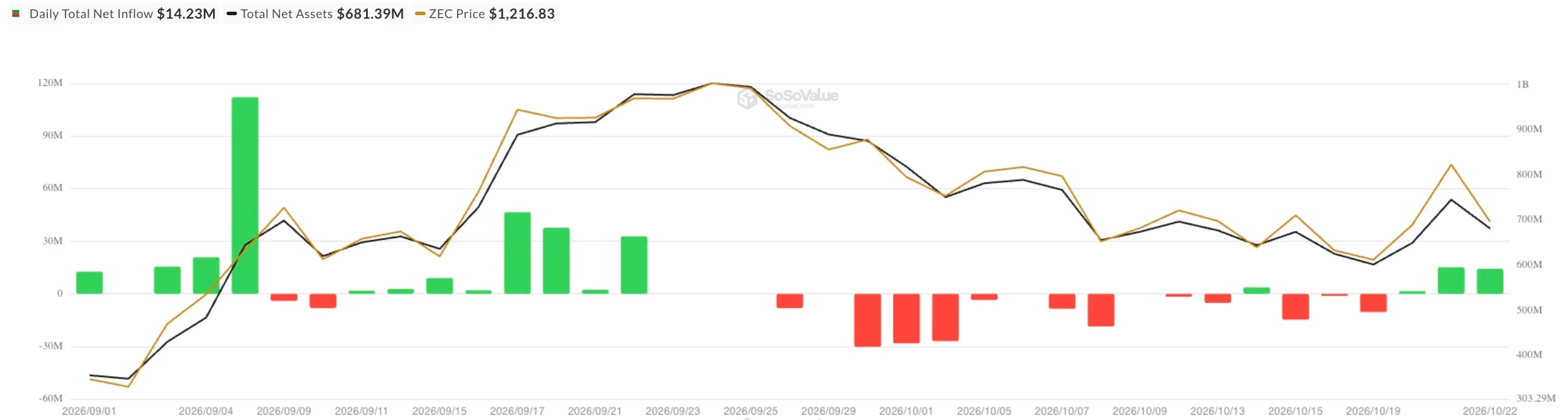
The strongest performance against the trend was achieved by Grayscale's spot Zcash ETF ( ZCSH ), which attracted a net inflow of 14.23 million US dollars on that day. Following inflows of 23.16 million US dollars and 12.88 million US dollars in the previous two trading days, this marks the third consecutive day of capital attraction, pushing the total net asset management scale of the fund to 681.39 million US dollars.
Through this regulated tool, institutional investors directly hold 3.11% of the market value of Zcash. The daily trading volume of this fund is 63.33 million US dollars, and the price of the underlying asset is 1236.83 US dollars.
At the same time, the spot XRP fund recorded an inflow of $3.55 million, all from the Franklin Templeton product FBIT. The net changes for Bitwise, Canary, Grayscale and 21Shares on that day were all zero.
Fundstrat, co-founder Tom Lee, stated that this round of market activity represents a healthy correction rather than a bubble: short-selling large tech stocks has become too consistent, while the bond market is strictly restricting the inflow of speculative capital. XRP ETF has accumulated a net inflow of over $1.8 billion to date, with a net asset management scale of $1.49 billion, accounting for 1.01% of the token's market value, based on an estimated target asset price of $1.31.
During the morning session, market attention shifted from fluctuations in Bitcoin prices to conflicts among large companies. In the United States, the battle for control over privacy technology is intensifying, accompanied by fierce accusations of code plagiarism.
In the US market, a battle over open infrastructure centered around Zcash is underway, with participants including Cameron and Tyler Winklevoss of Gemini, as well as Barry Silbert, the founder of DCG. Due to the tracking of AI on public networks, there has been an increase in the market's demand for privacy. As a result, the miners Cypherpunk Technologies and Fortitude Mining under their control each hold approximately 20% of the network's computing power. Large funds regard this asset as a scarce alternative to Bitcoin with a fixed supply.
At the same time, a technological dispute is also brewing: DFINITY founder Dominic Williams has publicly accused NEAR Protocol of patent theft. Williams claims that a key component of NEAR Intents is based on DFINITY's proprietary ECDSA threshold signature algorithm.
"The algorithm that has been running for two and a half years, @hosseeb, @grok, and NEAR, is patented. It seems they also took vetKeys, but that's not the main point. Clearly, if you are mining the codebases, researching, and working on your competitors' work without communicating with them or citing them, then that is the risk you have to assume." — dom | icp (@dominic_w) October 23, 2026
According to him, the NEAR scheme is only run on 8 servers, which completely lacks decentralization; moreover, due to American laws and litigation risks, there are records of emergency rollbacks to a slower algorithm on the GitHub of NEAR. Against this backdrop, the NEAR token fell by 1.29%, trading at $4.96.
At the same time, funds are flowing into regulated Asian markets, and traditional financial giants as well as national regulatory authorities are introducing stablecoins on a large scale into the real economy.
A brief summary of other important events is as follows:
- HSBC launches RedCoin in Hong Kong: This banking giant with an asset scale of $3.4 trillion has officially deployed RedCoin ( RCHKD ), a stablecoin that has been licensed by the Hong Kong Monetary Authority and is 100% backed by the Hong Kong dollar. It is now available for immediate use by 3.3 million users of PayMe applications and can be used for payments within a network of 100,000 merchants.
- Korean Stablecoins Legalized: The South Korean government has recognized that stablecoins can be used as an official means of payment since December 3rd. To this end, the LG CNS department of the LG group has established a strategic alliance with Chainlink in order to digitize the Korean won in the local cryptocurrency market, which is worth 68 billion US dollars.
- Zcash Anniversary and AI Verification: The Zcash project celebrates its tenth anniversary online. A sum of $1,000 invested five years ago is now equivalent to $7,178. On November 5th, before the Network Upgrade 7 ( NU7 ) hard fork, developers used the Anthropic's Claude AI tool to perform formal verification of the code security.
- Based on RLUSD, Ripple liquidity: Ripple announces a partnership with Arf platform to provide cross-border liquidity for the RLUSD stablecoins on the XRP Ledger network. This project is preparing to launch a Web3 lending feature before the Ripple Swell conference, while traders on Kalshi are betting on the scenario of a price rise to $1.80 by the end of XRP.
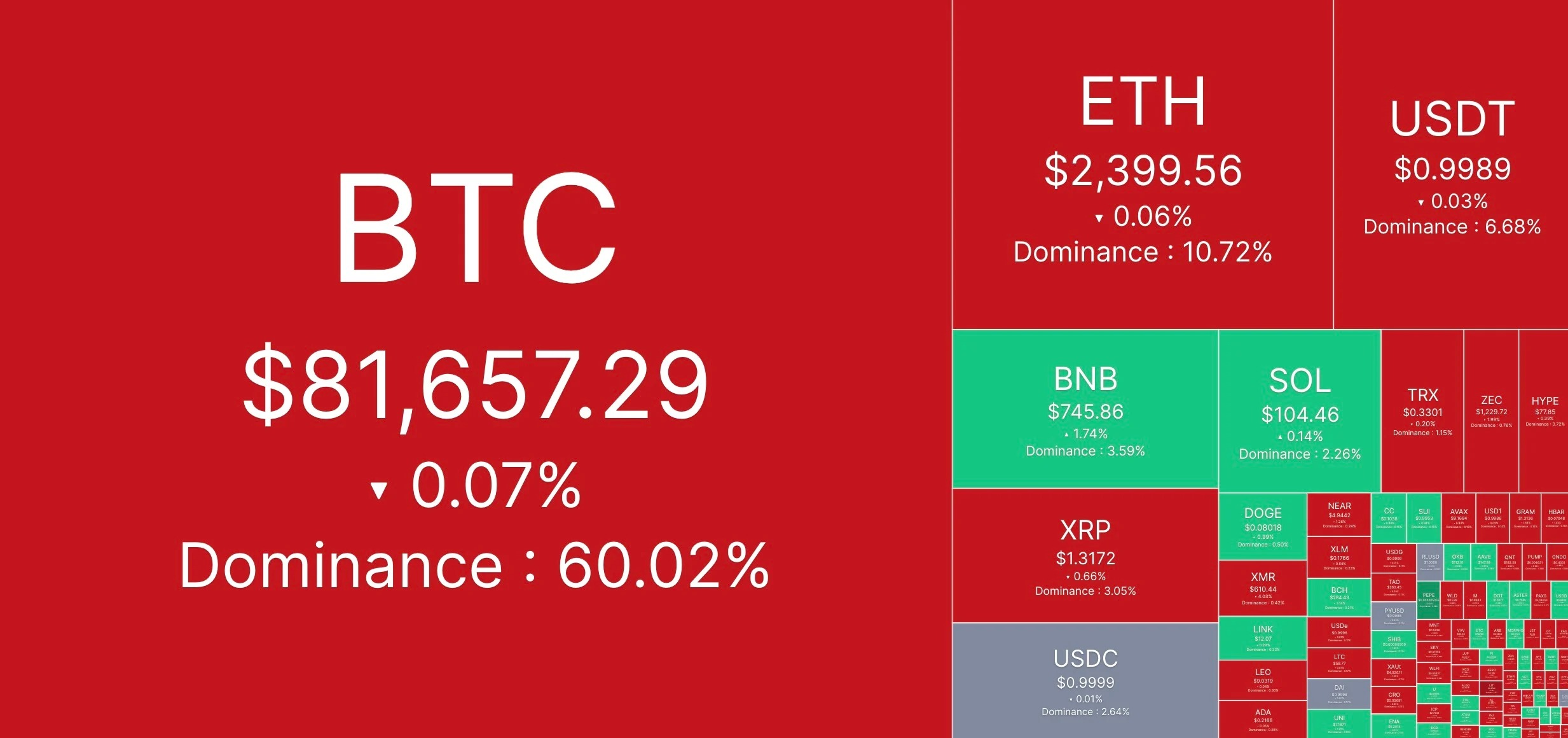
Bitcoin quotes remain at $81,657.29, down 0.07% in the past 24 hours, with a market share of 59.63%. The current decline is accompanied by the liquidation of margin positions. In the past 24 hours, a total of 82,246 traders in the futures market had positions totaling $332.09 million liquidated. The decline mainly hit the bulls: according to CoinGlass, 82.6% of the total forced closings came from bullish positions, amounting to $274.37 million.
The most affected were Ethereum derivatives, with a liquidation amount of 59.54 million US dollars, of which 82.1% was on the long side; Bitcoin derivatives had a liquidation amount of 52.28 million US dollars, with 87.3% also on the long side. Binance accounted for 45.5%, and the largest order appeared in the Hyperliquid XYZ : SOXL-USD trading pair, valued at 4.34 million US dollars.
This cycle of adjustments is in sync with the US tech sector; the SPDR Tech Sector Index (XLK) fell by 3.6%. After Meta disclosed that AI expenditures could reach up to $135 billion, the semiconductor sector almost fell by 7%.
Against the backdrop of Ethereum falling to $2,403.04, accounting for 10.72%, and Solana trading sideways at $104.46, the relative strength of XRP ($1.3172, up 0.66% daily) and Zcash confirmed a local rotation. The controversy surrounding the centralization of NEAR Intents is accelerating the flow of funds towards regulated exchange-traded products (ETF) in the United States that are based on protected protocols.
Indicators to pay attention to:
- Can the Bitcoin price range be maintained? Whether BTC can stabilize in the range of $81,700 to $82,000 will determine the speed of the market rebound.
- Zcash Hard Fork (November 5th): The launch of the NU7 upgrade is the main fundamental catalyst for maintaining institutional demand for ZEC.
- Ripple Swell Conference: Regarding the subsequent announcements regarding RLUSD stablecoins, it may drive XRP to break through the local resistance range of $1.32 to $1.50.
- ICP / NEAR Legal consequences of disputes: The stock price trend of NEAR Protocol will directly depend on the official response of DFINITY after filing charges in U.S. courts.