

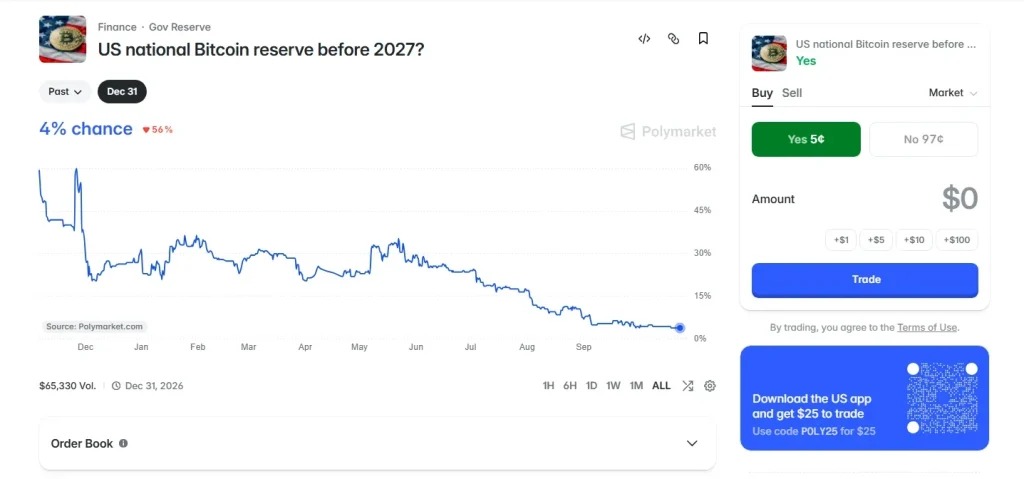
The "U.S. Reserves Modernization Act" ( ARMA / H.R .8957 ) was passed by the House Financial Services Committee on September 16, 2026. However, the current probability estimate for the U.S. to establish a national Bitcoin reserve by 2027 is around 4% to 9.5% according to Polymarket. The previous high point was around 60%, which occurred in December 2025, shortly after the executive order was introduced.
From today (October 24, 2026) until the 119th Congress expires on January 3, 2027, there is a remaining window period of 70 days, which includes:
- Unscheduled plenary votes in the House of Representatives;
- The Senate does not have any accompanying bills or committee procedures that are currently being advanced;
- With the Republican Party holding a majority of 53 seats, a minimum of 60 votes are still required to pass the filibuster threshold;
- Attach the provisions to the path of the National Defense Authorization Act ( NDAA ), whereas historical attempts to pass non-defense-related encryption legislation in this manner have failed.
The following is a step-by-step probabilistic assessment of the remaining legislative hurdles.
Core Key Indicators (as of October 26, 2026)
- 70 days: The number of calendar days remaining until the 119th Congress expires on January 3, 2027.
- 4%–9.5%: The odds that Polymarket will establish a reserve in the form of written law by the end of 2026.
- 49 to 50: The number of votes against the CLARITY bill at the Senate vote on September 15, 2026.
- $0: The amount of Bitcoin purchased by the Treasury Department from the open market in accordance with Executive Order No. 14233.
Legislative Clock: 70 Days and a Compressed "Lame Duck" Agenda
The constitutional term of the 119th Congress is January 3, 2027. Within the remaining 70 days, H.R.8957 must pass a vote by the entire House of Representatives, be approved by the Senate, and receive the President's signature.
However, the actual legislative schedule available for use is far less than 70 natural days:
- The members of the House of Representatives adjourned on September 17th and will not return until after the mid-term elections in November;
- The post-election "lame duck" session (lasting from mid-November to mid-December) usually consists of only 10 to 15 actual legislative/workdays;
- During the “lame duck” session of the Senate, voting time is often heavily occupied by matters that must be passed, such as federal appropriations, NDAA negotiation reports, and judicial appointments. Unnecessary standalone bills do not have institutional priority.
What is ARMA, and which contents have been rewritten or deleted?
H.R. The bill was introduced on May 21, 2026, by Republican Representative Nick Begich from Alaska and Democratic Representative Jared Golden from Maine. The original legislation authorized the Treasury Department to purchase up to 200,000 BTC per year for a period of five years, with a target total of 1 million BTC.
However, the version passed by the Financial Services Commission on September 16 with a vote of 28 to 21, along party lines, has been significantly amended under the alternative amendment proposed by Chairman Bryan Steil.
- Delete purchase authorization:Revoke the mandatory public market buying authority, and instead require the Ministry of Finance to complete a feasibility study within 180 days.
- Hosting and Locking Requirements:A 20-year lock-up period is uniformly set for seized or confiscated bitcoins, and a separate "digital asset reserve" is established for non-bitcoin assets.
- Audit:The requirement for quarterly cryptographic reserves certification will be changed to an annual audited report.
- Market Impact:The version passed by the committee is strictly speaking a custody and locking bill. Since it no longer contains requirements for purchases from the public market, there are no fiscal rating or budget disputes, making it easier to pass in the House of Representatives. However, its importance for short-term market demand has also significantly decreased.
Probabilistic Analysis: Step-by-Step Analysis of Remaining Levels
Step 1: Vote by the entire House of Representatives (simple majority threshold)
- Threshold: 218 votes are required out of 435 seats (the Republican Party holds a majority of 220 seats).
- Dynamic: Although the committee vote of 28 to 21 was completely along party lines, Jared Golden, one of the co-founders of the Democrats, is not part of that committee; therefore, it is not impossible to see cross-party support in the full-house vote.
- Main obstacle: Whether the House leadership will schedule a vote amidst the crowded and unproductive "lame duck" agenda.
- Probability of scheduling and passing: 55%–65%.
Step 2: Senate (60 votes required to terminate debate)
- The arithmetic of an independent bill: 60 votes are required to initiate the termination of debate. The Republicans hold 53 seats in the Senate, which means that at least 7 more Democratic senators need to switch their support. However, there is currently neither a corresponding Senate text nor a formal Senate committee hearing.
- Reference benchmark: The CLARITY bill, which had the support of a bipartisan committee, failed in the Senate on September 15, 2026, with a vote of 49 to 50, falling 11 votes short of the threshold to terminate debate.
- Probability (Senate passes it as an independent bill): 7%–10%.
Alternative path: serving as an additional clause for negotiation of NDAA
Incorporating the lock-up clause from ARMA as an additional provision into the National Defense Authorization Act for fiscal year 2027 ( NDAA ) would allow for a bypass of obstructive procedures, as NDAA is traditionally passed with over 80 votes in favor.
- Obstacle: During the negotiation process, the chairman of the Armed Forces Committee usually removes financial annexes that are unrelated to national defense, which is similar to the past failures encountered by SAFE Banking Act.
- Probability (to be retained in NDAA): 12%–15%.
Step 3: President's Signature
President Trump signed Executive Order 14233 in March 2025, requiring the federal government to retain seized crypto assets. Since the Steil amendment removed the purchase authorization, it also avoided opposition from the Secretary of the Treasury to public market expenditures.
- Conditional probability (if the bill reaches the president's desk): 95%.
Macro-chain market dynamics ( MVRV and exchange supply)
An analysis of the underlying blockchain structure highlights why the short-term price momentum weakened after the bill was revised from actively purchasing authorizations to locking in research results:
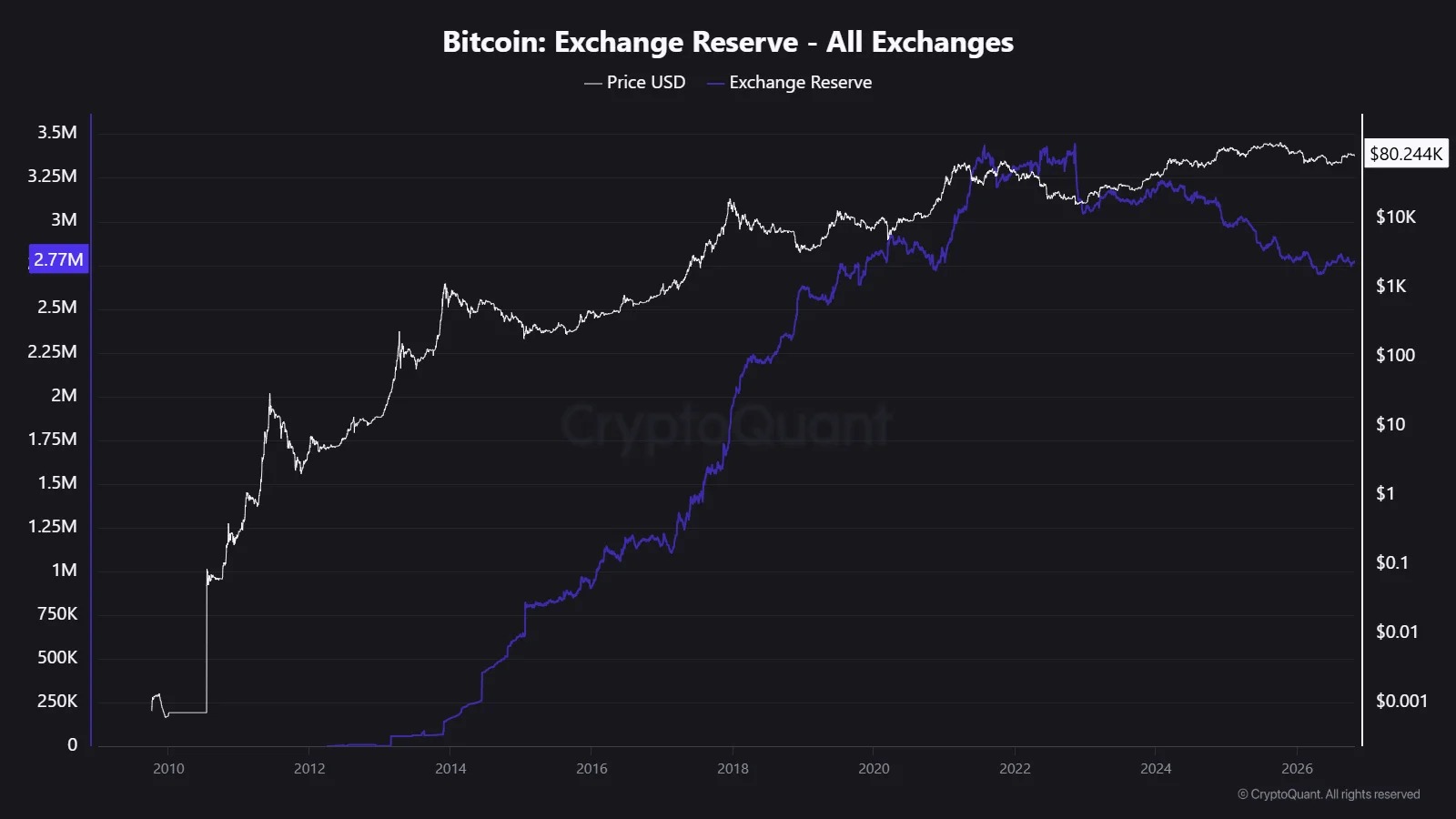
- Exchange reserves decline:The balance on the Bitcoin exchange is approximately 2.7 million BTC. If the purchase authorization of 1 million BTC as outlined in the original draft is carried out, it would absorb about 37% of the exchange's liquidity supply, resulting in a severe supply shock.
State-level and private sector actions, in contrast to federal-level resets
While federal legislation is still stuck in Congress:
- State-level reserves:Texas has passed SB 21 and will implement state-level Bitcoin purchases by the end of 2025. New Hampshire and Arizona have also passed similar framework laws.
- Corporate Increase in Holdings:MicroStrategy ( Strategy ) continues to increase its holdings of BTC independently of federal actions, holding over 848,250 BTC as of October 2026.
- 120th Congress Reset:If H.R.8957 fails to pass both houses by January 3, 2027, the bill will become invalid. It must be reintroduced from scratch during the 120th Congress, and a new coalition of co-sponsors must be established.
If ARMA fails: Reset the scenario.
Monitoring of blockchain addresses labeled as belonging to the U.S. government—such as the funds seized in the 2016 Bitfinex hacking case—shows that these assets are being actively integrated into the institutional custody system. In October 2026, 12,267 BTC were tracked as being transferred to internal cold storage related to the Treasury Department. This indicates that although Executive Order 14233 successfully prevented the assets from being liquidated, to legally convert the assets in these addresses into permanent national reserve funds, written legislative authorization such as that provided by ARMA is still required.