Key Points
- Ripple hopes to establish clearer rules regarding when the investment contract will terminate.
- The proposed Form TR should not become mandatory evidence.
- Exchanges may receive additional protection when relying on relevant declarations.
Ripple is requesting the U.S. Securities and Exchange Commission (SEC) to amend regulations regarding cryptocurrency projects to prove that their tokens are no longer related to securities-type investment contracts. The company believes that the proposed rules may create new uncertainties without providing additional protections.
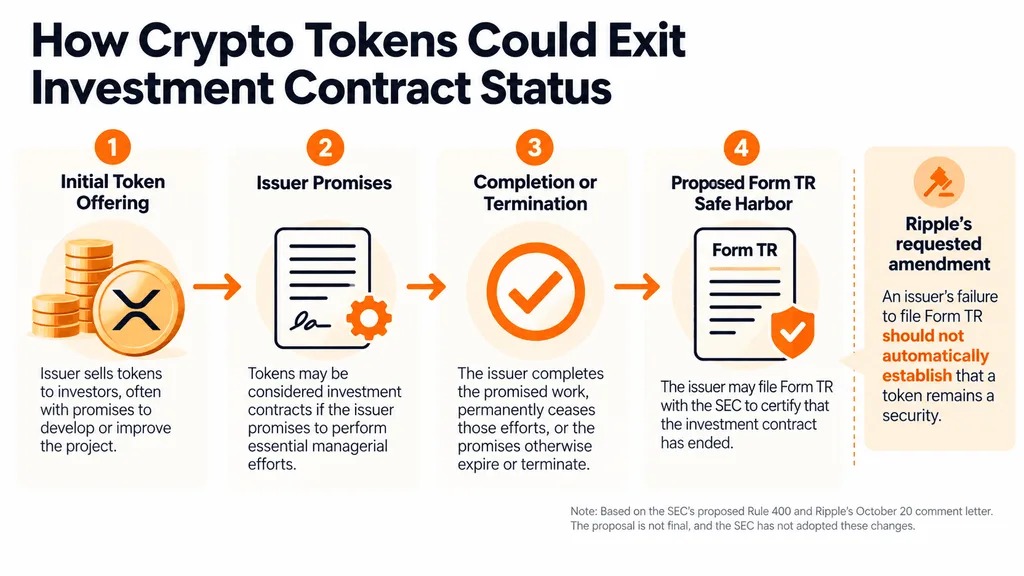
In an opinion letter dated October 20th, Ripple expressed support for SEC's proposal on "Regulation of Cryptocurrency Assets" ( Regulation Crypto Assets ), while also requesting modifications to rule Rule 400. This rule will establish a procedure that will no longer classify certain investment contracts as securities.
Ripple believes that just because the original issuer of a token once promised to develop or improve a certain project, it cannot be required to continue to bear the obligations of securities law indefinitely.
Ripple hopes that SEC can clarify when the investment contract will terminate.
SEC The proposed framework separates cryptocurrencies from the investment contracts to which they may be attached when sold.
According to the proposed Rule, eligible issuers may submit Form TR after completing or permanently ceasing the key management tasks previously promised to investors.
Ripple supports this mechanism, but hopes that SEC will acknowledge that investment contracts may also end when the commitments expire, are abandoned, or are terminated in other ways.
The reason this is important is that even if the developers of a particular blockchain are still active, the relevant legal obligations may have already expired.
Ripple had previously questioned SEC's reliance on "decentralized testing," stating that specific contractual commitments provided a more objective measure of performance.
Ripple is concerned that without this guarantee, future regulators may consider the absence of submitted documents as evidence that tokens are still related to investment contracts.
Ripple Why Hope to Secure More Protection for Crypto Exchanges
The proposal of Ripple involves more than just the token issuer.
The company stated that cryptocurrency exchanges, brokers, and traders need clearer regulations so that they can rely on publicly submitted Form TR certifications when deciding whether to support a particular transaction.
According to the approach suggested by Ripple, if intermediaries act in good faith, they should not face retrospective regulatory consequences merely because SEC later questions the authenticity of the issuer.
Ripple also hopes to adjust the proposed Rule by 500. This rule involves the issue of federal priority application in certain secondary market transactions.
According to the current draft, some conditions depend on whether the issuer continuously and timely fulfills its regulatory reporting obligations, which may expose intermediaries to compliance risks that they cannot independently control.
These issues follow closely on the broader cryptocurrency classification guidelines issued by SEC in 2026. Those guidelines distinguish investment contracts that associate digital assets with specific exchanges.
What might the proposed changes to XRP mean?
The XRP lawsuit of the company concluded in 2025, with both parties withdrawing their appeals. The important distinction between institutional sales and exchange trading for Ripple was thus maintained.
Earlier this year, Ripple also requested regulatory authorities to provide clarifications regarding XRP and other major cryptocurrencies.
At the same time, legislators are also considering similar issues through the CLARITY Act, reflecting that all parties are still making continuous efforts to clarify the regulation of digital assets.
The proposal on "Regulation of Cryptocurrency Assets" by SEC will also allow eligible issuers to raise a maximum of 5 million US dollars within four years, or up to 75 million US dollars within 12 months, provided that they meet the requirements for information disclosure and investor protection.
Ripple has previously indicated its support for these exemption arrangements, while emphasizing that regulatory clarity should not depend on years of litigation.
Author Marcus Hale introduces himself as a writer who focuses on Bitcoin, Ethereum, digital assets, regulation, ETF, and the encryption and financial markets adopted by institutions. His reporting focuses on developments that impact the market, investor trends, as well as the broader forces that shape the crypto economy.