The boom in artificial intelligence has been supporting U.S. economic growth for over the past year. However, Goldman Sachs' chief economist Jan Hatzius indicates that this support is about to peak; meanwhile, Apollo's chief economist Torsten Slok claims that the returns that were supposed to follow have not materialized.
In a report on Saturday, Slok wrote: 'Despite significant investments and widespread hype in the field of artificial intelligence, this technology has not brought any financial returns to American companies, except within the tech industry.'
In a report sent to clients on Monday, Hatzius stated that the growth momentum driven by the AI craze is expected to peak at the end of 2026 or the beginning of 2027, "even before recent concerns about the sustainability of the AI investment boom intensify."
Hatzius believes that AI is just one of the multiple reasons for the risk appetite shifting downward. Due to concerns about a potential escalation of tensions in the Middle East, prices of gasoline, diesel, aviation fuel, as well as natural gas in Europe and Asia, have returned to or surpassed their highs from March and April. Since the beginning of 2026, long-term interest rates on the yield curve in developed markets have risen by an average of about 100 basis points. Hatzius attributes part of this to large-scale deficits and "lending related to AI," and estimates that if this situation continues, it will drag down GDP by 0.6%.
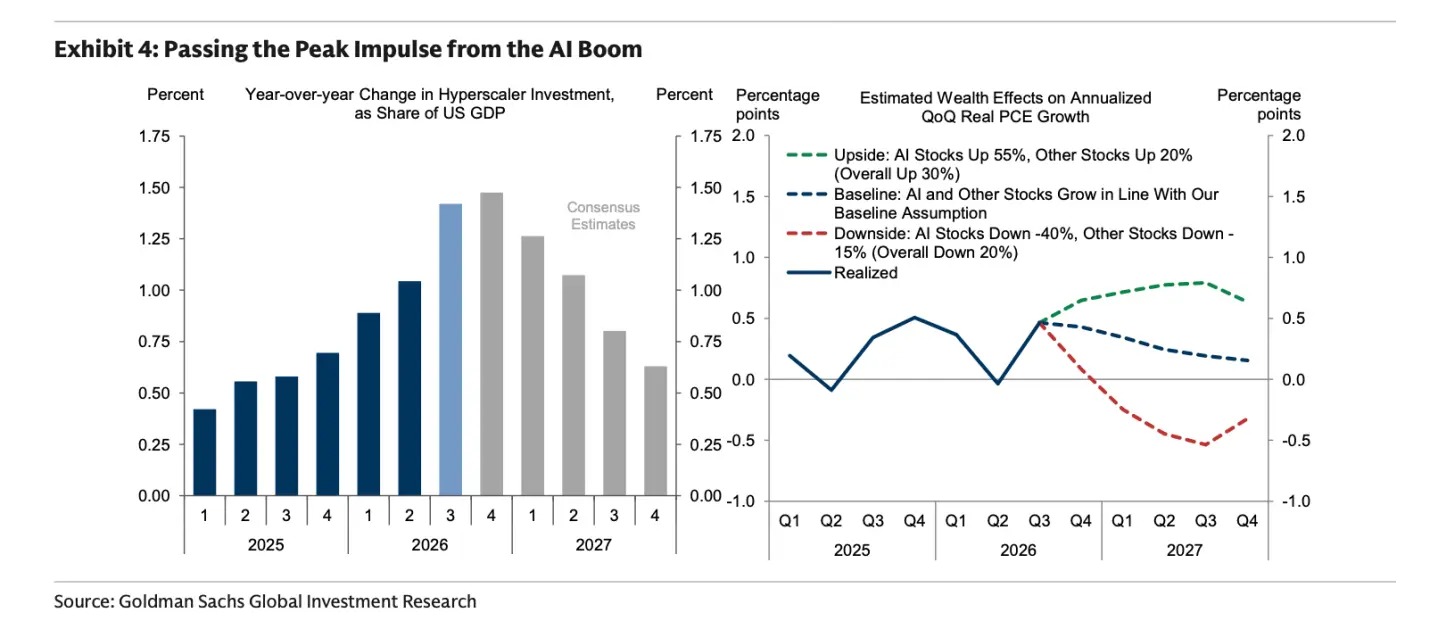
Hatzius writes that AI investment is still growing rapidly, but he expects its proportion of GDP to slow down in the coming year. Coupled with the gradual fading of the boost brought about by the increase in the US depreciation deduction policy last year, this will suppress the growth of capital expenditure, especially in the United States. (The One Big Beautiful Bill has reinstated 100% additional depreciation, allowing companies to immediately write off equipment purchase costs.)
This craze has also stimulated consumers through the stock market. Goldman Sachs estimates that the "wealth effect" brought about by AI has increased U.S. consumer spending by 0.4 percentage points over the past year, which is roughly equivalent to 0.25% of GDP. Hatzius predicts that this effect will decline in the coming year. If the stock market performance meets the "quite optimistic" expectations of Goldman Sachs strategists, this decline will be relatively slow; if stocks related to AI continue to fall, then the decline will be more pronounced.
S&P 493
The report from Slok explains why this boost is so concentrated. He writes that, after adjusting for inflation, per-employee income and profit margins have continued to rise among the “Big Seven,” while in what he calls the “S&P 493,” they have remained largely unchanged. According to the San Francisco Fed’s full-factor productivity indicator adjusted for utilization, productivity growth has not shown the improvement brought about by AI.
Slok writes: 'Without any impact on profits, mainstream American companies are contracting and beginning to regard token expenditures as a cost center, rather than a source of growth.'
He wrote that companies supported by venture capital are increasingly purchasing tokens, and cited data from the Ramp AI index as well as research by Ramp's chief economist, Ara Kharazian. Mainstream American companies "do not need the latest models, nor are they willing to pay for them."
Slok writes: 'As long as proxy AI and token expenditures remain limited to a small portion of the economy, the impact of AI on the macroeconomy will be very limited.'
Where the disagreement lies
Two economists have different views on what will happen next. Hatzius writes that Goldman Sachs' baseline scenario is that AI investments “will ultimately be rewarded with higher productivity and profits across the entire economy.”
Slok is not so sure. He writes that the question is whether mainstream companies can turn “increasingly affordable intelligence” into higher revenue and profit margins, as models are becoming more and more commoditized. “This might be harder than it sounds,” he says. AI may be a very good calculator, but in business, intelligence is mainly about judgment.
The optimistic assessment of Hatzius also comes with conditions. He wrote that one key channel for such returns is disruption in the labor market, 'and this will have negative macroeconomic effects in the short term.'
He wrote that the labor markets in developed economies are generally still strong. However, Goldman Sachs observes that the impact of AI is increasingly spreading beyond the tech industry. In the non-manufacturing sector in the United States, the proportion of companies that regularly use AI in their business functions now shows a statistically significant negative correlation with employment growth and a statistically significant positive correlation with unemployment rates.
This article utilized the generative AI for data retrieval and/or transcription. The journalist independently reported and verified the factual statements in the text, and manual editing was conducted before publication.