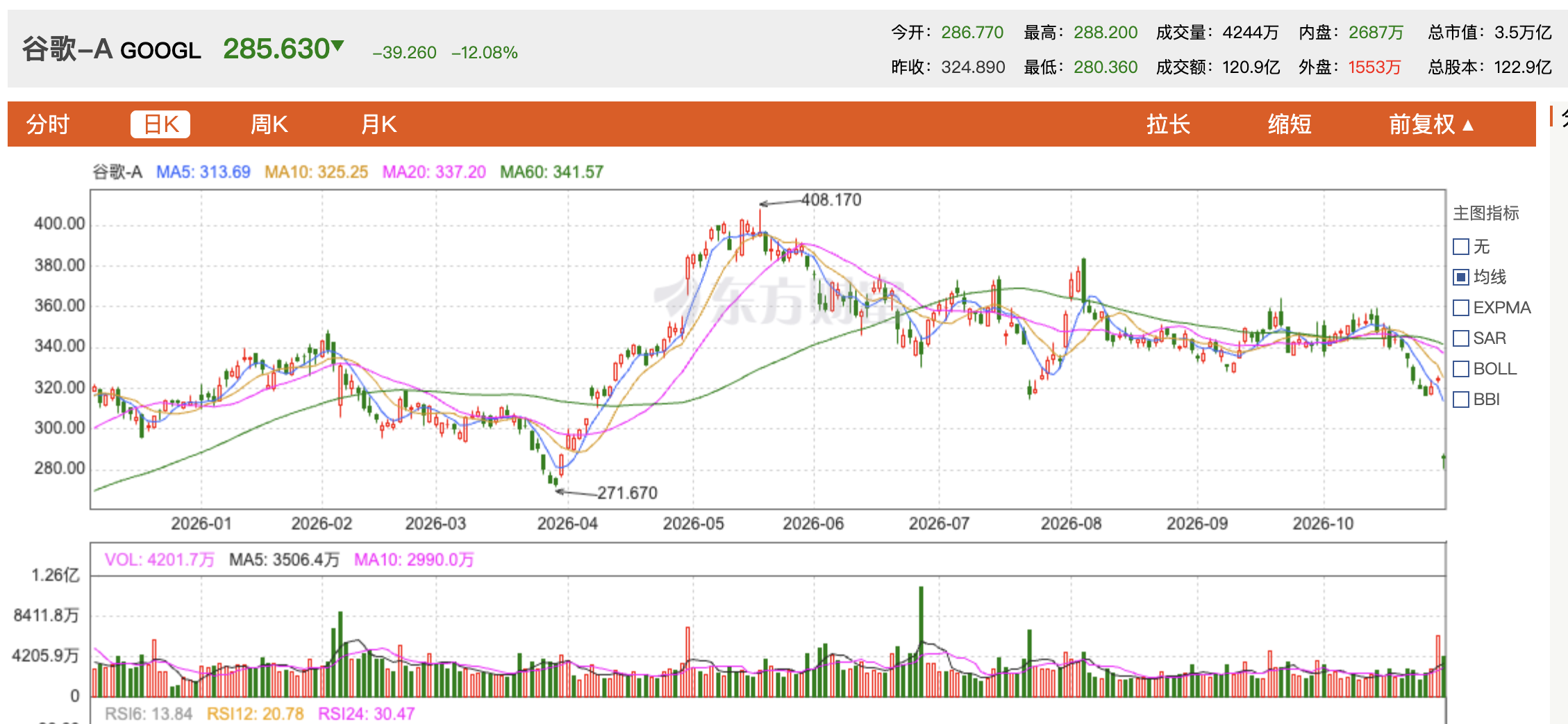
On the evening of October 29th, Beijing time, after the opening of U.S. stocks, Google ( GOOGL.US ) tumbled sharply, with a decline of over 13% at one point, setting a new record for the largest single-day drop in its history. Its market value decreased by more than $500 billion from the close of the previous trading day.
As of 22:10, Google's decline narrowed to around 12%, with a price of $285.63 per share and a total market value of $3.5 trillion. Compared to the closing price on October 28th, Google's stock price was $324.89 per share, with a total market value of $3.95 trillion.
Compared to the high of $408 per share on May of this year, Google has currently fallen by about 30%, erasing all of its gains for the year. Currently, Google has dropped from second place on the global market capitalization rankings to fourth place, behind NVIDIA, Apple, and Microsoft.
Today, Bank of America Securities lowered its target price for Google's parent company Alphabet from $430 to $380, while maintaining a "buy" rating. Oppenheimer also lowered its target price for Alphabet from $440 to $355.
On the news front, in the early hours of the 29th, Alphabet released its financial report for the third quarter of 2026, which fell short of market expectations in terms of both revenue and profit, and for the second consecutive quarter, its free cash flow was negative. Despite Google also launching a new generation of flagship models Gemini and Carbon to regain first place in the model rankings, this did not dispel investors' concerns.
Financial reports show that Alphabet had revenue of nearly $127.58 billion in the third quarter, a year-on-year increase of 25%, which is lower than market expectations; net profit was approximately $26.47 billion, a year-on-year decrease of about 24%, and net profit under non-U.S. Generally Accepted Accounting Principles (GAAP) decreased by 34% year-on-year.
Dolphin Research believes that Google's core financial indicators for the third quarter—search, cloud services, and profits—fell short of expectations, which is undoubtedly a further blow to Google, which already faces challenges in its narrative. The core issue with the financial report is that it portrays Google as more of a company that sells shovels, while at the same time causing its “money-making machine” of search to slow down.
Google's two core businesses are its advertising business and cloud business. In the third quarter, Google's cloud business saw accelerated growth, with revenue increasing by 103% year-over-year to $30.71 billion; Google's advertising business revenue was $82.01 billion, up 11% year-over-year. Among this, revenue from Google Search was $63.35 billion, showing a slowdown in growth rate.
At the end of last year, Google was highly sought after by the market due to its AI full-stack logic. However, this year, there has been a brain drain and a lag in the iteration of cutting-edge models, which has raised doubts and disagreements among investors. Dolphin Investment Research believes that although Google still has fundamental support from a long-term perspective, it lacks a strong driving force for a short-term rebound. The next catalyst for the stock price could be the launch of individual AI Agent to solidify traffic sources, as well as using TPU to secure more contracts and achieve large-scale deliveries.