Now, imagine repeating this process millions of times, while also keeping the delivery costs low enough so that customers are willing to place orders again.
This financial challenge is one of the reasons why DoorDash agreed to acquire Instacart for approximately $17 billion on October 29th. It is one of the largest transactions in the history of online grocery delivery.
Why is grocery delivery more difficult than delivering dinner?
Restaurants usually prepare the orders before the riders pick them up. In contrast, grocery delivery involves an additional step that relies heavily on manual labor: picking items one by one from the supermarket shelves.
Substitute products, refrigerated goods, bulk purchases, and delivery distances all add to the complexity of this process.
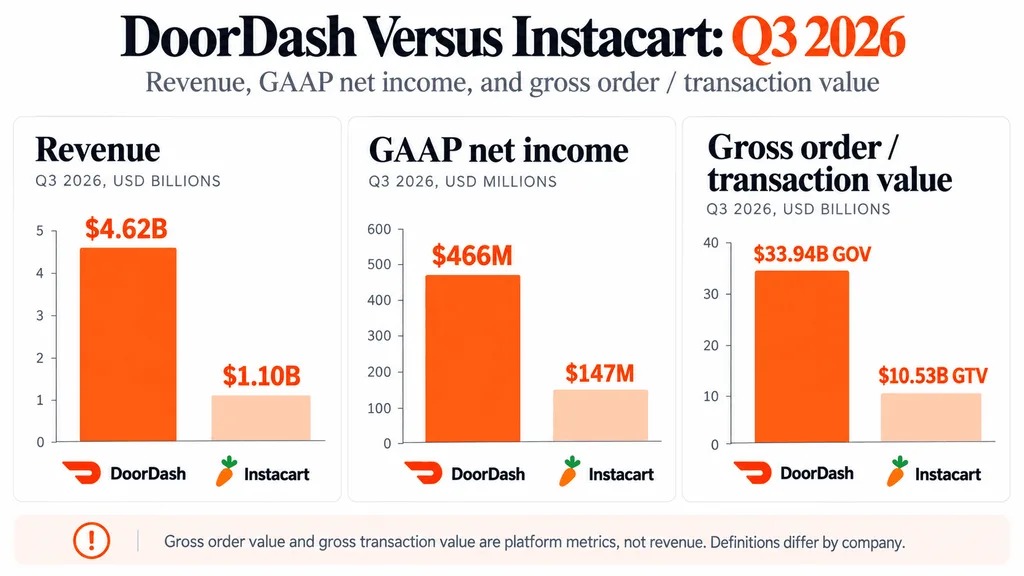
However, Instacart has already achieved profitability. In the third quarter, the company generated revenue of $1.095 billion and recorded a net profit of $147 million on the basis of total transaction volume of $1.053 billion.
This kind of pressure is not unfamiliar in the retail industry. Coinpaper has previously discussed how grocery chain companies struggle to cope in an environment of intensified competition and rising operating costs.
This merger may connect food delivery orders, supermarket purchases, and other local deliveries through a larger distribution network, thereby increasing the density of deliveries.
But a larger network does not necessarily automatically reduce the cost of each order.
This segment of business accounts for approximately 30% of Instacart's total revenue, indicating that the company's income does not come solely from grocery order delivery fees.
Retailers and consumer brands pay for visibility in shopping apps, which creates another source of revenue that is different from physical delivery services.
Member services provide another opportunity.
Costco Member business worth up to $5.91 billion indicates that sustained membership fees can support companies with lower profit margins on their products.
Why is DoorDash willing to pay $17 billion for scale?
What DoorDash acquired was not a startup that was still losing money and hoping to find a viable business model some day in the future.
What it acquired was a mature platform: with a quarterly order volume of 91.4 million, it has already achieved profitability in operations, and its technology is used by thousands of grocery retailers.
This strategy also reflects that competition is intensifying.
Wal-Mart has invested heavily in faster delivery and logistics, while Amazon continues to expand its grocery fulfillment capabilities.
DoorDash has previously also experimented with stablecoin payments, which could also become another way to reduce transaction friction. However, this measure is independent of the acquisition of Instacart.
Adrian Cole
Adrian Cole has been engaged in financial market reporting for over 6 years, with a focus on cryptocurrencies, stocks, and macroeconomic trends. He tracks Bitcoin, major altcoins, the U.S. stock market, interest rates, commodities, as well as data that drives market fluctuations. Over the years, he has written hundreds of market updates and analysis articles, with an emphasis on price trends, investor sentiment, and the connections between traditional finance and digital assets.