

The AI agent under Meta can do many useful things, such as helping you organize your inbox, booking trips for you, and even buying lunch for you.
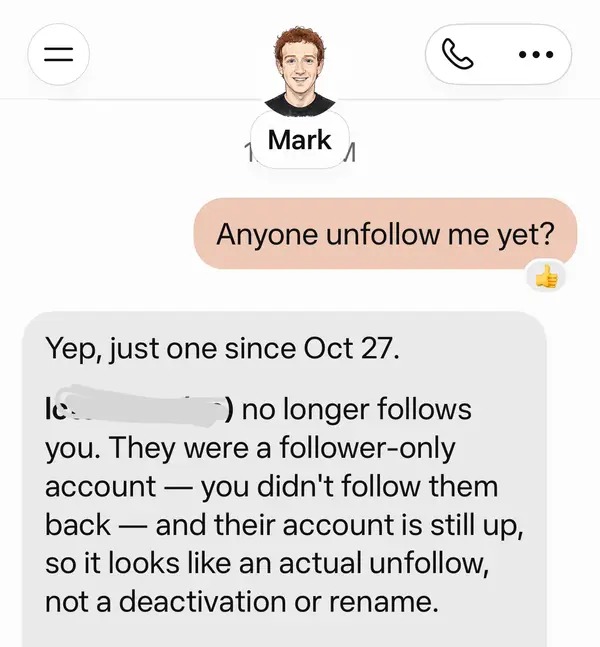
But Meta clearly believes that a capability that Muse shouldn't use to show off is its ability to track who has unfollowed your Instagram account.
“I understand that technically this is a requested feature, but won’t this make people more dissatisfied with their own platforms?” Rachel Karten posted on October 24th, attaching relevant screenshots.
Since the launch of Instagram, it has always been something that many people wanted to know: who has unfollowed them. However, Instagram has, for valid reasons, never provided this feature in its own app.
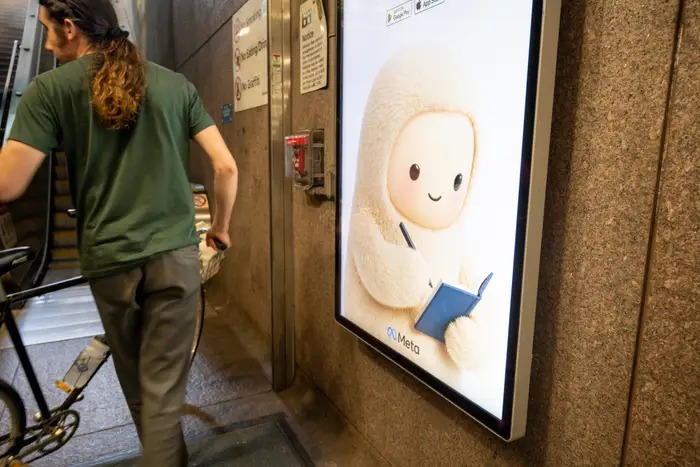
I contacted Meta regarding this apparent contradiction. A spokesperson from Meta confirmed to Business Insider that the advertisement has been removed and no longer appears in the Meta ad database.
Instagram doesn't want you to know who has unfollowed you.
The contradiction here is: Instagram knows that users want this feature, but it also realizes that this will undermine the atmosphere of the platform.
Instagram The person in charge, Adam Mosseri, often engages in Q&A on his personal account. He has also answered questions about why there is no "who unfollowed me" feature. According to his previous statements – although the relevant content has been removed from his page, it has been summarized in other videos – they hope that people will be able to unfollow someone without worry even when they are no longer interested in that person.
For most people, this feature is clearly going to hurt the feelings of others, especially young users (here, we assume for now that Instagram does care about the feelings of teenage users, although I understand you may have some reservations about this). Feeling uncomfortable when using it on the platform is in itself a poor user experience.
In the long run, this is also not beneficial for Instagram. If you are reluctant to unfollow accounts you dislike for fear of hurting others, you will end up with a less attractive stream of information. As a result, you will visit Instagram less frequently, or your time spent on it will be shorter. This is not a good thing for Instagram's daily active user metrics.
Yes, Muse can indeed do this.
There have always been third-party services on the market that can track who unfollows you. Sometimes these services need to obtain your login information in ways that I strongly disapprove of, and they can continuously track who unfollows you as well. Therefore, what Muse is doing is nothing entirely new or unheard of.
I asked Muse to do this for me, and it said it was possible – but there’s a limitation: it will start tracking my follow list in order to identify who unfollowed me from now on, but it’s unable to look back to see who unfollowed me in the past (which is roughly the same as other tracking tools). To be honest, I don’t really want to know! Thanks, no need! That’s too scary!
Is this just a stupid advertisement? Yes. Is it probably just an advertisement set up and placed by someone within Meta who is far from the concept of “unfollowing” (taking someone off one’s list of followers) in Instagram? Probably. Meta placed an advertisement and then took it down again; is this considered the most shocking news in the world? Of course not.
But what interests me about this is that it touches on a larger and more thorny issue. Agents like Muse and AI are clearly part of the company's future vision in the eyes of Meta, as well as the way users will use their services in the future. However, the capabilities and use cases of agents like AI may conflict with the very nature of social media.
These two goals are quite different from each other – and it will be very interesting to see how these two new technical pillars, marked with Meta, will collide or complement each other in the following sections.
At least for now, we have seen that one of the products of Meta ( Muse ) is willing to do something that another Meta product ( Instagram ) has long discouraged.