

São Paulo, October 30th / PRNewswire / -- Global leaders in the sugar and bioethanol industries, Copersucar, global providers of maritime, land, air, and logistics solutions, CMA CGM, the global bunkering trade leader under the Danish Bunker Holding Group, as well as the Santos Port Authority (APS), announced that Santos Port has begun to provide regular bioethanol bunkering services for ships.
The first order was completed this week, on October 19th, involving the addition of bioethanol to the CMA CGM IRON. This is a 13,000 TEU container ship equipped with the world's first certified three-fuel engine that can use bioethanol, the Everllence-B & W G95ME - C10.5-LGIM.
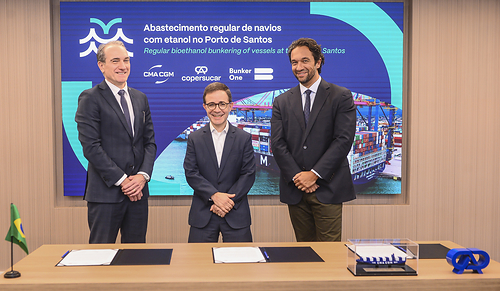
This initiative marks a transition from a pioneering experiment to a normalized supply model of bioethanol, enabling Port of Santos and Brazil to become one of the leading hubs for low-carbon fuel refueling. By the end of this year, it is planned to refuel several more CMA CGM vessels, with the fuel still provided by Copersucar.
The CEO of CMA CGM Brazil, Giovani Grassi, stated: "After the successful completion of our first operation in July, we have now entered a new phase, demonstrating that bioethanol can be safely, reliably, and on a commercial scale integrated into maritime operations. This move strengthens CMA CGM's commitment to accelerating the adoption of lower-carbon solutions and supports the development of a new energy ecosystem for the maritime industry."
The bioethanol provided by Copersucar comes from a mature and certified production chain. Sugarcane cultivation has mainly expanded to degraded pastures, while RenovaBio plans to establish strict sustainability and zero-deforestation standards.
This initiative also highlights its market potential. The global demand for marine fuel exceeds 270 billion liters per year. Calculated based on fuel energy equivalence, if only 10% of this demand is replaced, it could potentially create an additional market of about 50 billion liters per year for bioethanol.
Copersucar President Tom said, Manzano: "This initiative is a milestone for bioethanol and the maritime industry: it establishes the world's first green corridor for marine bioethanol refueling and opens up a new global terminal market for this fuel. With this move, Copersucar is connecting Brazil's production capacity and logistics infrastructure with international emission reduction demands, facilitating the entry of bioethanol into regular commercial operations. This marks the beginning of a new growth frontier for the industry, as this renewable solution now possesses the supply capacity, scale, and competitiveness required to advance maritime transportation."
This refueling operation involves the collaborative efforts of multiple partners, connecting all aspects of fuel production, transportation, storage, and refueling. The bioethanol produced by the associated sugar factory is supplied by Evolua Etanol and transported to Santos Port; Evolua Etanol is part of the Copersucar ecosystem, and the fuel is then stored by AGEO Terminais. This logistics infrastructure enables the use of biofuels for ship refueling.
During the bunkering process at the Santos Brasil terminal, after months of research and training by a professional team, Bunker One developed a pioneering procedure for Latin America, taking into account the low flash point of this fuel.
Santos Brasil CEO Ant ô nio Carlos Sep ú lveda stated that undertaking such business in Tecon Santos strengthens the company's commitment to the sustainable development of logistics in Brazil. "We have been working hard to reduce our own operational and customer operational carbon footprint. Contributing to the energy transition of the maritime industry is also part of this agenda."
Bunker One Latin American CEO Flavio Ribeiro stated: "Brazil has recognized the potential of bioethanol for decades. Now, we are bringing this experience into international shipping, combining Brazil's production capacity with the professional capabilities and global coverage of Bunker One. By leading this initiative, Port of Santos is positioning itself as a strategic destination for shipowners looking to reduce emissions, while other markets are still in the process of establishing regulations for such refueling."
The chairman of the Santos Port Authority ( APS ), Anderson Pomini, stated: " APS and all our partners involved in this project, as pioneers in global shipping and international maritime trade, have made history. The maritime industry handles over 90% of global trade transactions. By taking the lead in implementing bioethanol bunkering for ships, we have taken a decisive step towards a new era of sustainable development. We are very pleased and proud to have achieved this milestone."
The growth prospects of this market are also related to the evolution of the global fleet. According to data from Det Norske Veritas ( DNV ), 159 vessels are already equipped with methanol-compatible engines that can use bioethanol simultaneously, and it is expected that more than 450 new vessels equipped with this technology will be delivered by 2030, which should rapidly expand the potential market for bioethanol.