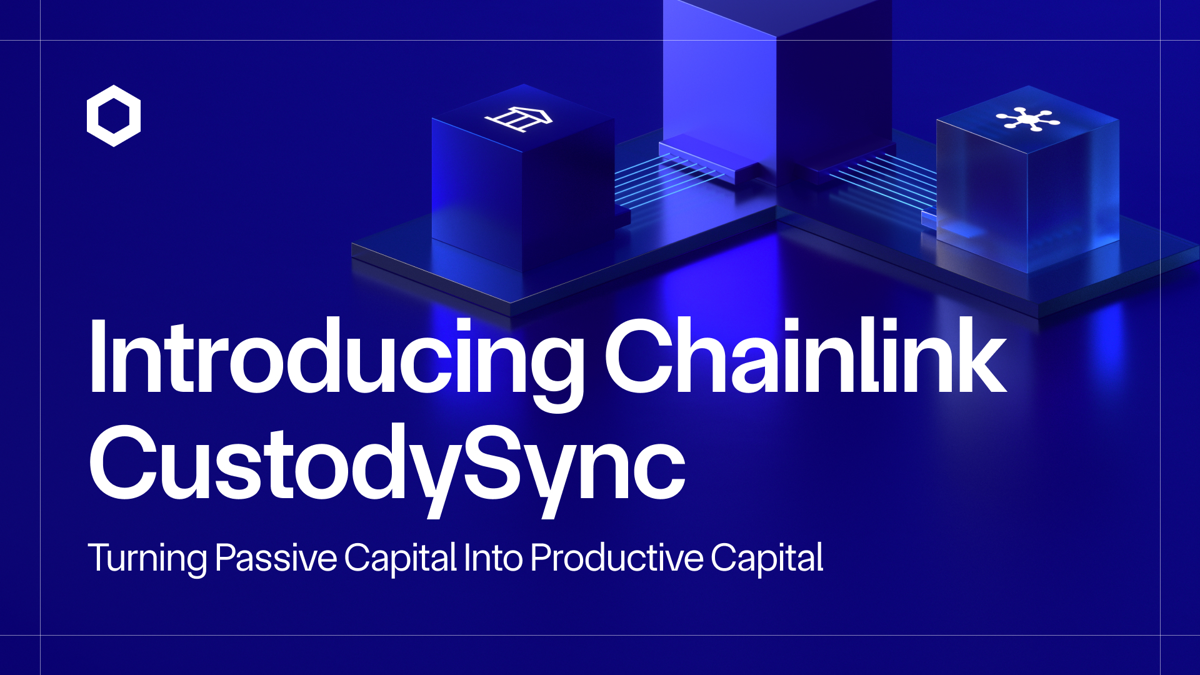


After institutions hand over their collateral to qualified custodian organizations, they can still obtain funds from the on-chain lending market. This is the approach outlined by Chainlink on October 26th when introducing CustodySync. The official first-party partner is Anchorage Digital Bank, which, in conjunction with its Atlas collateral management product, integrates the custodial arrangements familiar to institutions into the liquidity of DeFi.
The borrowing process has changed, but the location of assets remains within the original custody system. For institutions that have investment authorization and are subject to internal risk policy constraints, whether collateral can continue to be held by qualified custodians is directly related to the availability of a lending pathway. CustodySync attempts to address this gap between custody requirements and the needs for on-chain financing.
This product does not merge the two systems into a single ledger. The custodian continues to manage the collateral balance, while the on-chain market continues to provide loans. Synchronization is maintained in between through data and workflows. Understanding this division of labor is essential to clarify the responsibilities behind the description of assets on the chain: which party records the balance, which party quotes prices, and who is responsible for executing disposals when the collateral ratio exceeds the threshold.
One collateral; both systems must see the same status.
The first step described by the official guidelines is for institutions to deposit their assets with qualified custodian organizations. The Chainlink reserve certificate publishes the custodial balance onto the blockchain. Subsequently, a type of restricted-transfer token representing the custodial assets enters the on-chain lending market. The supply of these tokens reflects the amount of custodial assets, and they do not grant any rights to request access to the underlying assets outside of this lending mechanism.
The restrictions on credentials are crucial. Just because a mortgage is visible on the chain does not mean that it has become a regular token that can be freely circulated and independently exchanged for the underlying assets. The manner in which lending relationships are represented is different from how the assets themselves are kept and the rights are arranged. What institutions obtain is a financing channel, while the collateral remains within the custody framework.
When borrowing, funds are directly transferred to the borrower from the lending market. The borrowing, repayment, and accumulation of interest are automatically recorded in the custody records. The Chainlink runtime environment and the CRE monitoring custody system perform corresponding on-chain operations according to the authorization of the participants and synchronize the loan activities back. The continuity of this process relies not only on a single verification but also on each subsequent change in balance and debt.
The details that most significantly affect understanding are hidden within the price inputs. The on-chain lending market reads from Data Feeds, while custodian institutions receive the same price values through Data Streams. Officials point out that if different data is used on either side or there are delays, it may lead to different conclusions regarding the margin ratio: one side may deem it necessary to liquidate, while the other side may consider the position to still be healthy.
This kind of disagreement can turn the price issue into a loss allocation issue. Early liquidation may result in positions that are still considered healthy by the custodian; late liquidation, on the other hand, may lead to insufficient collateral to cover the loan. The purpose of a common price source is to allow both parties to use the same standard to calculate the value ratio of the loans. It addresses a link in state coordination, as the fluctuations in the prices of the borrowed assets themselves are still borne by the positions.
Sales after touching the line are still executed by the collateral agent.
The liquidation process reveals this institutional arrangement for maintaining connectivity. When the loan exceeds the agreed threshold, the appointed collateral agent sells the assets according to its own procedures. CustodySync records the proceeds from the sale that have been promised on the blockchain, maintains the position status during the settlement period, and finally completes the final settlement through a single atomic transaction.
Therefore, there is a clear role distinction between on-chain triggers and asset disposition. The market identifies risks in accordance with rules, acts as an agent to execute sales, and the system records the promised returns and settlement results. The operational capabilities of custodian institutions have not disappeared after integration; rather, they have become an important part of the entire loan lifecycle. For borrowing institutions and the funding market, it is necessary to understand how this chain of responsibilities is interconnected.
The standard smart contracts provided by Chainlink are deployed by lending markets or risk management parties to execute mortgage and loan operations. There are corresponding components for managed balances, prices, authorized actions, and loan records. This modular arrangement reduces the need for each custodian to develop connections individually, and also makes the interfaces and participants that must be verified during integration more specific.
As a result, the commercial gateway is opened to both sides simultaneously. Custodians can add lending services for existing customers, and the on-chain market can reach out to institutions that were previously restricted by custody policies. The officials have listed reduced operational costs and accelerated market access as product benefits, but they did not provide actual borrowing volumes or cost-saving measurements in this release.
The initial cooperation should also be understood within the original scope. As stated in Chainlink, the functions provided by each custodian may vary, and not all functions are necessarily available in Anchorage Digital Bank. Chainlink itself does not act as a custodian, lender, or counterparty in loan transactions. By reinstating this limitation into the chain of responsibilities, it can be avoided to mistake technical coordinators for fund keepers.
Institutions now have an additional option: while maintaining their custody arrangements, they can convert their assets into collateral for on-chain financing. The on-chain market gains new customer access, but it also has to accept the joint participation of the custody system, collateral agents, and final settlement in risk management. Changes in lending efficiency depend on whether both parties can continuously share the same position status, as well as whether sales and settlements can be completed according to pre-arranged plans when certain thresholds are reached.