Amazon's third-quarter financial report presents a clear duality: core operating profits exceeded expectations, and its much-anticipated cloud computing business AWS continued to grow at a high pace. However, the growth of its core e-commerce business was weak. The company's total revenue and EPS profits fell short of Wall Street's expectations, and AI related capital expenditures remained high, raising concerns in the market regarding free cash flow and the investment return cycle.
After the U.S. stock market closed on Thursday, September 29th, Eastern Time, Amazon announced that for the third quarter of this year, ending September 30, 2026, the company's net sales increased by 12% year-over-year to $20.194 billion, slightly below analysts' forecast of around $20.226 billion; diluted earnings per share ( EPS ) decreased by about 3.1% year-over-year to $1.89, while analysts expected a slight increase of 0.5% to $1.96; operating profit increased by 61.5% year-over-year to $28.08 billion, exceeding market expectations by more than 7%, and the operating margin rose to 13.9%, the highest level in the company's history.
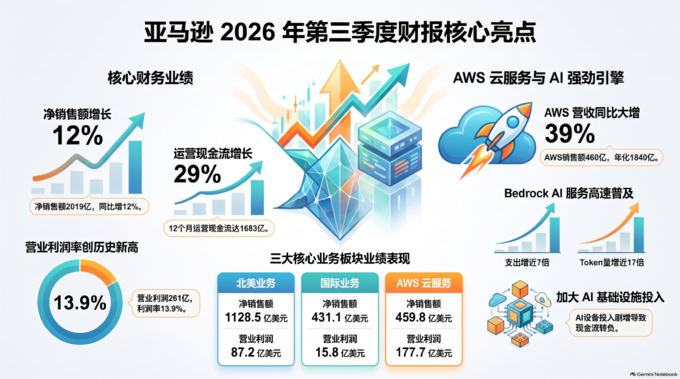
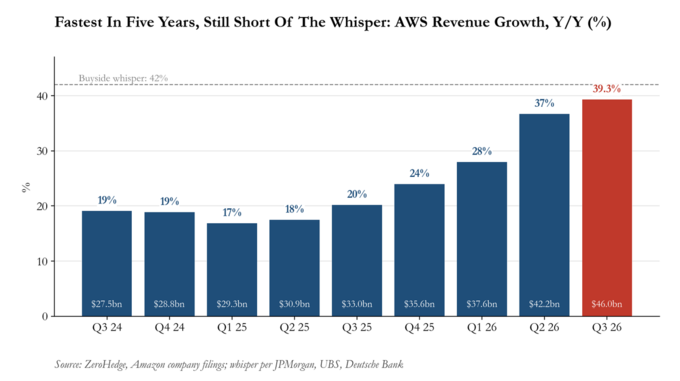
The biggest highlight of the financial report is still AWS. In the third quarter, AWS's net sales increased by 39.3% year-on-year to $45.98 billion, 1.3% higher than analysts' expectations, achieving the highest quarterly growth rate in nearly five years. The annualized revenue at the end of the quarter reached $184 billion, an increase of 8.9% from the end of the second quarter. CEO Andy Jassy emphasized in the financial report that investments in AWS in terms of functionality and infrastructure are paying off, and it expects that AWS revenue growth rates will exceed 40% in both 2027 and 2028.
Compared to AWS, online sales in the third quarter only increased by 2% year-on-year, marking the lowest quarterly growth rate since the beginning of 2023. Amazon's guidance for holiday season and fourth-quarter sales, which fell short of analysts' expectations, also indicates that its online business is unlikely to recover quickly in the short term.
Although AWS's revenue continues to grow strongly, the market is more concerned about the "cost." Amazon's capital expenditure on property and equipment in the third quarter amounted to $77.26 billion, which is approximately 1.2 times that of the same period last year and more than 34% higher than market expectations; free cash flow recorded a negative value for the second consecutive quarter, shifting from an inflow of $14.79 billion last year to an outflow of $42.36 billion, with the outflow scale far exceeding that of the second quarter. The company also maintained its guidance for annual cash capital expenditure of around $220 billion for 2026 unchanged and did not signal any slowdown in AI investment.
After the financial report was released, Amazon's stock price, which had already fallen by more than 4% on Thursday, tumbled further after the market closed, with the decline once exceeding 10%.
Revenues were slightly lower than expected, but the operating profit margin reached a record high.
In terms of overall revenue, Amazon's net sales in the third quarter were $20.194 billion, a year-on-year increase of 12%; if the impact of exchange rates is excluded, the growth rate is 13%.
Amazon would like to remind you that this year, the Member Day Prime Day has been moved up to the second quarter in most of the company's key market regions, while in 2025, Prime Day will fall entirely within the third quarter. As a result, the year-over-year growth rate for the third quarter is affected by this timing discrepancy; however, if this factor is excluded, the year-over-year revenue growth rate for the third quarter is expected to be approximately 400 basis points higher.
On the profit side, the situation is significantly stronger. Amazon's operating profit in the third quarter was $28.08 billion, a substantial increase of 61% compared to $17.42 billion in the same period last year. The operating margin also rose from 9.7% last year to 13.9%. This indicates that even though revenue was slightly lower than expected, improvements in efficiency in areas such as fulfillment, sales and marketing, and administrative expenses still supported a record-high operating margin.
Net profit was $20.69 billion, lower than the $21.19 billion in the same period last year; the diluted EPS was $1.89, a year-on-year decrease of 3%. This year-on-year decline is largely due to the high non-operating base from the same period last year – in the third quarter of 2025, Amazon recognized $9.5 billion in pre-tax income from Anthropic investments, while there was no similar income this year. Other revenue/expense items shifted from a positive $10.19 billion in the same period last year to a negative $700 million this year.
In other words, this financial report reflects not a slowdown in operating profits, but rather revenues and earnings per share falling slightly below expectations. Coupled with the pressures of non-operating items and capital expenditures, this has weakened investors' confidence in short-term returns.
AWS Continues to Accelerate: AI Requires Support for Cloud Services, but the Market Also Demands Returns on Investment
AWS was the most outstanding business line in the third quarter. The department's net sales amounted to $45.98 billion, a year-on-year increase of 39%, exceeding analysts' expectations of around $45.4 billion. The year-on-year growth rate further accelerated from about 37% in the second quarter, continuing to set the highest growth rate since the fourth quarter of 2021; AWS achieved operating profits of $17.77 billion, a year-on-year increase of 55%, with an operating profit margin of 38.7%, which is higher than the 34.6% from the same period last year.
In terms of revenue structure, online sales in the third quarter amounted to $68.5 billion, accounting for one-third of Amazon's net sales. AWS sales accounted for 23% of the total, which is higher than 18% in the same period last year, yet they contributed about 63% of Amazon's overall operating profit. This indicates that Amazon's profit pool still relies heavily on its cloud business, and the re-acceleration of AWS is crucial for supporting the group's valuation.
Financial report disclosure shows that AWS has recently signed new agreements with Meta, NVIDIA, OpenAI, Salesforce, Oracle, Qualcomm, Verizon, and others. Amazon Bedrock continues to grow rapidly, with Fortune 500 companies spending nearly 7 times more on Bedrock this year compared to last year, and the overall token volume has increased by nearly 17 times year-over-year; Bedrock AgentCore now has tens of thousands of customers using it, and the number of agents deployed in the third quarter exceeded twice the total of the previous three quarters.
Jassy also has a very aggressive stance on the prospects of AWS. He stated that AWS's annualized revenue operating rate in the third quarter has reached $184 billion, and he expects that the revenue growth rate of AWS will exceed 40% in both 2027 and 2028. He also mentioned that there has never been a company with a revenue scale of one trillion dollars in history, but Amazon may have two such businesses in the next 5 to 10 years.
But this is also where the market divergence lies: The growth of AWS indicates that the investments in AI are being transformed into demand. However, high growth also requires substantial investments in computing power, data centers, and chips. Investors are not denying the recovery of AWS, but they are re-evaluating how much cash flow such growth will consume.
AI Capital expenditure becomes the core of stock price pressure: Free cash flow turns significantly negative
Capital expenditure is the key factor that has triggered a negative market reaction to this financial report.
In the third quarter, Amazon spent $77.26 billion on property and equipment acquisitions, far exceeding the $35.1 billion of the same period last year and surpassing market expectations of $57.47 billion. Over the past 12 months, the company's net expenditure on property and equipment acquisitions reached $210.66 billion, a year-on-year increase of 82%. Amazon has made it clear that this growth mainly reflects investments related to artificial intelligence.
The cash flow statement shows that in the past 12 months, Amazon's operating cash flow was $168.3 billion, a year-on-year increase of 29%; however, its free cash flow was $42.36 billion outflow, which is about 5.6 times the $7.6 billion outflow in the second quarter, and last year at this time it was an inflow of $14.79 billion. In other words, the company's main business's ability to generate cash is still strengthening, but the pace of investment in AI infrastructure is even faster, and it has already consumed and reversed the free cash flow.
The balance sheet also reflects expansionary pressures. As of the end of the third quarter, Amazon's cash and cash equivalents amounted to $55.78 billion, lower than $86.81 billion at the end of last year; long-term debt rose to $173.13 billion, compared to $65.65 billion at the end of last year. In the third quarter, the company incurred an additional $48.1 billion in long-term debt financing, bringing the total long-term debt financing for the first three quarters to $115.1 billion.
For growth-oriented technology companies, capital expenditure is not necessarily negative, especially against the backdrop of a rebound in AWS growth. However, when capital expenditure in the third quarter far exceeded expectations and free cash flow turned significantly negative, while the company still maintains an annual forecast of approximately $220 billion in cash capital expenditures, the market naturally wonders: When will the AI investments begin to yield returns? Will they continue to put pressure on cash flow in the coming years?
North American and international operations: Revenue was affected by the Prime Day misalignment, but profits have improved significantly.
Retail-related businesses may not show strong growth on the surface, but there has been a noticeable improvement in profitability.
North American business reported net sales of $112.85 billion in the third quarter, a year-on-year increase of 6%, slightly below the market expectation of around $113.39 billion; operating profit was $8.72 billion, a significant increase of 82% from $4.79 billion in the same period last year, and the operating margin rose from 4.5% to 7.7%.
International business net sales amounted to $43.11 billion, a year-on-year increase of 5%, which is also slightly below expectations; if the impact of exchange rates is excluded, the growth rate is 8%. The operating profit for this segment was $1.58 billion, higher than the $1.2 billion in the same period last year, and the operating margin increased from 2.9% to 3.7%.
Amazon explained that changes in the timing of Prime Day affected the revenue growth rate in the third quarter. Online store revenue amounted to $68.47 billion, with only a 2% year-on-year increase; third-party seller services revenue was $46.49 billion, up 9% year-on-year; physical store revenue was $5.71 billion, also up 2% year-on-year. The number of paid products globally increased by 12% year-on-year, and global transportation costs increased by 11% year-on-year, indicating that order volumes were still growing, but the revenue structure was affected by the timing of promotional activities.
Therefore, the retail business cannot be simply understood as a deterioration in demand. More accurately, retail revenue in the third quarter fell short of market expectations, but improvements in profit margins and delivery efficiency continued. The company stated that Prime members experienced the fastest delivery speeds in the same period of history during the third quarter, with over 1.5 billion items delivered on the same day or the following day.
The slowdown in advertising business growth is another weak point in the financial report.
The advertising business's performance in the third quarter fell short of expectations, which is another factor that dampened sentiment, in addition to capital expenditures.
Amazon's advertising service revenue increased by 11% year-over-year to $19.64 billion, which is about 6% lower than analysts' expected revenue of $20.87 billion; excluding the impact of exchange rates, the growth was 12%. This growth rate is a significant slowdown compared to the previous quarters' growth of over 20%, and it is also lower than the market's expectation of around $20.87 billion.
The company stated that advertising revenue is affected by the Prime Day time point as well as several other temporal factors, and it expects that the year-over-year growth rate of advertising revenue in the fourth quarter will rebound to a high single-digit range. If this forecast comes true, the slowdown in advertising revenue in the third quarter may be more due to temporary disruptions rather than a structural slowdown in the advertising business.
However, the market is inevitably more sensitive in the short term. Advertising has been one of Amazon's businesses with higher profit margins and faster growth in recent years. Once the growth rate slows down, it will undermine investors' confidence in the retail ecosystem's ability to monetize. In contrast, subscription services have performed more steadily, with revenue in the third quarter reaching $14.01 billion, a year-on-year increase of 11%, which is higher than the market's expectation of around $13.69 billion.
The fourth-quarter guidance is not bad, but the median values for revenue and profit are below expectations.
Amazon's guidance for the fourth quarter was generally in line with Wall Street's expectations, but it did not bring enough surprises.
The company expects its net sales in the fourth quarter to be between $240 billion and $247 billion, representing a year-over-year increase of 12% to 16%, including an adverse exchange rate impact of about 60 basis points. The median of this revenue range is $243.5 billion, which is slightly lower than analysts' forecast of $244.52 billion, but the expected value falls within the guidance range.
More importantly, there is the guidance on operating profit. Amazon expects its operating profit for the fourth quarter to be between $28.5 billion and $33.5 billion, while the market is anticipating around $33.1 billion. In other words, the upper limit of the company's guidance is only slightly higher than the consensus forecast, and the midpoint of $31 billion is lower than expected.
This explains why the stock price reacted so sharply: revenue in the third quarter and EPS both fell slightly below expectations, advertising revenue was lower than anticipated, the profit guidance for the fourth quarter was on the weaker side, and at the same time, capital expenditures far exceeded expectations, with the annual AI investment plan remaining high. The strong growth of AWS and the historical highest operating margin are highlights of the financial report. However, in the current market environment, investors are more concerned about whether AI investments will continue to suppress free cash flow, and whether high capital expenditures can be converted into sufficiently high profits and cash returns within a visible period.