

After facing pressure for most of October, Stacks ( STX ) is now showing stronger signs of rebound. The token has risen to around $0.36, breaking through a downward resistance trend line on the 1-hour chart and once again standing above several short-term moving averages. At the same time, its Bitcoin staking program has also attracted attention, with the first two bonding periods attracting over 700 BTC. The combination of improved price momentum and increased Bitcoin participation is bringing STX back into the market's focus. However, will this latest rebound be sustainable enough to push the token towards even higher resistance levels?
Why are the prices of Stacks ( STX ) rising?
The latest rebound is fueled by the increasing activities surrounding the Bitcoin financial infrastructure related to Stacks. One of the key advancements is the expansion of Bitcoin staking, a mechanism that allows Bitcoin holders to participate in staking and earn rewards denominated in BTC while retaining control of their assets. The first two bonding cycles attracted a total of approximately 735 BTC, with 230 BTC in the first cycle and another 505 BTC in the second cycle.
The next round of the bonding cycle is expected to begin around November 10th, and the project will also transition to a monthly bonding window. As capacity expands, this expansion may increase the demand for STX, as the protocol will use STX and BTC together to support the capacity of bonding.
The network is still preparing for the upgrade to Epoch 4.1, with a target date of early December. It is expected that this upgrade will set Clarity 7 as the default version of the new smart contract and provide support for the further development of the ecosystem. Technical fixes and the renewed focus on Bitcoin staking seem to be supporting this broader narrative.
Stacks Price Analysis: STX Breaks Through the Downward Trend of October
After rebounding in the range from $0.27 to $0.28, STX showed a clear bullish trend on the 1-hour chart. The latest increase has pushed the token to around $0.368, breaking through the downward resistance trend line that had been suppressing attempts at recovery throughout the second half of October. This breakthrough has also enabled STX to stand above the short-term moving average, with the current price operating above $0.35. The increase in trading volume during this latest rise indicates an increased level of buy interest, but this breakthrough still needs to be sustained.
On the upside, $0.38 is the current resistance level. If it can remain above this level, it may create room for further gains towards the $0.40 to $0.48 range, where the next round of selling pressure could emerge. If it can break through this range more strongly, the short-term structural improvement will be further enhanced.
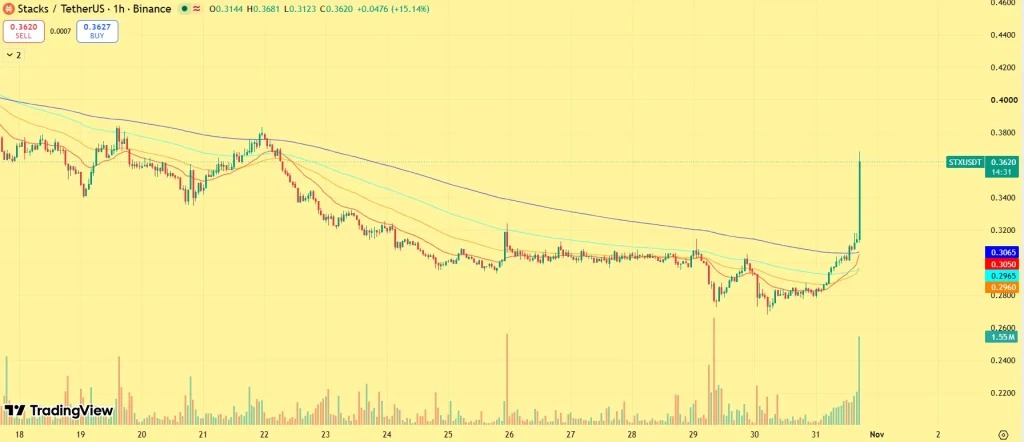
On the downside, $0.306 is the initial support level, followed by the psychological barrier of $0.30. If STX loses this area, the moving average cluster around $0.295 to $0.294 could become the next observation zone. A further decline to $0.28 would put the recent breakout at risk.
Can the next round of Bitcoin staking cycles enhance the demand for STX?
The upcoming bonding cycle may bring another important catalyst to the Stacks ecosystem. The first two cycles have shown that Bitcoin holders are willing to participate in this program, but the next phase will test whether this demand will continue as capacity expands.
Stacks has also set the target for Epoch 4.1 to early December. It is expected that this upgrade will set Clarity 7 as the default language version for the new smart contract, along with other improvements to the network. In addition to these advancements, the ecosystem is also working to extend the use of pledged Bitcoin to decentralized financial applications, including lending and yield-based products. If more BTC enter the network and are put to productive use, it may enhance the long-term logic of Stacks.