

As companies continue to innovate, Ukraine's uninterfered fiber-optic drones are flying farther and farther, but the question for one company is whether it is worth continuing to extend their range.
This type of drone can transmit commands and video via physical cables, making it immune to enemy electronic warfare, especially traditional radio frequency interference. The images provided by these drones are clearer than those from other FPV drones, and they can be used for both reconnaissance and attack purposes. As their range has increased, Ukrainian officials and companies have been expressing their celebration over this development.
However, a major Ukrainian manufacturer of fiber optics and interceptor drones, TechEx, told Business Insider that continuing to break these limits may not be worth it.
The company has already manufactured models with a maximum range of up to 35 kilometers and 40 kilometers. TechEx A senior executive Oleg stated that, for safety reasons, he is only willing to reveal his name. "We are currently considering whether it is still necessary for the next generation of fiber-optic drones to have a range of, for example, 45 kilometers or 50 kilometers."
He stated that the reason for his hesitation is that flying farther requires heavier spools, as well as larger batteries to support the additional weight of these spools. "This might affect the payload capacity of the drone."
So we're still figuring out whether such long-range FPV will actually be used on the front lines, or whether we'll stick to, for example, 40 or 45 kilometers.
UAV companies have always had to constantly balance the weight of cameras, explosives, weapon mounts, communication equipment, and other accessories. For manufacturers of fiber-optic drones, this balance is even more difficult to maintain, as they also have to carry a reel of cables.
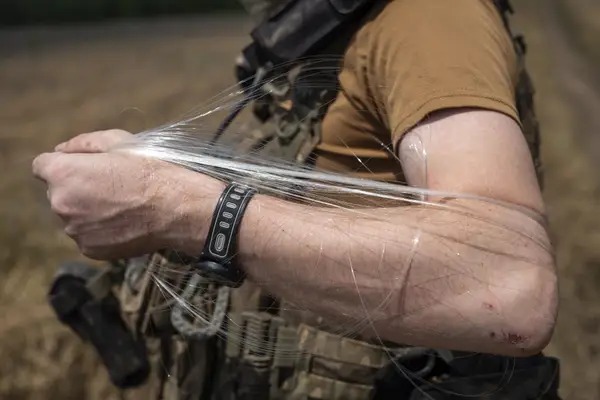
Some Ukrainian drone manufacturers also stated that for fiber-optic drones, a shorter range is actually more effective, as the longer the distance, the higher the risk of cable breakage.
The Ukrainian national-supported innovation platform Brave1 mentioned when introducing the Stalker XO -10 and Stalker XO -15 drones from TechEx that fiber-optic drones "have some limitations, including the need to carry a reel of cable, which is gradually released during flight, and provide communication for the operator."
"Since the spool itself has a certain weight, this will limit the payload of the drone," said Brave1, referring to unmanned aerial vehicles here.
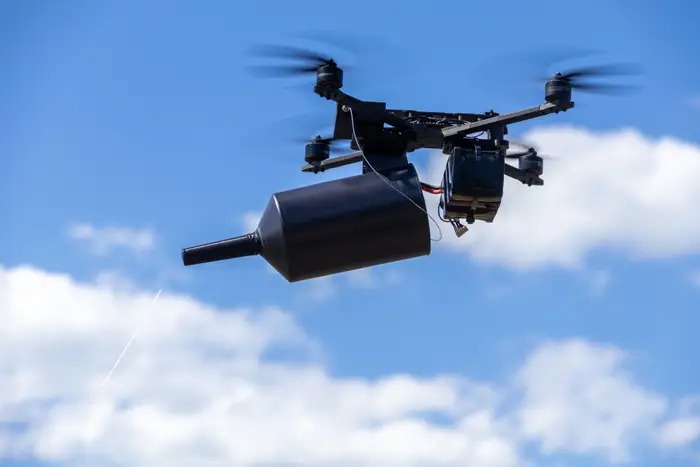
Brave1 indicates that TechEx has so far alleviated this cable weight limitation through 'good engineering solutions', and it is believed that their work 'allows these drones to achieve higher payloads while maintaining the other advantages of fiber optics'.
However, whether this remains true for longer voyages is still unknown at present.
TechEx represents that Olha told Business Insider, the company has developed technology to reduce the weight of spools, which is achieved through "subtle adjustments and changes" in the manufacturing method of spools and the way optical fibers are wound. Last year, the Ukrainian Ministry of Defense stated that the Stalker series of drones have a "record-low spool weight" among Ukrainian fiber-optic drones.
Not all companies view the trade-off between weight and range in the same way, which might be a good thing for Ukraine. Different combat units use a variety of drones from various companies to carry out different tasks, and soldiers say they appreciate this flexibility as it allows them to choose the most suitable equipment for each mission. Some tasks may require drones with longer ranges and smaller payloads, while others need stronger firepower over shorter distances.
Moreover, attack missions are not the only scenarios where the weight of explosives is a factor. Soldiers have described using fiber-optic drones and their onboard cameras for intelligence collection. However, this still presents trade-offs, as some higher-quality cameras are heavier.
Fiber-optic drones are just a part of Ukraine's continuously expanding arsenal, which also includes long-range strike drones, medium-range strike drones, and even heavy bombers. Many of these systems are capable of carrying payloads that are much heavier than those of small FPV drones. Each system has its own advantages and vulnerabilities, which forces manufacturers and soldiers to weigh which capabilities are most important for specific missions.
TechEx will continue to receive feedback and requests from troops that use its drones, and this information will influence the company's decisions regarding what products to manufacture.
Oleg said that the company has a technical support department that collaborates with over 100 operational units, which is why the products undergo changes almost every week, ranging from minor updates to major modifications.
Feedback, as well as field tests by military pilots and operators, is crucial to the company's work. It also drives the company to adopt some counterintuitive approaches, deviating from what it initially considered to be the most effective methods and those that best met the needs of the troops.
For example, the company's Striker drone interceptor prototype was initially much larger, with a payload of 1.5 kilograms. However, tests and feedback indicated that it needed to be smaller, more flexible, and did not require such a large payload.
Olha said, "We were able to completely redesign it, and in the end, it looks almost entirely different from the initial prototype." Developing new weapons of war is a process of continuous re-evaluation, rethinking, and ongoing evolution.