Although Apple's new CEO delivered a first report card that set a new revenue record for the fourth fiscal quarter, market sentiment weakened due to factors such as underperforming in the Greater China region, pressured gross margins during the holiday season, and an imbalance between supply and demand for foldable screen products.
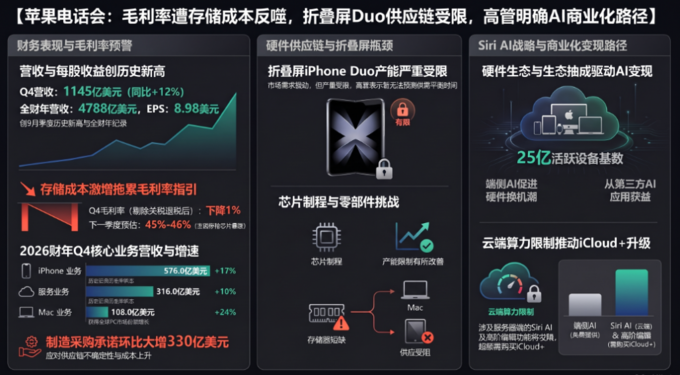
According to data disclosed by Apple, as cited by Wall Street Journal, after the U.S. stock market closed on Monday, November 2nd, Eastern Time, Apple announced that its revenue for the fourth fiscal quarter increased by 11.7% year-on-year to $114.477 billion, exceeding Wall Street's forecast of around $113.47 billion and also surpassing the company's previous growth guidance range of 9% to 11%.
However, despite fourth-quarter revenue exceeding analysts' expectations, weak sales in the Greater China region and holiday-season guidance that fell short of some optimistic forecasts continued to put pressure on the stock price, which once dropped by about 4% after the market closed.
Subsequently, the new CEO John Ternus attended a teleconference for the first time. He characterized the Chinese market as having "great momentum" and stated that the production ramp-up of foldable screen phones iPhone Duo is progressing smoothly, but supply constraints will continue to pose pressure this fiscal quarter.
Memory price pressures were a recurring core topic during this teleconference. Apple's management stated that the current trend in memory prices is 'unprecedented,' and the company has successively raised prices at Mac, iPad, and iPhone to partially offset costs; manufacturing and procurement obligations increased by $33 billion from the June quarter to the September quarter.
Apple has provided a gross margin guidance for the December quarter of 45% to 46%, which is a significant decline from 47.9% in the September quarter. Management attributes the main reasons to higher memory costs, as well as the cloud inference expenses incurred due to the launch of Siri AI.
In addition, Ternus has for the first time clarified the commercialization path for Siri AI. He stated that functions that rely on server-side models, including Siri AI and intelligent image editing, will have usage limits set in the future; users who require higher capacity can purchase extended access rights and incorporate them into the iCloud + subscription system.
Mixed performance: Total revenue sets a record, but the Greater China region fell short of expectations
Looking at the overall data, Apple's total revenue in its fourth fiscal quarter reached $114.5 billion, a year-on-year increase of 12%, exceeding Wall Street's forecast of $113.47 billion. Among this, the revenue from the iPhone business was $57.58 billion, also higher than the expected $56.49 billion.
Worldpanel Survey data shows that iPhone ranks among the best-selling models in the United States, China (urban areas), India, the United Kingdom, Germany, Australia, and Japan. Ternus stated when evaluating this performance:
Today, Apple is proud to report that its revenue for the September quarter reached a record $114.5 billion, an increase of 12% year-over-year... This marks a perfect conclusion to our best fiscal year ever. We are ending this year with the most ambitious product lineup we have ever had.
However, the market's focus quickly shifted to the Greater China region. Data shows that Apple's revenue in the Greater China region during its fourth fiscal quarter was $17.54 billion, which is lower than the market's consensus forecast of $18.75 billion, with a difference of nearly $1 billion.
In response to analysts' questions about the Chinese market, Ternus stated:
"We are very satisfied with our performance in the Greater China market, which is mainly driven by iPhone and Mac."
He also mentioned the recent trip of the senior management team to China, emphasizing that "there is a great momentum for growth there." However, the article cites Bloomberg analysis stating that the performance of the Greater China region did not meet market expectations, largely because the much-anticipated foldable screen phones iPhone Duo were not supplied in sufficient quantities during the fiscal reporting period.
AI Commercialization path begins to emerge: Setting a usage limit to promote iCloud plus subscriptions
In regards to the highly anticipated AI strategy, CEO John Ternus has referred to the latest AI driven version of Siri as a “new chapter” for the company, and has mentioned this multiple times during the conference call:
"This is the Siri we've always wanted."
Regarding how AI can generate revenue for the company, which is of concern to investors, Apple has provided a clearer path: the limitations of cloud AI will become a driving force for its service business.
Ternus reiterates that some server-side AI functions will have usage limits in place, with the aim of encouraging heavy users who wish to exceed the default usage limits to subscribe to the iCloud+ service.
However, the article states that Wall Street is not entirely convinced of Apple's narrative regarding AI. When asked whether AI intelligent agents will disrupt Apple's service business in the future, and when Apple will be able to launch intelligent agents that go beyond simple question-and-answer interactions, Ternus did not provide a direct answer, but only stated:
"Currently, Siri is request-based... but Apple has seen the opportunity to expand its functionality over time. The most important thing is to protect people's data."
In terms of service business, Apple's service revenue in the fourth fiscal quarter was $31.57 billion, a year-on-year increase of about 10%, which was generally in line with expectations. However, CFO Kevan Parekh provided a guidance for service revenue in the next quarter of only “8% to 9% year-on-year,” and the article suggests that this indicates that the growth rate of this high-profit business is slowing down.
Supply Chain and Guidance: Memory Costs at "Unprecedented Levels," Foldable Screen Production Capacity Still Rising
For the upcoming holiday season in December, which corresponds to the first quarter of the 2027 fiscal year, Apple has provided relatively positive overall revenue guidance. CFO Parekh indicates:
"We expect the company's total revenue for the December quarter to grow by 7% to 10% year-on-year, which reflects our best projections under the circumstances of limited supply. We anticipate that this will be the quarter with the highest revenue in the company's history."
Parekh further stated that the cloud computing inference costs associated with Siri AI will be included in the service sales costs, and will be recognized on a deferred basis in the same manner as Maps, Siri, and iCloud. These costs will be allocated over the usage period after the equipment is sold, which will have a certain negative impact on the gross profit margin of the hardware business for the December quarter.
He warned that the gross margin for the December quarter will be between 45% and 46%, which is lower than the analysts' forecast of 47% and significantly lower than the level of over 50% in the June quarter.
Management believes that the core issues affecting gross profit margins lie in costs and the supply chain. Ternus stated bluntly at the meeting that the continuously rising storage costs are "unprecedented" and warned that there will be even greater pressure on storage costs in the December quarter.
To address this situation, Apple's manufacturing and procurement obligations have increased by $33 billion over the past few months. COO Sabih Khan, who participated in the financial report Q&A session for the first time, added that as Apple transitions more of its product lines to 2-nanometer chips, supply chain constraints will continue to ease.
Regarding the foldable screen phones that have drawn significant market attention, iPhone and Duo, management acknowledges that there is currently a mismatch between supply and demand. Sabih Khan indicates that Apple is excited about the initial market response, and the capacity ramp-up of Duo is "progressing smoothly," but at the same time, he also admitted:
"At this moment, it is very difficult to predict when supply and demand will reach equilibrium."
Capital returns remain stable, and cash policy has become more flexible.
Apple's net profit for the fourth quarter was $30.7 billion, with earnings per share after dilution at $2.10, a year-on-year increase of 14%, of which tariff refunds had a favorable impact of $0.05; operating cash flow was $28.1 billion.
As of the end of the quarter, Apple held $137 billion in cash and marketable securities, with total debt amounting to $80 billion. During the quarter, the company returned $28 billion to shareholders, which included $3.9 billion in dividends and equivalent items, as well as $24 billion in stock repurchases.
The board of directors announced a cash dividend of $0.27 per share, which will be paid to shareholders registered as of November 12 on November 16, 2026.
Parekh reiterates that Apple no longer aims for net cash neutrality, but rather independently assesses its cash and debt positions to maintain flexibility. The company's capital allocation principle remains to prioritize investment in its business and to return excess cash to shareholders.
The text states that for investors, the key variables going forward will be the improvement speed of iPhone and Duo supply, the trend in memory costs, and whether Siri AI can translate into increased upgrade and service revenue while also bringing about cost increases.
Key points to note during the phone call
At the beginning of the teleconference, the person in charge of investor relations, Suhasini Chandramouli, stated that this discussion included several forward-looking statements regarding revenue, gross margin, operating expenses, taxes, and future business prospects. The actual results may differ significantly from the forecasts due to factors such as macroeconomics, tariffs, and legal and regulatory procedures.
In his opening remarks, Ternus stated that Apple's revenue for the September quarter reached $114.5 billion, a year-on-year increase of 12%, setting a new record for the September quarter and contributing to Apple achieving its best fiscal year revenue and earnings per share performance to date. He referred to iPhone Duo as "the most transformative iPhone since the first generation of iPhone," and noted that the company has just completed one of the periods with the highest number of product releases in its history.
He also introduced new products such as the MacBook Pro, iMac, 14-inch MacBook Pro, iPad, mini, Apple Watch, AirPods, HomeView, Apple TV, 4K, and HomePod mini. He emphasized that Apple is bringing a more powerful AI experience to all its products, including the “powerful and deeply personalized” Siri AI.
Ternus indicates that Siri AI launched a beta version for English-speaking users in the United States in September, and in October, it expanded to users of French, Japanese, Korean, Portuguese, and Spanish languages. He stated that Apple still has numerous opportunities in areas such as health, emerging markets, enterprises, and education. As an example, he mentioned that Apple recently reached the largest educational cooperation agreement in its history with the Philippine Department of Education, which will involve deploying 170,000 MacBook Neo devices for teachers and staff.
In terms of business breakdown, Apple disclosed:
- iPhone reported quarterly revenue of $57.6 billion, a year-on-year increase of 17%, despite challenges from supply constraints and unfavorable foreign exchange conditions.
- Mac reported quarterly revenue of $10.8 billion, a year-on-year increase of 24%, despite also facing supply constraints.
- iPad reported quarterly revenue of $6.2 billion.
- Quarterly revenue from wearable devices, smart homes, and accessories amounted to 8.3 billion US dollars.
- The quarterly revenue from service business reached $31.6 billion, a year-on-year increase of 10%, setting a new historical high.
Parekh stated in the financial review that this quarter's product revenue was $82.9 billion, a year-on-year increase of 12%; service revenue was $31.6 billion, a year-on-year increase of 10%. The company's overall gross margin was 47.9%, with product gross margin at 37.2%. Both benefited from tariff refunds, which had a positive impact of about 1 percentage point on the gross margin for the September quarter. Service gross margin was 76%, an increase of 40 basis points from the previous quarter. Operating expenses amounted to $19.2 billion, a year-on-year increase of 21%, reflecting Apple's continued investment in research and development.
He also stated that Apple's annual revenue reached $478.8 billion, a year-on-year increase of 15%; the annual earnings per share were $8.98, a year-on-year increase of 20%, both setting new historical highs.
Q&A session: AI cashing out, memory costs, and supply restrictions become focal points
During the Q&A session, analysts focused on asking about issues such as the release time of iPhone, the performance of iCloud, the AI intelligent entity, service business growth, gross profit margin pressure, memory procurement, the cost structure of Siri AI, and the supply-demand balance of iPhone and Duo.
For iCloud +, Ternus indicates that cloud service revenue in the September quarter reached a record high. iCloud + is a product that Apple "is very optimistic about." He mentioned that currently, the iCloud + plan has been incorporated into Apple TV and Apple Arcade in over 100 countries and regions, and Apple also believes that there are good opportunities for Apple Intelligence in terms of commercialization. For functions that rely on server-side models, including Siri AI and intelligent photo editing, usage limits will be set in the future, and users with higher demands can purchase extended access rights.
Regarding the potential impact on the AI intelligent agents and service business, Ternus stated that Siri AI is built on a modern orchestrator-driven architecture, which provides room for future scalability. However, Apple's primary focus remains on providing capabilities in a way that protects security and privacy.
Regarding service business growth, Parekh indicates that in the September quarter, service business grew by 10% year-on-year. Video, cloud services, payment services, and advertising all reached record highs, while music also set a record for the September quarter. Entering the December quarter, service business is expected to continue to face an external exchange rate headwind of about 0.5 percentage points. At the same time, App Store is still affected by the headwind of mobile gaming and adjustments to business models in some countries.
Regarding the gross margin issue, Parekh stated that in the gross margin guidance of 45% to 46% for the December quarter, most of the year-on-year decline will be driven by rising memory costs. Ternus noted that the current memory pricing trend is "unprecedented," with memory costs increasing from the June quarter to the September quarter, but this was partially offset by the advantage of carried inventory costs and a decrease in costs of some non-memory components; entering the December quarter, memory costs are expected to rise further.
Ternus added that Apple raised the prices of Mac and iPad at the end of June, and also raised the price of iPhone in September to partially offset cost pressures; however, after the December quarter, memory procurement prices are expected to continue to rise, while the cost benefits from carrying over inventory will gradually decrease.
Regarding the cost of Siri AI, Parekh indicates that as Apple continues to introduce Siri AI to more users, the related cloud costs will be included in the service sales cost. At the same time, the company will defer a portion of the revenue, just as it does for device-bundled services such as Maps, Siri, and iCloud, and will recognize this revenue gradually over the device's lifecycle. Both of these factors will have an impact on the gross margin.
For iPhone and Duo, Sabih Khan indicates that the initial market response has been very satisfactory for Apple. Currently, supply is still limited, and the increase in production is progressing smoothly. However, it is "difficult to predict when supply and demand will reach equilibrium." He also mentioned that during the September quarter, Apple faced supply constraints in iPhone, Mac, and iPad, mainly driven by high demand and insufficient flexibility in the supply chain. Entering the December quarter, supply constraints in Mac and iPad will be primarily due to memory, as demand has exceeded previous expectations.
Regarding the Chinese market, Ternus stated that Apple is "very satisfied" with its performance in the Greater China region. In the September quarter, revenue in this region increased by 21% year-on-year, setting a quarterly record, mainly driven by iPhone and Mac. For the whole year, the Greater China region saw a growth of 28%. He mentioned that consumers' response to the latest product lineup, including iPhone and Duo, has been enthusiastic, with the active device installation base reaching a historic high, and the number of upgraded users in mainland China iPhone also set an annual record.
Regarding capital allocation, Parekh reiterated that Apple no longer aims for net cash neutrality. Instead, the company independently assesses its cash and debt positions to optimize both while maintaining flexibility. However, the principle of capital allocation remains unchanged: priority is given to investing in the business, and any excess cash is returned to shareholders.
At the end of the call, Apple reiterated that its capital expenditure for the December quarter is expected to increase by 11% to 13% year-on-year, driven mainly by increased investment in research and development, particularly in the area of AI. Ternus added that the company is confident that the current level of investment is sufficient to support the established roadmap.