

Core Points
- US regulators give priority to the consequences brought about by AI over technical complexity.
- Simple bank agents can also pose significant financial risk exposures.
- When AI begins to utilize funds, manual supervision becomes of paramount importance.
An artificial intelligence system capable of solving complex problems may be more dangerous to banks than a basic program that can only execute simple instructions. The key difference lies in whether this software is truly able to allocate funds.
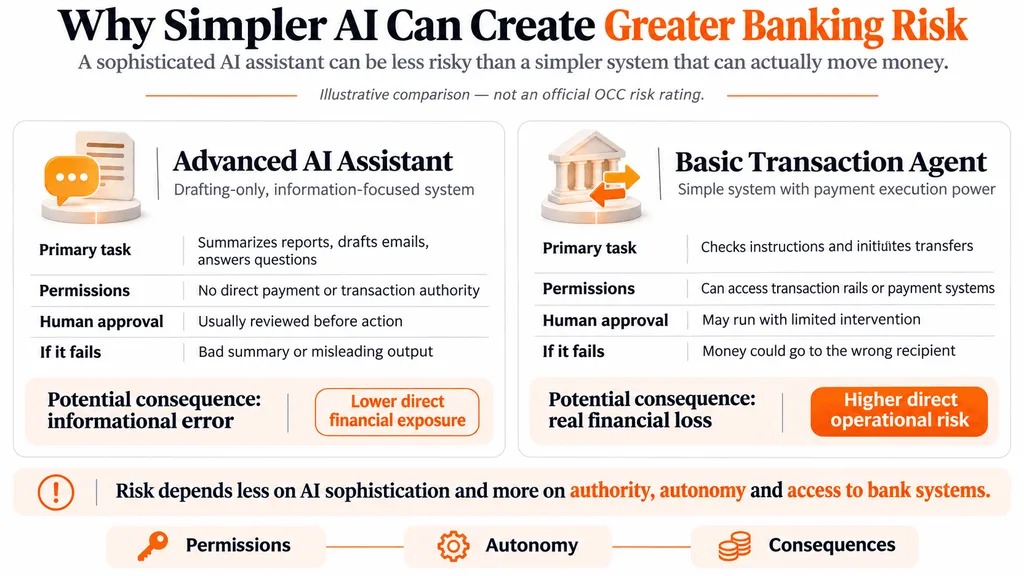
This judgment is at the core of a new regulatory framework issued by the US Federal Reserve (OCC) on November 4th. The regulatory agency believes that even a simple transaction processing agent may pose greater financial risks than a complex AI model that is limited to internal drafting work.
This guide does not specifically compare bank agents with ChatGPT. However, this principle helps to explain why the growing AI payment market brings risks that are not present in ordinary chat conversations.
Why a simple AI proxy might be more dangerous
Imagine that there are two systems running within the same bank.
The first system uses advanced AI technology to summarize financial reports, draft emails, and answer employee questions. It may occasionally provide inaccurate information, but its output is still subject to manual review.
The task performed by the second system is much simpler: to identify an approved payment and initiate a transfer. Although the required technology is less complex, it directly connects to the bank's transaction infrastructure.
If the first system fails, employees may only receive a misleading summary. If the second system misunderstands the instructions, it could transfer money to the wrong recipient.
The framework of OCC emphasizes potential consequences, permissions, and human supervision, rather than technical complexity. This is particularly important as autonomous payments move from experimental demonstrations to real financial transactions.
The real risk lies in granting AI the authority to act.
Traditional chatbots mainly generate information. The proxy AI system can also interact with external software, access sensitive accounts, and perform operations with limited human intervention.
This capability brings additional security issues. Tampered instructions, misinterpretations, or unauthorized operations could affect customer balances before anyone notices.
Recent incidents related to OpenAI proxies also indicate that even in legitimate tasks, automated systems can potentially weaken security measures. Although these incidents did not involve bank transactions, they highlight the broader challenges faced in supervising proxy systems that have operational permissions.
OCC lists several factors that should be considered when reviewing high-risk systems, including restricting autonomy, strengthening independent control, and conducting meaningful human supervision.
Why aren't regulatory authorities calling for a ban on AI?
Adrian Cole
Adrian Cole has been engaged in financial market reporting for over 6 years, with a focus on cryptocurrencies, stocks, and macroeconomic trends. He tracks Bitcoin, major altcoins, the U.S. stock market, interest rates, commodities, as well as data that drives market changes. Over the years, he has written hundreds of market updates and analysis articles, with an emphasis on price trends, investor sentiment, and the connections between traditional finance and digital assets.