


As the broader crypto market rebounds, Bitcoin prices have once again topped $80,000, Ethereum has risen above $2,400, and XRP has returned to above $1.30.
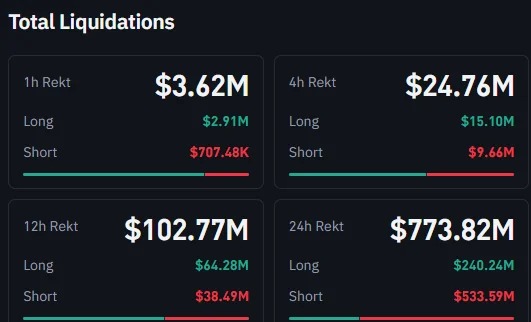
Within the past 24 hours, the amount of margin calls in the crypto market reached $772.75 million, of which short positions accounted for $534.38 million, exacerbating this round of rebound.
The decline in oil prices, the weakening of the US dollar, and the rebound in the US stock market have improved risk appetite, although recent short-covering activities indicate that market volatility remains high.
After the intense fluctuations triggered by the U.S. mid-term elections, the crypto market is experiencing a widespread recovery. Bitcoin has once again surpassed $80,000, and Ethereum as well as XRP have joined the rally, driving up major digital assets overall. The article states that this recovery is accompanied by a significant reduction in bearish positions, an improvement in the traditional market environment, and a renewed interest from investors in riskier assets. In the past 24 hours, nearly $773 million worth of crypto positions were forcibly liquidated. The key question at present is whether the improving market environment will be able to sustain this upward trend.
Why is the crypto market rising today?
The U.S. stock market rebounded after the fluctuations triggered by the mid-term elections, helping to restore risk appetite. On November 4th, the Dow Jones Index, the S&P 500 Index, and the Nasdaq Index all rose, while falling oil prices and a weaker U.S. dollar also provided additional support for risk-sensitive assets.
The article states that oil prices are particularly important. A decline in energy prices could alleviate concerns about inflation and reduce the pressure on interest rate expectations. This would help to improve the overall investment environment, however, the policy prospects of the Federal Reserve remain a key variable for the market.
Political background has also influenced trading. The results of the mid-term elections initially sparked uncertainty in the market regarding the future direction of US crypto regulation. However, investors seem to have re-evaluated its short-term impact, allowing digital assets to rebound along with the stock market.
The crypto market suffered a margin call of $772 million: short sellers incurred the greatest losses
This means that short positions accounted for approximately 69.2% of the total margin call amount. As prices rose, bearish traders were forced to close their positions, which in turn created additional buying pressure and accelerated the market rebound.
This change indicates that although bears have suffered most of the losses over the broader 24-hour period, the pressure faced by long traders has also been increasing during recent price fluctuations.
Bitcoin, Ethereum, and XRP lead the rebound
Bitcoin broke through $80,000, bringing a significant boost to the broader market. Ethereum once again reached $2,400, while XRP rose above $1.30. Their increases indicate that this round of recovery is no longer limited to Bitcoin but has extended to major altcoins as well.
In this round of rebound, Ethereum's percentage increase was stronger than that of Bitcoin, indicating that the market's interest in large-cap alternative cryptocurrencies has once again heated up. XRP also participated in the rise, although its increase was relatively modest.
The next challenge is whether these assets can hold onto the prices that have been recovered. Bitcoin needs to maintain a price of $80,000, while Ethereum and XRP need to sustain buying interest around $2,400 and $1.30 respectively.
Can this round of rebound continue?
The article argues that the crypto market has regained momentum, with supporting factors including an improvement in the macro environment, a rebound in the stock market, and a large-scale short squeeze. Bitcoin's return above $80,000 has also helped Ethereum and XRP to attract buying interest again.
The trend in the next phase will depend less on short covering and more on new spot demand, inflow of institutional funds, and an improvement in market participation, to see if these factors can support further price increases.