


Core Scientific is one of the largest companies in the field of Bitcoin mining and plans to gradually phase out its mining operations by the fourth quarter of 2026. It is not the only company doing so. Other large mining enterprises, including MARA Holdings, Riot Platforms, and HIVE Digital, have already begun to shift from traditional Bitcoin mining to other businesses.
But what drives these large companies to adjust their mining operations? The reasons might be surprising.
Core Scientific is saying goodbye to Bitcoin mining
During the third-quarter financial report conference call in 2026, Core Scientific confirmed that it expects to end its own mining operations by 2026. Starting from 2027, the company will focus on providing data center space for AI and high-performance computing.
This transformation has already been reflected in its financial results.
Core Scientific achieved managed revenue of $215.4 million in the third quarter, an increase of nearly 60% compared to the previous quarter. The managed business accounted for 93% of total revenue, while Bitcoin's own mining only generated $12.3 million in revenue. After adjustments, EBITDA also rose to $133.6 million, with a profit margin of 57%.
The company's active mining machine capacity as of the end of 2025 has decreased by nearly 50%.
It even paid $41.9 million to terminate the Bitcoin mining equipment agreements with Block and Proto, thereby ending future device deliveries.
Why are Bitcoin miners moving away from mining?
The economics of Bitcoin mining are becoming increasingly difficult for large, listed mining companies.
After the halving in April 2024, the block reward decreased from 6.25 BTC to 3.125 BTC. For listed mining companies, the average cost of producing one Bitcoin has risen to about $88,341. When the trading price of Bitcoin is at $80,000 or below, miners may incur losses for each coin produced. Even if Bitcoin briefly rises above $80,000, the profit margin remains very thin.
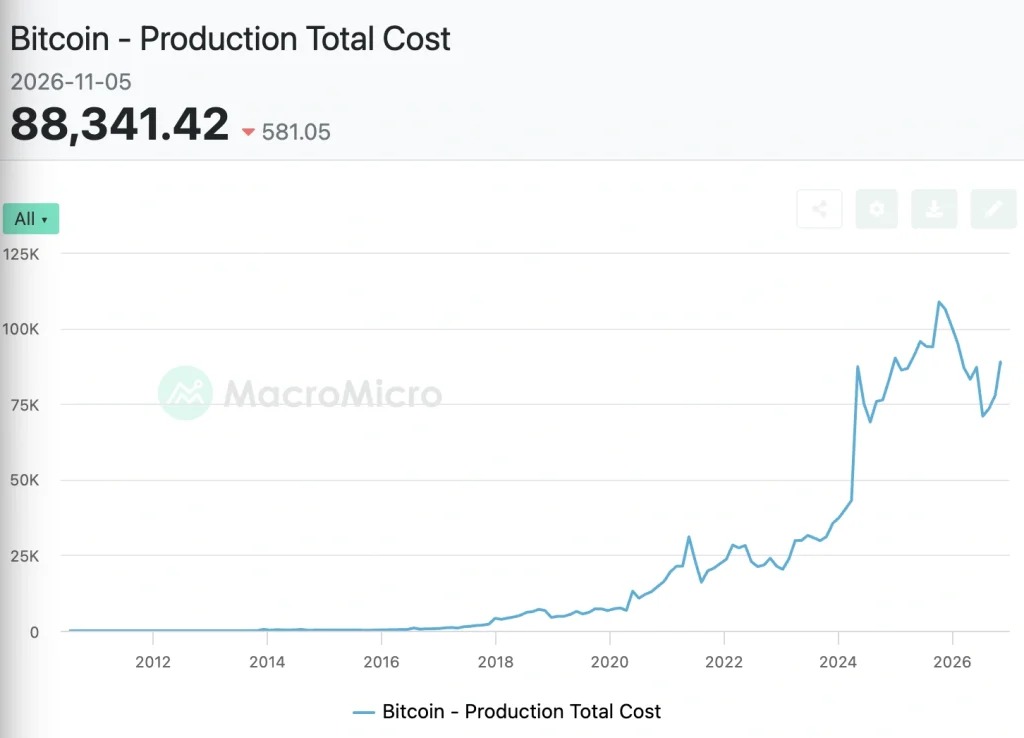
These changes have put pressure on mining profits. Core Scientific stated that earlier this year, a weaker mining environment led to a write-down of $266.5 million for its mining-related assets.
Electricity costs are also prompting miners to consider other businesses. According to an energy infrastructure analyst, 1 megawatt of electricity can generate approximately $1.9 million in revenue over five years for Bitcoin mining, while the same amount of electricity used for the workload of a AI data center can generate about $7.9 million in revenue.
This makes the AI data center a more profitable option for companies that already possess large-scale power facilities. Instead of using electricity for Bitcoin mining, it is better to rent out the facilities to AI companies through long-term contracts.
Core Scientific is already doing this. Its agreement with AMD and Neocloud covers approximately 530 megawatts, while AMD still has a reservation right for an additional 1,925 megawatts of potential capacity.
Core Scientific is not the only mining company to make such a turn.
Several other large mining companies are also following a similar path. MARA Holdings sold approximately 15,133 BTC in March, cashing in around $1.1 billion, and reduced its workforce by 15%. At the same time, it reallocated capital to strengthen its balance sheet and pursue other opportunities.
Riot Platforms has gone further in the direction of AI. The company signed a 20-year lease with a large AI laboratory, involving 191 megawatts of critical IT capacity, with initial contract revenue estimated at 9.1 billion US dollars.
HIVE is reducing its Bitcoin mining operations in Sweden, while expanding its AI and HPC infrastructure in Canada.
This shift is becoming increasingly evident across the entire industry. As companies reallocate their production capacity to AI and high-performance computing, at least 35 EH/s of computing power are set to leave the ranks of listed Bitcoin mining companies.