

U.S. tech stocks suffered heavy selling on Thursday, but cross-asset signals indicate that the root of this storm lies in the position structure, rather than a collapse in macro fundamentals.
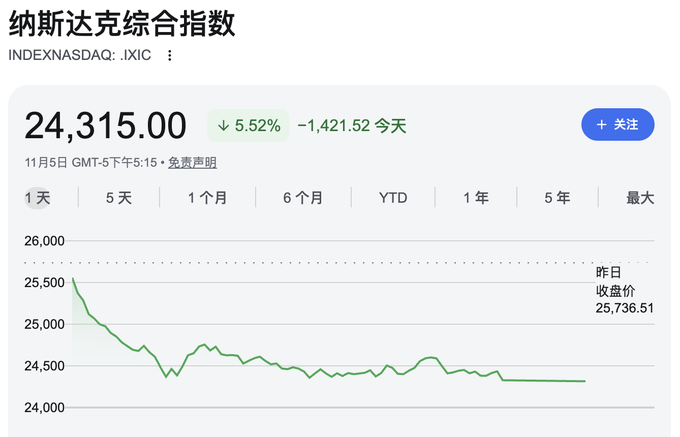
The Nasdaq index fell by more than 5%, the S&P 500 index dropped by over 4%, and the Dow Jones index also tumbled by over 5%. All components of the S&P 500 closed in the red, with the tech sector leading the declines. The trigger for this sell-off was the market's growing concerns about stricter AI regulations after Democrats gained control of the U.S. Congress in the mid-term elections.
The most dangerous signal of this round of decline comes from the market structure itself. Goldman Sachs Information Technology saw a heavy short-selling impact, with a single-day drop of about 10%, marking the largest single-day decline since January 2025 and reaching a low point since March.
This trend indicates that the short sellers are realizing their profits, while the long holders who once competed against them are forced to liquidate their positions and leave the market. Bloomberg analysts warn that "long liquidation flowing into a crowded short position" is one of the most dangerous structural patterns in the market.
Position dominance, rather than fundamental collapse
The core logic behind this sell-off in technology stocks lies in the breakdown of the position structure, rather than a substantial deterioration in corporate profitability or the macroeconomy.
According to Bloomberg's analysis, when the asset with the largest decline happens to be the one that has been most heavily shorted, the signal sent is that the shorts were correct in their judgment, and the longs who previously opposed them are collectively surrendering. The chain reaction of forced liquidations by the longs often pushes the decline far beyond what fundamental factors could explain.
For this very reason, semiconductor stocks are being treated as software stocks today – this is not a fundamental analysis, but rather a clearing of positions.
The mechanical selling triggered by index rebalancing has further amplified this ongoing fundamental re-pricing, especially regarding the valuation correction of the entire new cloud computing (neocloud) business model.
In addition, in such market environments, the effect of margin calls (margin call) cannot be ignored – long positions are forced to sell their most liquid holdings, which are often highly concentrated in high-market-value tech stocks, thereby triggering a negative feedback loop of 'panic selling leading to more panic selling'.
Valuation remains high; tech stocks do not indicate a buying signal.
Some market participants have clearly warned that this decline does not constitute an opportunity to buy on dips.
The Bahnsen Group Chief Investment Officer David Bahnsen pointed out in the report that the fundamental driving force behind this sell-off is the serious disconnect between the valuation of the tech sector and reality, and even after the significant decline on Thursday, the valuations of tech stocks remain high.
He also emphasized that the structural issue of the S&P 500 index being overly concentrated in technology-related stocks is a deep-seated cause of the market's vulnerability this time.
David Bahnsen It is recommended that investors shift their focus to the defensive sectors of the market, including essential consumer goods and energy companies. These sectors have a history of stable cash flows and continuous dividends, and they possess stronger risk resistance in the current environment.
Position reset takes time; buying orders have not yet entered the market.
Although severe short-term fluctuations can sometimes be seen as a sign that the market has bottomed out, such resets of positions often take several days to be confirmed, and it is not advisable to prematurely conclude that a turning point has been reached.
Currently, the information reflected in the traders' positions is not optimistic – despite the obvious correction in asset prices, there are almost no signs of buying interest entering the market. This closely aligns with the analysis made by analysts last week, which indicated that a "capital preservation mode" has been fully activated. The position adjustments at the end of the year under this mode may continue until mid-November.
From a broader perspective of signaling systems, the continuous selling strategy of CTA, the marginal losses of defensive stocks, and the trading pattern of 'increased volume during declines and decreased volume during rebounds' all confirm that this is a correction driven by positions, rather than a systemic collapse due to economic recession.
The yield on 2-year U.S. Treasury bonds fell by more than 10 basis points on the same day, indicating a clear risk-aversion sentiment in the market. However, the overall trend suggests that the end of this round of volatility will be marked by the completion of the "weak bullish position liquidation."