

On Thursday, Goldman Sachs' telephone exploded.
“The level of pain is extremely high.”
This is a statement sent by Goldman Sachs' top stock trader, John Flood, to clients in his report on Thursday. His telephone, in his own words, was "exploding."
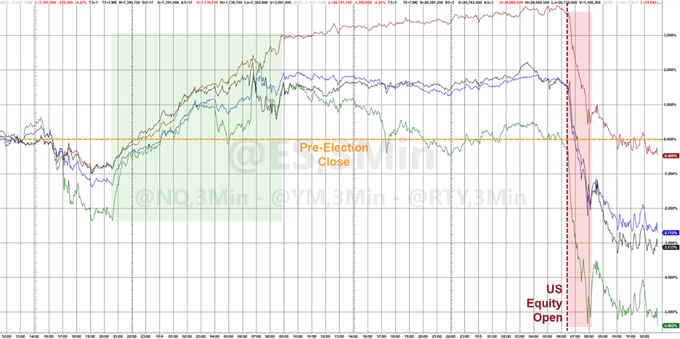
The Nasdaq 100 index closed down 6.4% on Thursday, with a market value evaporating by about $2.3 trillion in a single day, marking the largest one-day decline since March 2020. The S&P 500 fell 4.4%, and the Philadelphia Semiconductor Index tumbled 12%. The “panic index” VIX soared 70%, NVIDIA lost all of its gains for the year, and Sandisk plummeted 22% in a single day.
The direct trigger for this collapse was the Democratic Party's sweeping victory in both houses of Congress during the midterms. Goldman Sachs immediately warned that this "blue tsunami" would result in a suspension of capacity expansion for about 45% of America's planned data centers – the core narrative supporting the valuation of AI tech stocks – which was questioned by political reality overnight.
However, the severity of the market downturn far exceeds what can be explained by the policy impact alone.
In a report released during trading on Thursday, Charlie McElligott, a derivatives strategist at Nomura Securities, provided another explanation: a considerable portion of this collapse was actually caused by "the smartest among them" themselves.
McElligott describes a market paradox: on Thursday during U.S. trading, when Morgan Stanley calculated a mechanical sell order of $52 billion before the close at noon and this became known to everyone on Wall Street, everyone tried to sell in advance in hopes of buying back at lower points. As a result, those who acted prematurely themselves became the force driving the price down. He warned that if the usual pattern of a low point around 2-3 p.m. followed by a rebound did not occur, those who rushed to sell would also become the force contributing to the decline. Indeed, the market closed on that day in a disastrous manner. Coupled with leverage of ETF amounting to $47 billion, volatility control funds of $61 billion, and dealer along with negative gamma, the total mechanical selling pressure exceeded $100 billion, and this situation continued into Friday as well.
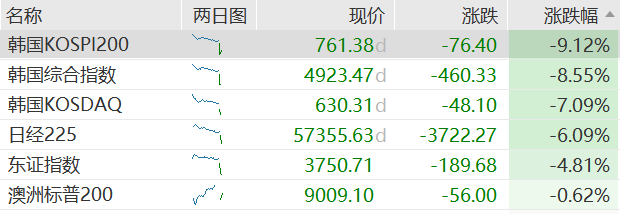
And today, in the Asia-Pacific market, the sharp declines in South Korea and Japan are providing an answer to this question.
A $100 billion time bomb, known to the entire Wall Street.
To understand the logic of McElligott, one must first understand a mechanism.
There is a type of product in the market called leverage ETF, such as "double-long on NASDAQ". Every day, before the market closes, they must do one thing: rebalance their daily profits and losses back to the target leverage ratio. When the market tumbles sharply, this means they must sell a large number of stocks before the close – the more severe the decline, the more they have to sell. This is passive, mechanical, and inevitable.
There is also a type called Volatility Control Funds ( Vol Control ). When market volatility soars, they systematically reduce their stock positions – this is also done mechanically, and it usually happens with a one- to two-day lag.
On Thursday, these two forces combined, and the scale of it was frighteningly large.
On November 5th at noon local time, Morgan Stanley's derivatives team calculated that if prices remained at the level of 1 p.m., the forced selling volume of the leveraged product ETF before the close of trading would be approximately $52 billion. Of this, just the semiconductor sector alone would account for $21 billion, with NASDAQ 100 accounting for another $15 billion.
The figures provided by Nomura’s McElligott are slightly lower, but still staggering: the leverage ratio is around $47 billion, which is the second-largest single-day rebalancing volume in Nomura’s database to date, only behind the $51.3 billion on June 5th of this year. He added that this sale was “particularly painful” because 86% of the assets were concentrated in technology and AI related targets.
The combined effect of approximately $61 billion in sell orders from volatility control funds, and the additional $7 billion in selling pressure generated by dealer negative to gamma for every 1% decline, easily exceeds a total supply of over $100 billion across the market.
The key characteristic of these numbers is that they can be calculated in advance.
After Morgan Stanley calculated the figure of 52 billion at noon, in the words of McElligott, "on Wall Street, no information can remain confidential for more than 45 minutes" – this figure quickly became "known throughout Wall Street."
The clever money's strategy: Sell in advance, wait for a lower price, and buy back.
What was the reaction of traders upon learning about this mechanical buy order?
As mentioned by McElligott, active traders usually try to "take the lead" when facing such mechanical trading flows.
The logic is simple: since there will be a wave of large-scale passive selling before the market closes, I’ll sell now and then buy back at a lower price once the price has dropped significantly.
Moreover, this strategy has been effective recently. McElligott pointed out in the report that during the recent trading days with significant single-day fluctuations, the market often reached its lowest point between 2 and 3 p.m. Eastern Time. Subsequently, early entrants and hedging positions began to reverse their positions, take profits, and close their trades, driving the market to rebound before the close. As a result, the closing price was higher than the extreme value implied by those "expected" mechanical sell-offs.
Just last Thursday, McElligott reminded the market again that "it's here again" – at that time, the leverage factor ETF faced a sell order of $35 billion, and in the end, the market exhibited the classic pattern of a "2-3 point low followed by a closing rebound."
During the market crash in South Korea in June this year, the same scenario occurred in the U.S. stock market as well.
On the day of the tariff suspension in April, this mechanism operated in reverse: McElligott calculated the largest-ever pre-closing rebalancing of +34.3 billion US dollars. Early buyers took advantage of the situation, ultimately driving a significant rise in the market.
So on Thursday, when the figure of $52 billion from Morgan Stanley spread throughout the market at noon, every trader who knew about this amount was thinking of the same thing: sell now, wait for the low point around 2-3 in the afternoon, and then buy back again.
The trap of reflexivity: The cavalry are the very ones who are selling it.
Then, McElligott, wrote a chilling concern in the report: "What if that 'assumed low point between 2 and 3 in the afternoon followed by a rebound' never happens at all?"
Obviously, what's frightening now is that these numbers are so large that if we don't experience that almost taken-for-granted late-session pattern of "first hitting a low point and then rebounding" (by one or two percentage points from that low point), we won't be able to rebound within the "standard TWAP" time frame between 2 and 3 in the afternoon; instead, we will hit new lows... After giving the market the illusion that it might rebound in the last hour, the market closes at its lowest point.
This is precisely the core of the paradox of reflexivity.
When everyone knows the same script and acts according to it at the same time, the script itself becomes ineffective.
The $100 billion in mechanical sell orders that were supposed to occur mainly before the market closed were scattered throughout the day by proactive traders who "took the lead" ahead of time. These traders themselves became the force that drove the market down.
At the same time, there is a one- to two-day lag in the selling orders of volatility control funds – the sharp decline on Thursday will trigger these funds to continue selling on Friday. McElligott writes that at 3 p.m. on that day, the volume of sales from volatility control funds corresponded to a decline of about $61 billion; if the decline expanded to 10%, this figure would rise to $70 billion.
What's more fatal is: when all the early buyers have already sold their shares and are waiting for that "low point" – who will be there to buy them back?
McElligott used a meme in the report to describe this scenario: everyone is sitting in chairs, waiting for the same rebound – but there are not enough chairs.
ZeroHedge analyzed and summarized as follows:
“Sometimes the cavalry arrives at 3 in the afternoon. Sometimes, the cavalry is the very person selling it.”
On Thursday, the cavalry did not arrive. The market closed at its lowest point of the day: the Nasdaq 100 fell by 6.4%, and the S&P 500 fell by 4.4%.
Trampling scene: The "Year's Best Deal" was wiped out within 48 hours
Before the reflexivity mechanism was triggered, there was another powder keg in the market waiting for a spark.
McElligott calls this year's "Best Trade of the Year" on Wall Street the "Semiconductor-Energy Dumbbell Strategy" – going long on semiconductors (AI as computing power demand benefits), while also going long on energy (geopolitical risk premium + inflation hedging). This strategy had a cumulative return of up to 66% just a few weeks ago, with a Sharpe ratio of 3.3.
Then, in the past 48 hours, both legs were knocked down at the same time:
- Energy: Down 10.2% this week
- Semiconductors: Down 13.1% this week
The Z-Score ratios are -17.2 and -10.1 respectively.
The collapse of the energy sector stems from the market's re-pricing of the Iranian situation – McElligott observes that the White House has sent signals of possible relaxation on the Iranian issue, leading to a rapid withdrawal of the war premium. This week, Brent crude oil experienced its largest decline since the outbreak of the pandemic.
The collapse of semiconductor stocks stems from market concerns about data center regulation after the Democratic Party swept through Congress.
Both directions collapse simultaneously, and funds holding a dumbbell strategy face not only losses but also are forced to close their positions. The mindset described by McElligott of "retaining this year's gains and surviving to enter next year" is completely shattered at this moment.
Walleye The firm announced the return of customer funds on the same day and dismissed the head of its equity department, describing it as the worst month since the COVID-19 pandemic. A Goldman Sachs trader John Flood described the long positions held by institutions as "once again stuck in a deadlock." The large-scale cloud computing positions bought during yesterday's rebound were quickly sold off, and "so far, no buyers have entered to take over the positions."
Abnormal trading volumes at the ETF level confirm the degree of panic: SPY trading volumes are 160% higher than the 20-day average, QQQ are 100% higher, and those in the semiconductor sector ETF SMH are 150% higher.
According to Vanda Research, a senior stock strategist, the selling volume by retail investors on Thursday "is expected to be the largest liquidation of retail investors since the end of July last year."
Bonds are being short-sold to the point of exhaustion, and another aspect of the market is also suffering losses.
There is another leg that is being overlooked, and it is also breaking at the same time.
CTA Trend Fund has accumulated a large number of bond short positions this year, which is part of the 'short-selling bonds/long-ingflation' trading strategy and also serves as an implicit complement to the dumbbell strategy.
The stock market crash triggered a rush of safe-haven buying into the bond market, causing U.S. Treasury prices to soar, and bond shorts were forced to close their positions. According to calculations by McElligott, there is a risk of "massive short squeeze" in the bond market: if U.S. Treasury prices rise another 2%, it could lead to a forced purchase of about $225 billion in global bonds, including approximately $48.5 billion in 2-year U.S. bonds, $69.5 billion in 2-year Eurozone bonds, and $23.9 billion in 10-year Japanese bonds.
This means that the short squeeze in bonds is itself becoming a force that drives up the bond market and further compresses the long positions in stocks—a yet another feedback loop.
The collapse is not over yet: Lagging selling pressure on Friday
The close on Thursday does not mean the end of this round of mechanical selling pressure.
There is a lag in the execution of volatility control funds. McElligott writes that the market decline on Thursday will continue to trigger sell orders for such funds on Friday – “Today’s decline is further adding to the queue.”
UBS's estimate is more straightforward: its risk control rebalancing model shows that if the S&P 500 falls by 2%, the scale of sales by systematic funds could reach $95 billion to $105 billion.
The Asian market is already answering this question.
On Friday morning, South Korea's composite index plummeted by 8.8%, falling below the 5,000-point mark and triggering the circuit breaker mechanism—a level that South Korean President Lee Jae-myung once regarded as a milestone for economic recovery. The Nikkei 225 index also tumbled nearly 5.8%, breaking below the 60,000-point mark during the session, and has fallen more than 20% since its June high, officially entering a technical bear market.
U.S. stock futures saw a slight rebound in early trading in Asia, with Nasdaq futures turning negative for a brief period, indicating that some investors began to buy on dips. However, UBS warned that the pressure from systematic selling has not yet been fully relieved.
There's another variable on Friday: the U.S. non-farm payroll report for October will be released on that day. The market consensus is for an increase of 59,000 new jobs, with the unemployment rate remaining at 4.2%. The direction of these data will determine whether this round of adjustments can find a window for respite.