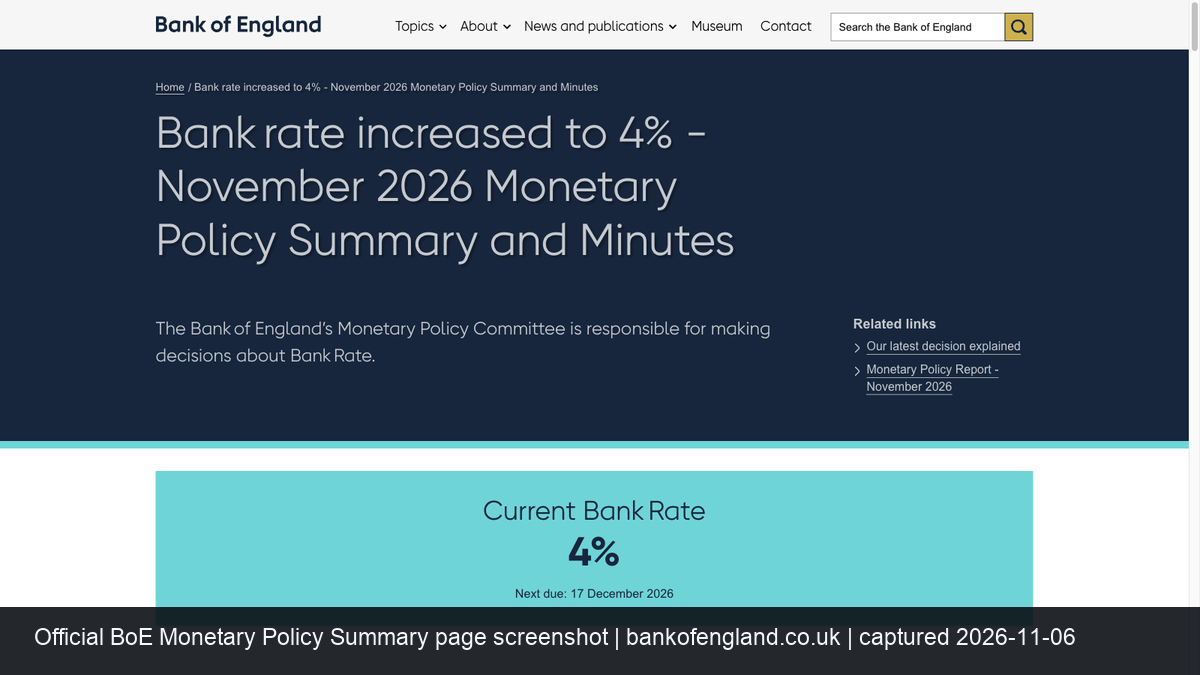


A single interest rate hike can be described as a single number, but the Bank of England's decision in November was more like an attempt to answer a timing question: whether the rise in energy prices would be a short-lived shock or if it would penetrate into wages, service prices, and inflation expectations, lingering longer than anticipated. The results of the meeting announced on November 5th showed that the Monetary Policy Committee decided by a vote of 8 to 1 to raise bank rates by 25 basis points to 4%; the only dissenting vote called for a 50 basis point increase to 4.25%. The disagreement was not about the fact that energy has become more expensive, but about how forcefully to prevent a second round of effects. For households, this is not an abstract debate in a conference room; it will be reflected in energy bills, mortgage rates, and real purchasing power at the same time.
Oil and gas prices push forecasts higher again
In September, the UK's consumer price index rose by 3.5% year-on-year, with direct energy costs contributing about 1 percentage point to this increase. The central bank expects inflation to rise to around 5% by the middle of 2027, before it begins to fall as the year-on-year base effect of energy costs diminishes and restrictive monetary policies continue to take effect. This trajectory indicates that inflation has not yet reached its peak, and household bill pressures are likely to increase in the coming months.
The meeting materials provided the temperature of the impact. Based on the average of 15 working days in the UK as of October 27th, the recent month's Brent crude oil futures were at $108 per barrel, and the UK's near-month natural gas futures were at 216 pence per sam, which is 38% and 81% higher respectively than reported in July. Energy prices are not abstract variables: they first affect gasoline, heating, and electricity costs, and then influence a wider range of prices through transportation, production, and service costs.
Why do 8 people choose 25 basis points?
Most commissioners believe that a 25-basis-point adjustment is sufficient to respond to more persistent inflation risks, while also allowing for continued observation. There is no immediate answer to how the energy shock will affect other commodities and wages. Some companies have not yet fully borne the increase in oil and gas prices through hedging or long-term contracts; others may choose to reduce their profit margins rather than raise prices immediately. This will result in indirect effects being delayed, and if policies are based solely on current month's data, it is easy to misjudge what has "not yet occurred" as something that "will not occur."
At the same time, austerity has already affected financing conditions. Meeting minutes mention that since September, the benchmark two-year mortgage rate has risen by nearly 50 basis points. Higher interest rates will suppress demand and investment, and also increase the monthly payments for families that are about to refinance. Monetary policy needs to prevent inflation from becoming entrenched, but it cannot pretend that raising interest rates comes without costs.
What is that 50-basis-point vote of opposition worried about?
Committee members who support a larger interest rate hike believe that the inflation risk has clearly shifted upwards, with wage growth and service inflation still exceeding levels consistent with targets. Energy and food prices are particularly sensitive for households, and their continued rise may affect wage negotiations in 2027. Once businesses and workers begin to price according to higher inflation, central banks will need to pay a greater cost in terms of demand to bring expectations back down.
But a 50-basis-point increase also means a more significant immediate impact. Central banks face a typical dilemma: energy supply is affected by geopolitical conflicts, and raising interest rates cannot produce a single barrel of oil or a cubic meter of natural gas; what they can do is to suppress other forms of demand in order to prevent a single external shock from spreading into widespread price increases. If the measures are too mild, their credibility may be damaged; if they are too severe, it could place excessive costs on families and businesses that are already under pressure.
The market should not regard 4% as the end point.
The Bank of England has not provided a preset interest rate path. Future decisions will depend on how wages, service prices, corporate pricing, demand, and the energy market evolve. The forecasts in the meeting materials are also based on conditions such as futures curves; if regional conflicts ease, oil and gas prices may fall, but if supply facilities are further damaged, prices could exceed the current curve. The so-called "expected 5% by mid-year" is not a guarantee, but rather a central path under a combination of conditions.
For investors, what is more important to watch is not whether there will be a mechanical increase of another 25 basis points at the next meeting, but whether a second-round effect will occur. If wage growth continues to remain high and companies start to pass on energy costs more broadly, policies will tend to be more hawkish; if demand weakens, profit margins can absorb the costs and oil prices fall, then the necessity for continued tightening will decrease.
The core signal of this decision to release is that the central bank no longer regards the energy shock merely as noise that will subside on its own, but it also does not assume that it will inevitably evolve into long-term inflation. A 4% rate is a risk management measure, not a declaration of victory. The real test will come from the payrolls, service prices, and household expectations in the coming quarters.