

As concerns about the tightening regulation of US AI spread to Asia, South Korea announced measures to stabilize stock market fluctuations, and Bitcoin's trend entered a period of consolidation.
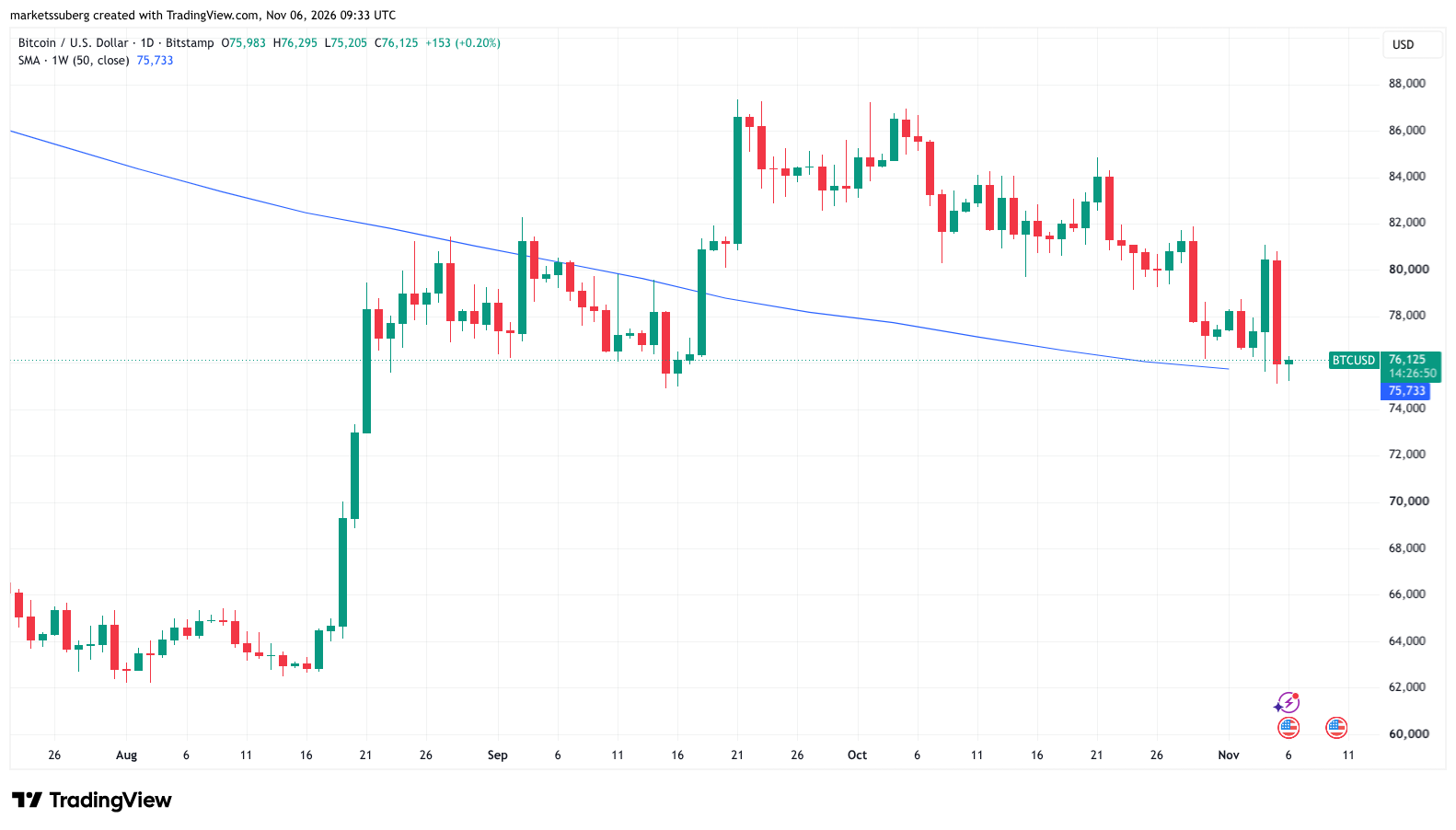
On Friday, as the sell-off in U.S. tech stocks spread to Asian markets, Bitcoin ( BTC ) remained above $75,000.
Key points:
- Bitcoin fell by 6.6% to $75,109 on Thursday before stabilizing at Bitstamp.
- South Korea's KOSPI fell by more than 8% shortly after opening on Friday, triggering a trading halt. The South Korean government announced that starting from next Monday, there will be a three-month exemption from the requirements for securities firms to provide collateral as guarantees for financial funds.
- Analysts say that after the Democratic Party's victory in the election, the market is concerned that the United States will strengthen regulation of AI. The Philadelphia Semiconductor Index fell 12.2% on Thursday.
South Korea relaxes guarantee rules, KOSPI falls 6%
Data from TradingView shows that BTC / USD traded near its 50-week simple moving average ( SMA ), at $75,733.
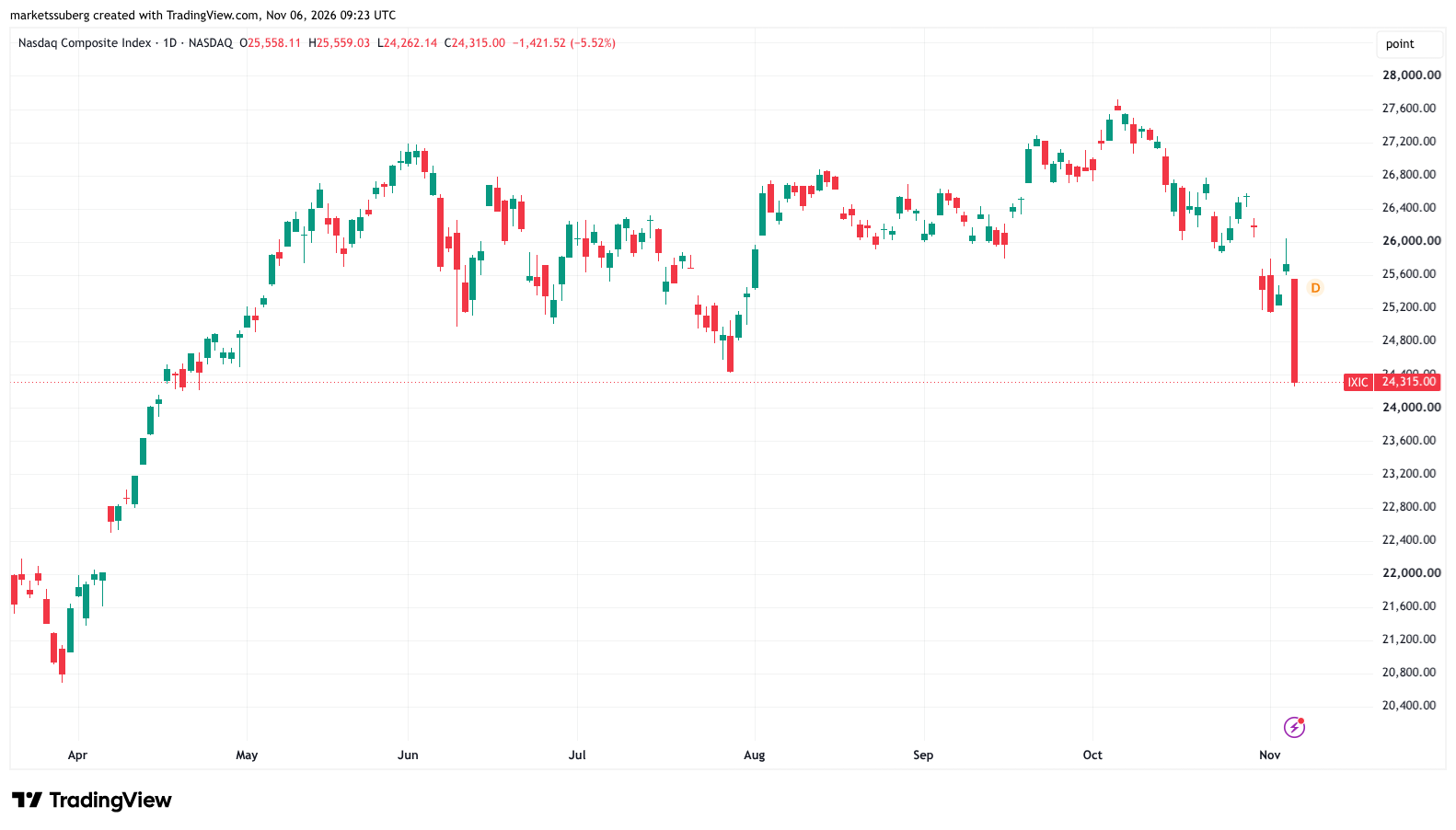
On Thursday, as the U.S. stock market continued to experience selling pressure during trading hours on Wall Street, the currency pair fell by 6.6% at one point. The S&P 500 index and the Nasdaq Composite Index, which is dominated by tech stocks, closed down by 4.4% and 5.5% respectively.
On Friday, Asian stock markets continued their downward trend. South Korea's KOSPI Composite Index tumbled by more than 8% shortly after opening, triggering the circuit breaker mechanism and suspending trading for 20 minutes. Subsequently, the decline narrowed, and the index closed down 6% at 5,059.69 points, marking the lowest closing level since March 31.
At an emergency meeting, South Korean Vice Prime Minister and Minister of Planning and Finance Lee Jong-il announced measures to reduce forced sales.
According to local media reports, starting from next Monday, securities firms will be exempted from the requirement to maintain a financial capital guarantee ratio of 140% for a period of three months. Relevant authorities stated that if fluctuations intensify, they will be prepared to take further measures.
The Chosun Ilbo quoted an unnamed government source as saying, "We take seriously the expansion of global stock market fluctuations following the U.S. mid-term elections."
The person also stated, "However, the domestic market has overreacted to external factors."
Analysis suggests that the sharp decline in U.S. stocks is "more technical in nature rather than due to fundamental factors"
After analysts attributed the decline on Wall Street on Thursday to the Democrats taking control of both the House of Representatives and the Senate, there were concerns in the market that AI regulators would tighten their oversight. These concerns were added on top of the market's previous worries regarding capital expenditures in that industry.
Market commentary service The Kobeissi Letter cites a post by Democratic Representative Yassamin Ansari on X. Ansari calls for a pause on “advanced AI development.” The Kobeissi Letter indicates that the possibility of a complete ban on AI in the United States is not high.
The Kobeissi Letter wrote on X: 'We believe that the United States will not ban AI (almost certain). Even if such a ban were possible to implement, it would mean that the United States would cede its position in the global AI competition to China. That will not happen.'
He also stated, "We believe that today's decline is more technical in nature rather than fundamental."
Kobeissi pointed out that the decline on Thursday was mainly concentrated in the technology sector; if that sector is excluded, the S&P 500 index only fell by about 2.5%. The Philadelphia Semiconductor Index, which tracks 30 semiconductor companies, closed down 12.2% on Thursday.
Economists Mohamed El - Erian also stated that legislators need to find a common stance on AI policies.
In an article with the identifier Substack, he wrote: 'The 'let-it-develop' approach adopted by the United States towards AI is consistent with the productivity potential of this technology and the needs of national security. However, this approach not only falls short in terms of safety and proliferation control, but also fails to engage all sectors of society.'
El-Erian indicates that this rebound reflects 'real concerns', information failures, as well as behavioral factors.
Cointelegraph Previous reports have indicated that during the tenure of Republican presidents, strong stock market returns often followed after Democrats swept the Congress in mid-term elections. In recent months, the correlation between Bitcoin and the S&P 500 index has also become more positive.